Third Reich - Document Pair for a Woman Born in 1915 from Schönthal/Lemberg

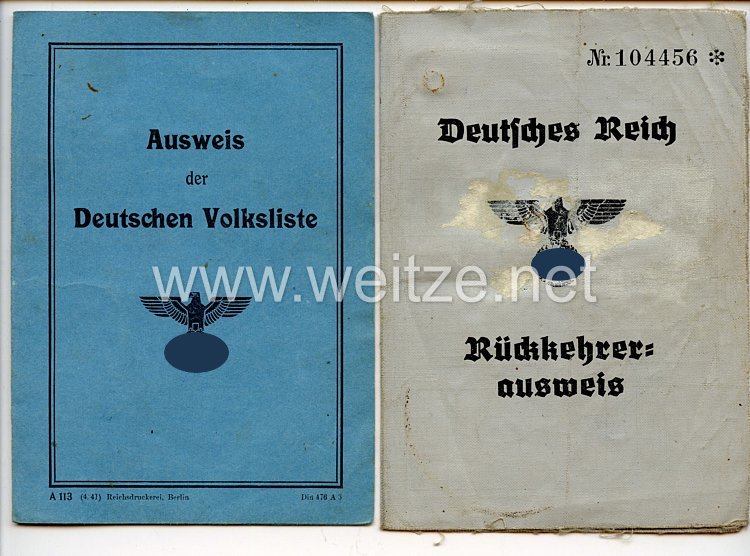
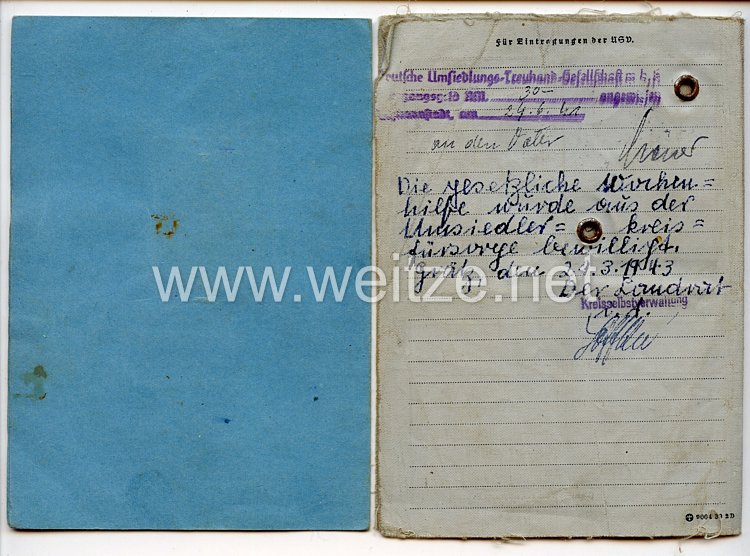
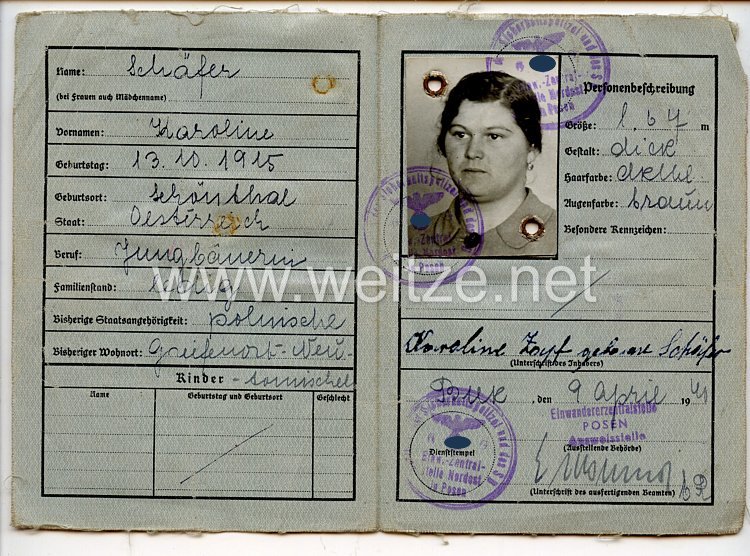
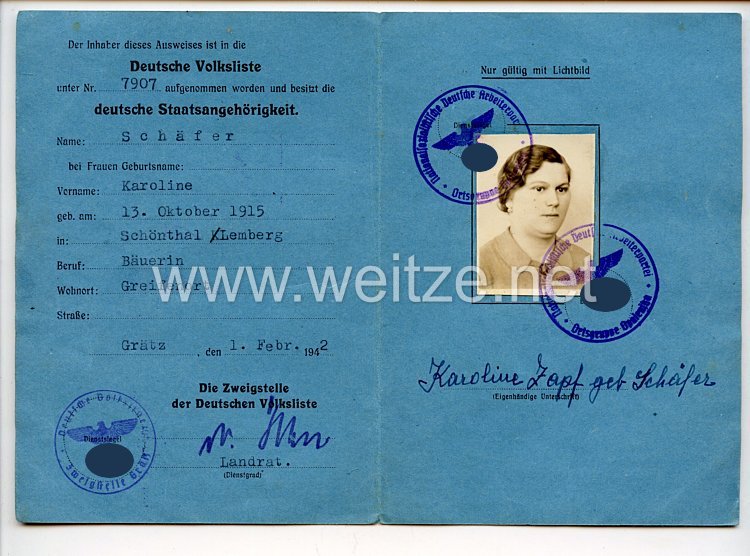
Returnee identification card issued on April 9, 1941 and stamped by “Der Chef der Sicherheitspolizei und des SD, Einw.-Zentralstelle Nordost in Posen” (Chief of the Security Police and SD, Immigration Central Office Northeast in Posen), with photograph; Deutsche Volksliste (German National List) identification card, issued in Grätz on February 1, 1945, with photograph, registered under No. 7907 in the list and now possessing German citizenship; partially heavily worn condition.
353597
260,00

Third Reich - Document Pair for a Woman Born in 1915 from Schönthal/Lemberg

These documents – a Returnee Identification Card from 1941 and a German National List Identity Card from 1945 – offer a poignant glimpse into the complex and often tragic history of the ethnic German population in Eastern Europe during World War II. These papers document the fate of a woman born in 1915 from Schönthal near Lemberg (present-day Lviv, Ukraine) and reflect the dramatic upheavals experienced by millions of people in this region.

The Rückkehrerausweis (Returnee ID), issued on April 9, 1941, bears the stamp of the Chief of the Security Police and SD, Immigration Central Office Northeast in Posen. This document must be understood in the context of the Hitler-Stalin Pact of August 1939 and its secret protocols, which led to the partition of Poland and the Baltic states between Germany and the Soviet Union. Following the German invasion of Poland in September 1939 and the Soviet occupation of Eastern Poland, including the Lemberg area, the ethnic Germans (Volksdeutsche) living there were given a choice: to remain in the Soviet Union or to “return home” to the German Reich.

The “Heim ins Reich” (Home to the Reich) program was coordinated by Heinrich Himmler in his capacity as Reich Commissioner for the Strengthening of Germandom. The Einwandererzentralstelle (EWZ – Immigration Central Office) was one of the principal agencies administering these resettlements. Between 1939 and 1941, approximately 130,000 ethnic Germans from Soviet-occupied territories, including Galicia and Volhynia, were resettled in the German Reich. The Returnee ID served as an official document for identifying these individuals and regulating their settlement, usually in the Reichsgau Wartheland or other incorporated Eastern territories.

These resettlements were part of a broader plan for the “Germanization” of occupied territories. The ethnic Germans brought back from the Soviet Union were to be settled in areas from which the Polish and Jewish populations had been forcibly expelled or murdered. This policy was an integral component of Nazi racial ideology and the concept of Lebensraum (living space).

The second document, the German National List Identity Card (Deutsche Volksliste), was issued on February 1, 1945, in Grätz (Grodzisk Wielkopolski), just weeks before the collapse of German rule in these territories. The Deutsche Volksliste (DVL) was a classification system introduced in occupied Polish territories to categorize individuals according to their “racial” and political reliability.

The DVL was divided into four categories: Category I and II included active ethnic Germans and those who had maintained their German identity; Category III concerned persons of German descent but Polish cultural affiliation; Category IV encompassed “Polonized” Germans. Registration in the DVL brought both privileges and obligations, including German citizenship but also liability for military service.

The fact that this ID was issued so late in the war, in February 1945, is remarkable. By this time, the Red Army had already liberated large parts of Poland, and the German authorities were in full disarray. The issuance of such documents at this stage demonstrates the bureaucratic persistence of the Nazi regime even in the face of military defeat.

The registration number 7907 suggests that thousands of people were enrolled in the National List in Grätz. Many of these registrations occurred under coercion or due to external circumstances, which led to considerable legal and moral problems after the war. Poland often regarded registration in the DVL as collaboration, while those affected frequently argued they had no choice.

The “partially heavily worn condition” of these documents speaks volumes: they were carried under difficult circumstances, possibly during the chaotic flight from the advancing Red Army in the winter and spring of 1945. Millions of Germans and ethnic Germans fled from the Eastern territories during this period, often under catastrophic conditions.

These documents are not merely historical artifacts but testimonies to individual fates during one of the most turbulent periods in European history. They document forced resettlements, the racial classification of people, and the far-reaching consequences of Nazi population policy. For historians, such personal documents provide invaluable insights into the administrative machinery of the Nazi regime and the lived reality of the people affected.

r