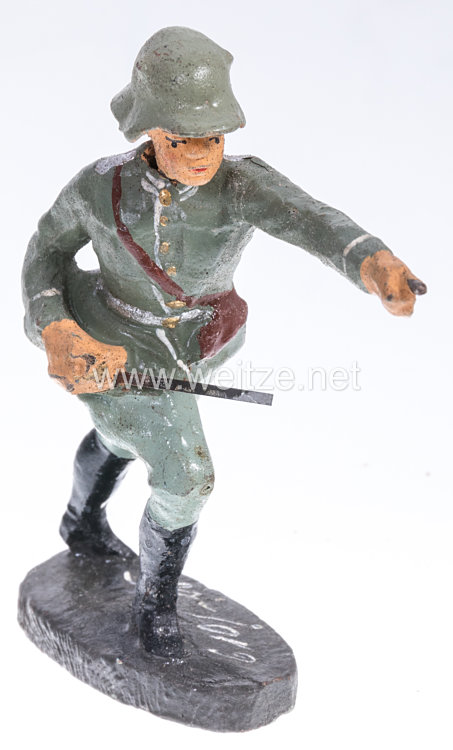
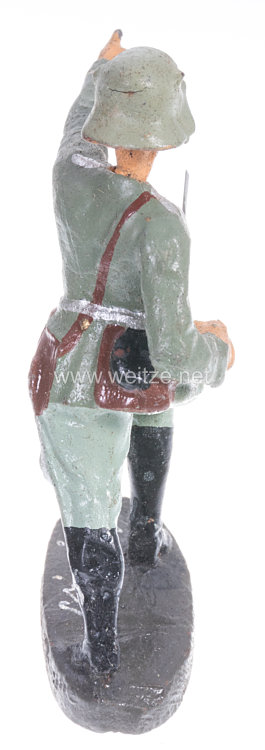
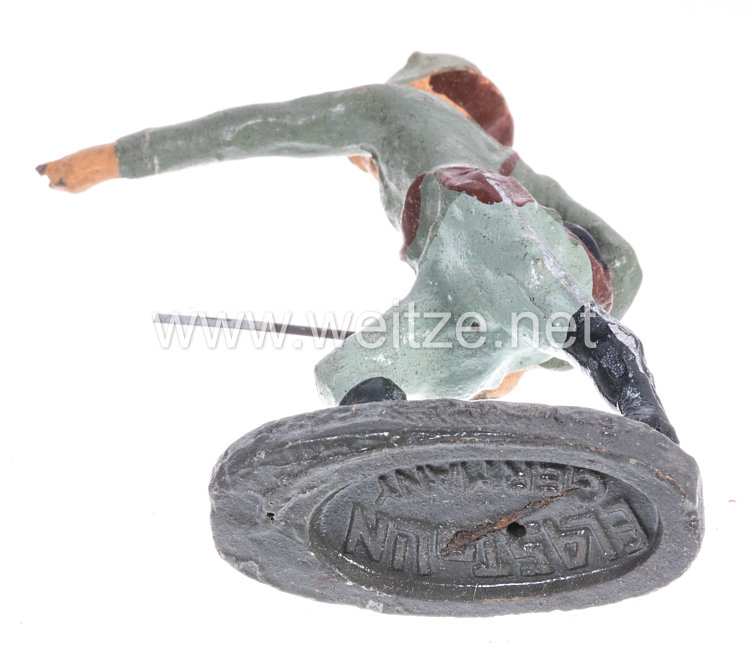
Elastolin - Army Officer Leaping
Elastolin Army Officer in Jumping Pose: A Historical Collectible from German Toy History
This Elastolin figure of a jumping army officer measuring 7.5 cm represents a significant chapter in German toy and military history. Hausser-Elastolin GmbH, founded in 1904 by twin brothers Christian and Georg Hausser in Ludwigsburg, revolutionized the toy industry through the development of figures made from the innovative material Elastolin.
Elastolin was a groundbreaking material mixture consisting primarily of casein (a milk protein), chalk, glycerin, and other additives. This material was significantly more durable than traditional composition figures made from clay or plaster and allowed for finer details and more dynamic poses. The figures were formed around a wire framework, providing additional stability. From the 1920s through the 1950s, Elastolin was the leading material for toy figures in Germany.
The Officer Representation
The figure depicts an officer of the Wehrmacht-Heer (German Army) in a dynamic jumping pose, typical for combat scenes and military actions. Such representations were particularly popular during the 1930s and early 1940s, when military toys dominated the German toy landscape. The 7.5 cm size corresponds to approximately 1:24 scale, which along with the 7 cm format was among Elastolin's standard sizes.
The uniforms and equipment of these figures were reproduced with remarkable attention to detail. Officer figures typically displayed characteristic rank insignia, shoulder boards, and equipment typical for officers such as pistol holsters and binoculars. Painting was done by hand, with various color schemes used depending on the branch of service and time period.
Historical Context and Production
During the Weimar Republic (1919-1933), Elastolin already produced extensive series of soldier figures representing various epochs. With the Nazi seizure of power in 1933, production focus increasingly shifted to contemporary military representations. Wehrmacht figures were manufactured in large quantities and were extremely popular with children.
At its peak, the Hausser company employed several hundred workers and exported its products worldwide. The figures were sold in elaborate sets depicting entire battle scenes, parades, or military installations. Besides infantry soldiers, there were also cavalry, artillery, vehicles, and buildings in matching scale.
War's End and Post-War Period
During World War II, production became increasingly restricted as raw materials and labor were needed for the armaments industry. After 1945, the American occupation forces initially prohibited the production of military toys. Elastolin then switched to civilian themes, including Wild West scenes, circus figures, and animals.
In the 1950s, production of soldier figures resumed, but now with historical themes such as Romans, knights, and Napoleonic troops. Modern Wehrmacht representations were not reintroduced into the product line. In the 1960s, Elastolin production began to decline as plastic figures increasingly dominated the market. Traditional Elastolin production finally ended in 1983.
Collector Value and Preservation
Today, Elastolin figures are sought-after collector's items whose value depends on rarity, condition, and historical significance. The stated condition 2 according to toy collector classification means the figure is well-preserved with only minor signs of use. However, Elastolin material is sensitive to moisture and temperature fluctuations, making preservation challenging. Cracks in the material or flaking paint are common signs of aging.
Collectors value these figures not only for their historical significance but also for their craftsmanship and detailed representation of contemporary uniforms and equipment. They serve military historians as three-dimensional references for uniform studies and provide insights into the popular culture and toy history of the 20th century.
Elastolin figures remain a fascinating testament to German craftsmanship while documenting the complex history of their time of origin.