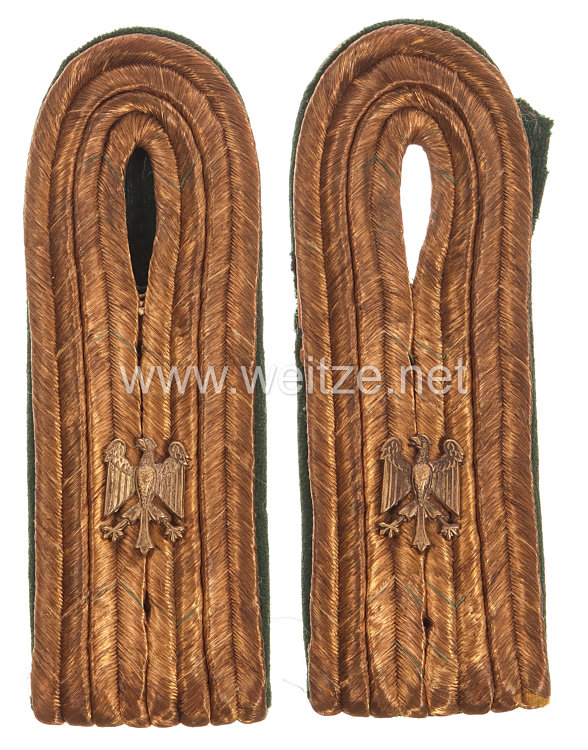
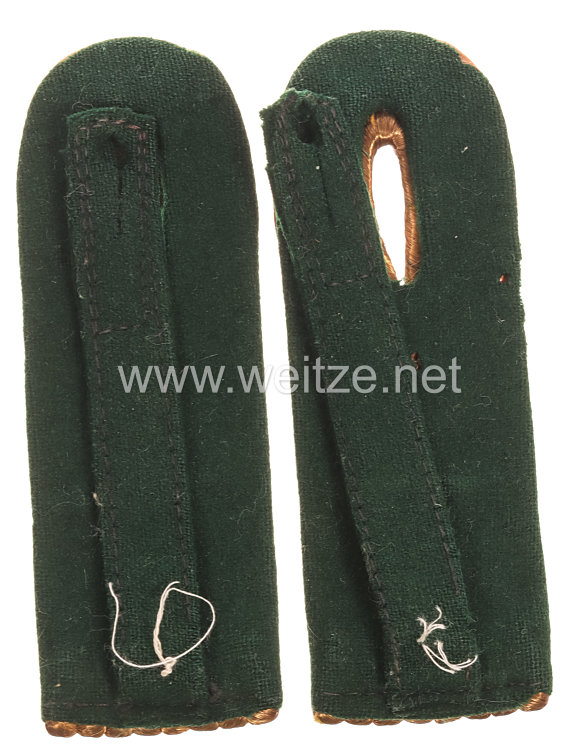
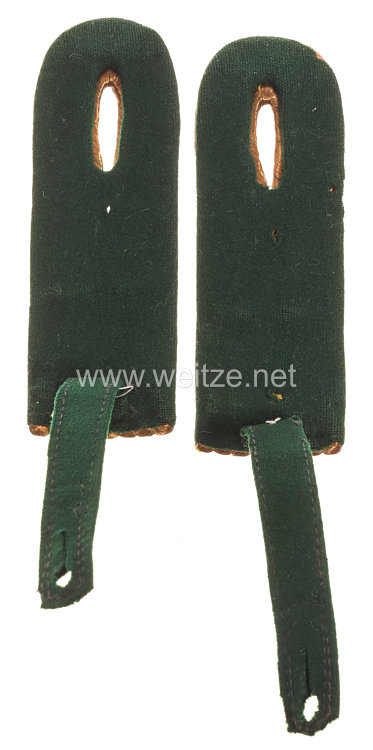
Weimar Republic Pair of Shoulder Boards for a Customs Secretary

Circa 1924. Worn, condition 2.
448896
100,00

Weimar Republic Pair of Shoulder Boards for a Customs Secretary

These shoulder boards for a Customs Secretary from the Weimar Republic represent a fascinating chapter in German administrative history during the interwar period. Following the collapse of the German Empire in 1918 and the establishment of Germany's first democracy, all state institutions faced the challenge of adapting their uniforms and rank insignia to the new republican order.

The Customs Administration was among the most important agencies of the young republic. After the Treaty of Versailles in 1919, with its associated territorial losses and reparation payments, border control and customs collection were of existential importance to the German state. Customs officials formed a paramilitary organized formation that performed not only fiscal but also law enforcement duties, particularly at the new and often disputed borders.

The rank of Customs Secretary (Zollsekretär) corresponded to the intermediate service level of the customs administration. These officials had completed advanced training and carried considerable responsibility in the daily processing of customs controls and supervision of cross-border trade. The position was comparable to a non-commissioned officer in the military sphere but possessed independent administrative authority.

The dating to around 1924 is of particular historical significance. This year saw the peak and resolution of the hyperinflation crisis through the introduction of the Rentenmark. Simultaneously, a comprehensive reorganization of the state administration took place, including the customs authorities. The Reich Customs Administration was modernized and its uniform regulations standardized, deliberately distancing itself from the monarchist symbols of the Imperial era.

Shoulder boards from this period typically displayed the characteristic features of the Weimar uniform reform: they dispensed with the crowns and monograms of the Hohenzollern dynasty, using republican symbols instead. The coloring and design followed the uniform regulations of the Reich government, which prescribed uniform identification of all customs officials throughout the Reich territory.

The material quality and workmanship of such shoulder boards varied considerably depending on the time of manufacture. During the inflation years of 1922-1923, high-quality materials were barely available, and many uniform pieces were made from substitute materials. After currency stabilization in 1924, quality improved significantly. The shoulder boards were typically sewn onto the uniform and had to withstand the daily demands of field service.

Customs officials of the Weimar Republic often stood at the forefront in combating smuggling, which was rampant during the economically difficult interwar years. Especially in border regions with Poland, France, and the Netherlands, frequent confrontations with organized smuggling gangs occurred. The uniform and its rank insignia were therefore not only symbols of authority but also practical necessities for identification while on duty.

A pair of shoulder boards, as described here, was worn symmetrically on both shoulders of the service uniform. They enabled immediate recognition of rank and affiliation with the customs administration. This was particularly important during joint operations with other agencies such as the Reichswehr, the Protection Police (Schutzpolizei), or the Border Police.

The political turbulence of the Weimar Republic was also reflected in the customs administration. Many officials were conservatively minded and skeptical of the Republic, yet dutifully fulfilled their tasks. With the Nazi seizure of power in 1933, the era of these uniform pieces ended. The entire administration was brought into line, new rank insignia with Nazi symbolism were introduced, and many officials had to discard or modify their old uniforms.

Today, such shoulder boards are important collectibles and historical documents. They convey an authentic impression of the administrative structure and daily life of state employees in Germany's first democracy. The indicated condition grade of 2 suggests visible signs of wear, which confirms the authentic use of these rank insignia in actual service and increases their historical value.