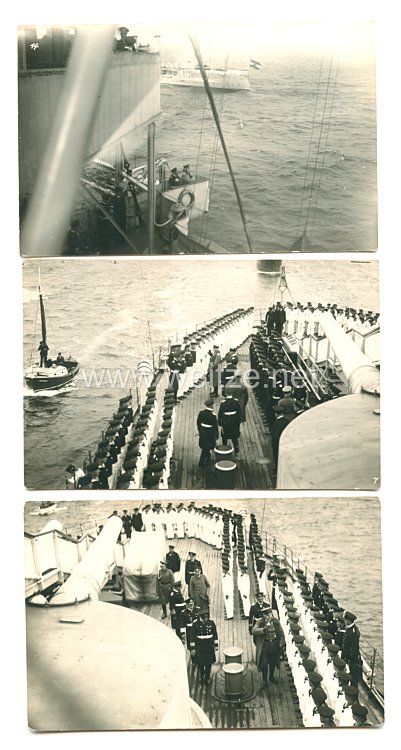
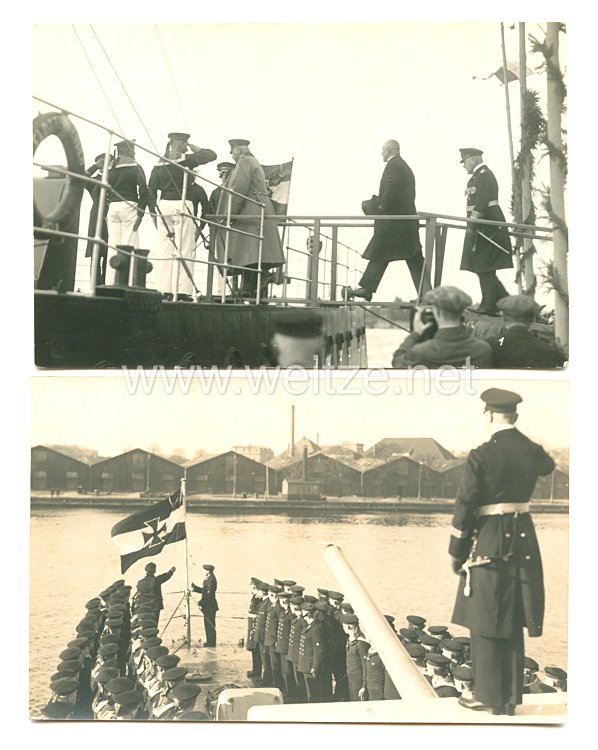
Weimar Republic Photos, Paul von Hindenburg Inspecting a Warship of the Reichsmarine
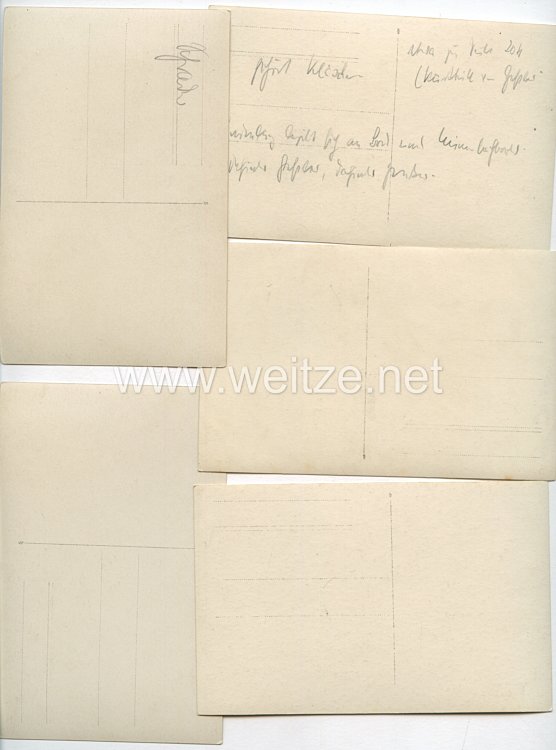
This collection of five postcard-sized photographs documents a significant moment in the history of the Weimar Republic: a visit by Reich President Paul von Hindenburg to a warship of the Reichsmarine. Such photographs represent important historical documents that provide insights into the military-political conditions of Germany's first democracy between 1919 and 1933.
Paul von Hindenburg (1847-1934), the legendary field marshal of World War I, was elected as the second Reich President of the Weimar Republic in 1925. His inspections of the armed forces carried great symbolic significance, as they represented continuity between the imperial military and the republican armed forces. For many Germans, Hindenburg embodied the monarchist tradition and military greatness of the fallen German Empire.
The Reichsmarine emerged in 1919 from the Imperial Navy under the strict provisions of the Treaty of Versailles. This treaty drastically limited the German naval forces: it was permitted only six battleships (armored ships), six cruisers, twelve destroyers, and twelve torpedo boats. Submarines were completely prohibited. The maximum crew strength was limited to 15,000 men, including officers.
Despite these restrictive conditions, the Reichsmarine attempted to maintain and develop its operational capabilities. Under the leadership of admirals such as Hans Zenker (Chief of Naval Command 1924-1928) and later Erich Raeder (1928-1943), the navy strove for modernization within treaty limitations. The development of the revolutionary Deutschland-class pocket battleships from 1929, which became internationally known as “pocket battleships” due to their innovative construction, demonstrated the will for technical innovation despite limited resources.
Photographic documentation of fleet visits by the head of state served multiple purposes: They demonstrated civilian control over the military, an essential principle of republican order. Simultaneously, they were intended to strengthen public confidence in the limited armed forces and reassure national-conservative circles who were skeptical of the Republic. For the Reichsmarine itself, such high-level visits were important for morale and prestige.
Postcard-sized photographs were a widespread medium during the Weimar era for documenting and disseminating official events. They were frequently produced by official military photographers or accredited press photographers and later distributed as postcards, in magazines, or as collectibles. The format enabled wide distribution and served public relations purposes.
The “used condition” of these photographs suggests they may have been mailed, collected, or otherwise utilized. Many such images found their way into private photo albums, served as patriotic mementos, or were exchanged between naval enthusiasts and veterans. The Reichsmarine consciously maintained a tradition of photographic documentation of its activities.
Hindenburg's relationship with the Reichsmarine was shaped by his general attitude toward the military. Although primarily an army officer, he respected the navy as an important part of national defense. His visits to warships emphasized the importance of naval forces for national identity, especially since Germany had largely lost its status as a maritime power after losing its colonies and drastically reducing its fleet.
From today's perspective, such photographic documents are valuable sources for the military and political history of the Weimar Republic. They illustrate the complex relationships between military traditions, republican statehood, and the search for national identity during a time of great political and social upheaval. The Reichsmarine navigated this field of tension between monarchist tradition, republican loyalty, and increasing pressure from nationalist forces that ultimately led to the Nazi seizure of power in 1933.
These photographs thus represent more than mere documentation of a ceremonial visit—they embody the contradictions and challenges of Germany's interwar period, when democratic institutions struggled to reconcile with authoritarian traditions and an officer corps that often remained ambivalent toward the republican system it nominally served.