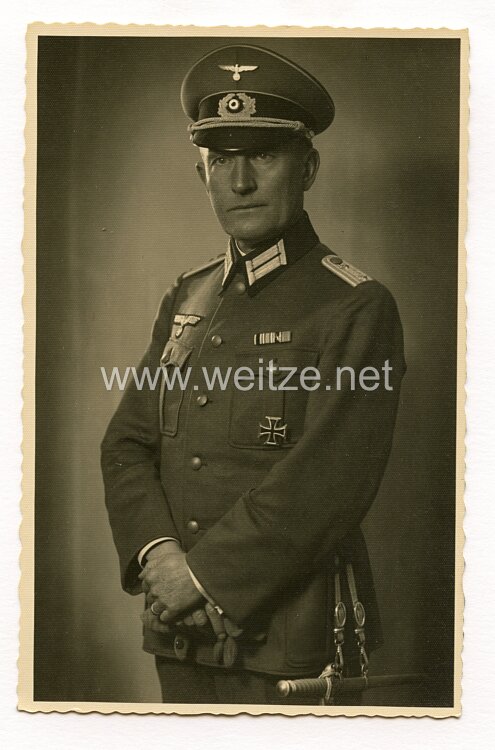
Wehrmacht Portrait Photograph, Hauptmann with Iron Cross 1st Class 1914
This portrait photograph in postcard format depicts a Wehrmacht Hauptmann (Captain) wearing the Iron Cross 1st Class in its 1914 version. Such photographs represent important historical documents that provide both military-historical and social-historical insights into German military history of the early 20th century.
The Iron Cross was originally instituted on March 10, 1813, by King Friedrich Wilhelm III of Prussia during the Wars of Liberation against Napoleon. The decoration was awarded in three classes: 2nd Class, 1st Class, and the Grand Cross. The Iron Cross 1st Class represented a significant military decoration and was awarded for outstanding bravery and leadership achievements. Unlike the 2nd Class, which was worn on a ribbon, the 1st Class was affixed directly to the left breast of the uniform.
With the outbreak of the First World War on August 5, 1914, Emperor Wilhelm II renewed the institution of the Iron Cross through an imperial decree. The 1914 version differed slightly from earlier versions: the cross displayed the year “1914” on the lower arm, a crown on the upper arm, and a “W” for Wilhelm in the center. During the First World War, approximately 218,000 Iron Crosses 1st Class were awarded, making the decoration rare but not exceptional.
The rank of Hauptmann (equivalent to Captain in other armies) designated a company commander who typically commanded 100 to 250 men. A Hauptmann who wore the Iron Cross 1st Class from the First World War and still served during the Wehrmacht period belonged to the generation of front-line officers from World War I. These officers formed the backbone of military leadership during the interwar period and World War II.
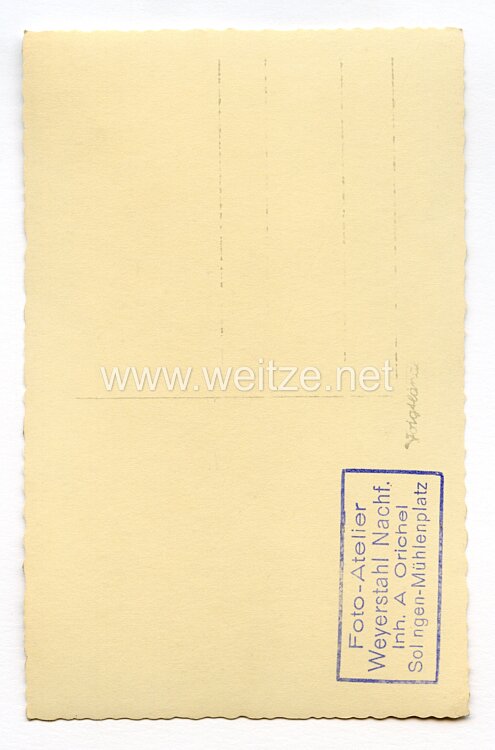
Portrait photographs in postcard format were extremely popular in the early 20th century. The standard format measured approximately 9 x 14 cm and corresponded to the then-common postcard dimensions. Soldiers frequently had themselves photographed in professional photo studios or by regimental photographers to send these images to family members and comrades or to keep as personal mementos. The reverse side was often designed like a postcard, with space for an address and message.
The uniforming and display of medals and decorations on such photographs followed strict military regulations. The Army Service Regulations precisely regulated how decorations were to be worn. The Iron Cross 1st Class was attached to the upper left breast, with the exact position prescribed. In photographs, soldiers took particular care to present their decorations clearly visible, reflecting pride in their military achievements.
Photographs like this are today important military-historical sources. They document not only the uniforming and medal recipients of a particular era but also provide insights into social structures, military hierarchies, and the self-representation of soldiers. For modern research, such photographs are indispensable in reconstructing uniform details, the wearing of decorations, and the identification of units based on badges and collar insignia.
The condition rating “2” according to common collector grading indicates a well-preserved specimen with minor signs of use. Photographs from this period are sensitive to light, moisture, and mechanical damage. Original photographs in good condition are becoming increasingly rare and represent important historical documents.
The bearers of the Iron Cross 1st Class from 1914 who later served in the Wehrmacht formed a bridge between two world wars. Their experiences from the First World War significantly shaped the tactical and strategic considerations of German military leadership in the 1930s and 1940s. Wearing the 1914 decoration even during World War II was expressly permitted, and many officers proudly displayed it as a sign of their long military experience and proven valor.