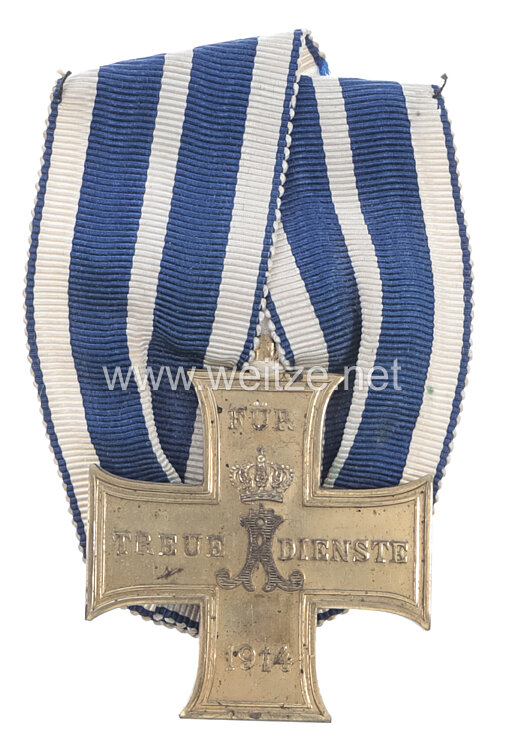
Schaumburg-Lippe Cross for Faithful Service 1914 - 1918
The Schaumburg-Lippe Cross for Faithful Service 1914-1918 represents a significant testimony to German orders and decorations history from World War I. This honor badge was instituted by the Principality of Schaumburg-Lippe, one of the smaller German federal states, to recognize faithful service during the years of the First World War.
The Principality of Schaumburg-Lippe was one of the smallest member states of the German Empire, with an area of only about 340 square kilometers and approximately 46,000 inhabitants at the beginning of the 20th century. Despite its modest size, the principality maintained its own tradition of awards and decorations. During World War I, Prince Adolf II Georg (1883-1936) stood at the head of the principality, having assumed government in 1911.
The institution of the Cross for Faithful Service occurred in the context of the comprehensive mobilization of all German states during World War I. Like other German federal states, Schaumburg-Lippe developed a system of decorations to honor both military and civilian merits during the war years. The Cross for Faithful Service 1914-1918 belonged to those honor badges that were not exclusively intended for frontline combatants, but could also be awarded to persons who contributed to the war effort through faithful duty fulfillment at home or in non-combatant functions.
The specimen described here consists of gilt base metal, which was typical for the manufacture of honor badges in the later war phase, when precious metals became increasingly scarce. The gilding nevertheless gave the piece a dignified and representative appearance. The cross is attached to a combatant's ribbon, indicating a military award. The term “combatant's ribbon” refers to a ribbon worn during combat operations, as opposed to peacetime ribbons.
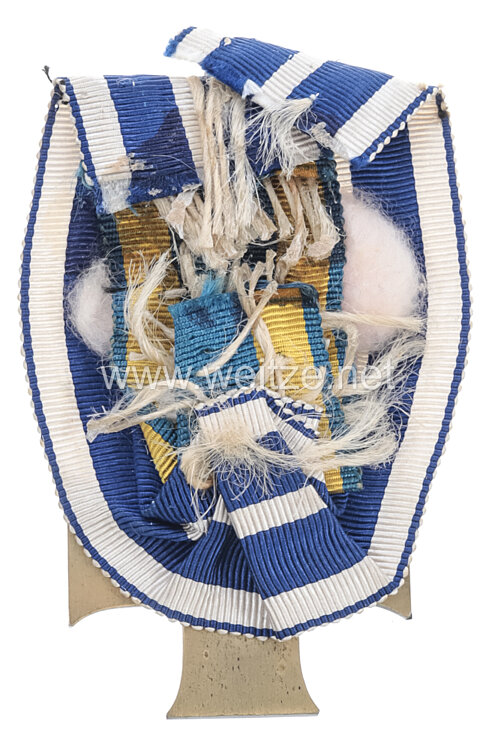
The fact that the piece was removed from a medal bar is a common phenomenon with historical militaria. Medal bars were mounting devices on which several decorations of a wearer were mounted side by side to be worn together on the uniform. After World War I and especially during the economically difficult years of the Weimar Republic, such bars were frequently dissolved to sell or pass on individual decorations.
The order system of Schaumburg-Lippe comprised various decorations, including the House Order of the Schaumburg-Lippe Rose and various crosses of merit. The Cross for Faithful Service 1914-1918 belonged to the honor badges specially created for wartime and reflects the need to decorate a large number of persons for their war efforts.
After the end of World War I and the abdication of the German princes in November 1918, the conferral of decorations by the former princely houses ceased. Prince Adolf II abdicated on November 15, 1918, ending the official conferral practice of the principality. However, decorations already awarded could continue to be worn, and many veterans wore their honor badges with pride even in the Weimar Republic.
The preservation of such decorations is of considerable historical value, as they not only document military history but also provide insight into the system of social recognition and hierarchy of the Empire. The Principality of Schaumburg-Lippe, although small, was an integral part of the German federal system, and its decorations represent the federal structure of the Empire.
The stated condition 2 indicates, according to common numismatic and militaria collector classification, a good to very good state of preservation, with slight signs of use but without significant damage. This is remarkable for an object that is over a century old and was presumably worn.
Today, decorations from Schaumburg-Lippe are comparatively rare and valued by collectors due to the small size of the principality and the correspondingly limited numbers awarded. They document an important aspect of German regional history and World War I from the perspective of one of the smaller German states.