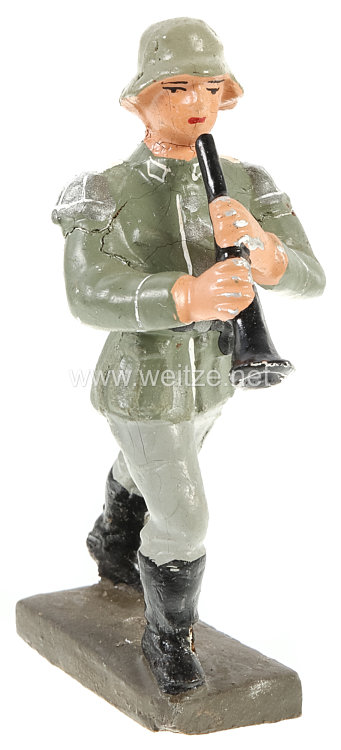
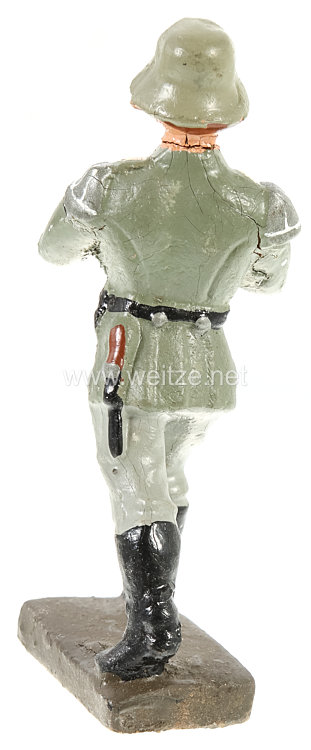
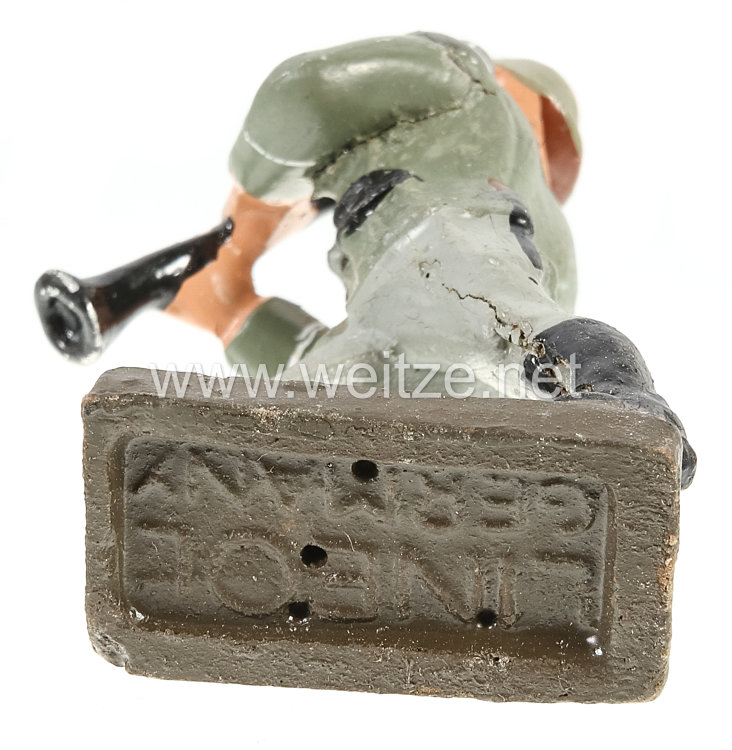
Lineol - Army Clarinet Player Marching
The Lineol figure of a marching clarinet player of the German Army represents a fascinating chapter in German toy history and military representation culture of the first half of the 20th century. Standing 7 centimeters tall, this composition figure embodies the characteristic quality and attention to detail for which the manufacturer Lineol became known worldwide.
The company was founded by Oskar Wiederholt in 1906 in Brandenburg an der Havel. The name “Lineol” was derived from “Leinöl” (linseed oil), one of the main components of the composition mass from which the figures were made. This special compound consisted of a mixture of linseed oil, wood flour, casein, and other binding agents, which were pressed into metal molds and then hand-painted. Unlike the hollow lead figures of competitor Elastolin, Lineol figures were solid and heavier.
Military bands, which included clarinet players, played a significant role in the military tradition of the German Army. According to military service regulations, each regiment had its own band that performed at parades, marches, and ceremonial occasions. The clarinet had been a fixed instrument in German military music since the 19th century. The Prussian military music tradition, dating back to the 18th century, had a lasting influence on German military musical culture.
During the Weimar Republic (1919-1933), Lineol produced various figures of Reichswehr soldiers, including musicians in different poses. After the Nazi seizure of power in 1933 and Germany's rearmament from 1935 onwards, the production of military toy figures expanded considerably. The figures now showed Wehrmacht soldiers in various uniform variations, including members of military bands.
The uniform representation on such figures generally followed the official uniform regulations of the German Army. Musical units wore the same basic uniform as regular soldiers of their branch, supplemented by specific insignia and sometimes special versions for parade uniforms. The characteristic field-gray uniform of the Wehrmacht was complemented by details such as shoulder boards, collar patches, and headgear.
The production of such toy figures had not only commercial but also cultural-propagandistic aspects. They served to convey military values and glorify soldiering to the younger generation. Toy manufacturers like Lineol received state support during the Nazi era and produced their figures in large quantities for the German and international markets.
World War II brought considerable restrictions for the toy industry. Raw material shortages, conversion to war production, and finally the destruction of many production facilities led to the near cessation of manufacturing. The Lineol factory in Brandenburg was damaged toward the end of the war and found itself in the Soviet Occupation Zone after 1945.
After the war, production initially continued under Soviet administration but was nationalized in 1950. The West German part of the company attempted a new start but could never match its earlier success. Production finally ceased permanently in the 1960s.
Today, original Lineol figures are sought-after collectibles. Their value depends on various factors: condition, rarity of representation, completeness of painting, and historical authenticity. Figures in condition 2 show slight signs of wear but are still well preserved with largely intact painting. Musician figures are often rarer than simple infantry figures due to their special representation and delicate instruments.
Scholarly engagement with military toys has increased in recent decades. Historians recognize in these objects important sources for understanding military culture, propaganda mechanisms, and child-rearing in different historical epochs. Museums and private collections preserve these witnesses of a bygone era as documents of social and cultural history.