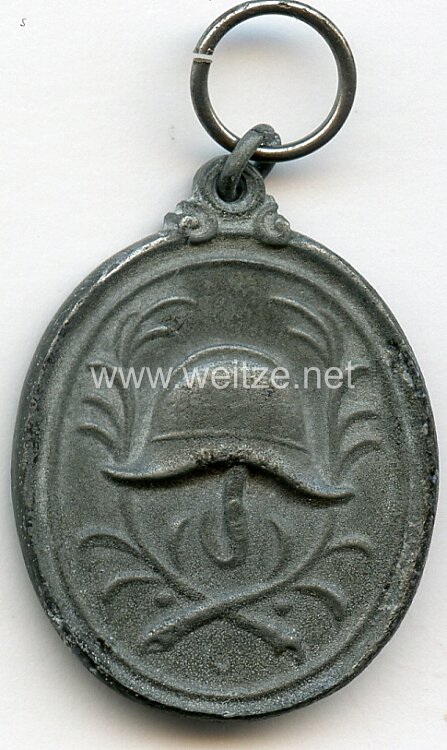
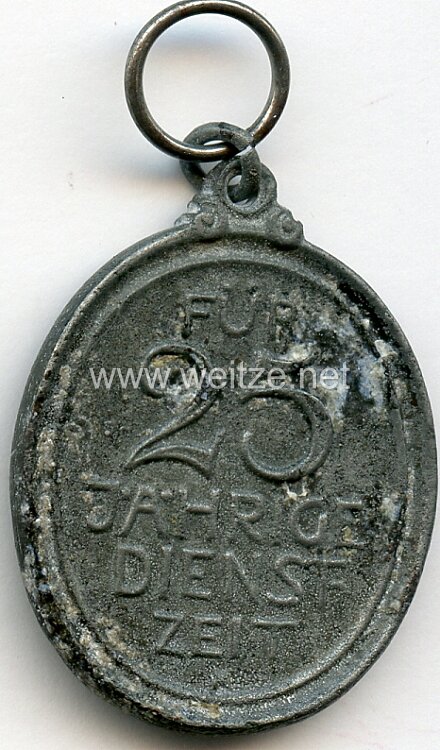
Free State of Bavaria Fire Brigade Honor Badge for 25 Years of Service
The Fire Service Honor Badge for 25 Years of Service of the Free State of Bavaria represents an important tradition of recognizing long-standing merit in Bavarian firefighting. This decoration was awarded during the Weimar Republic period between 1918 and 1933, when Bavaria was organized as a free state and maintained an independent system for honoring meritorious firefighters.
After the end of the monarchy in 1918 and the proclamation of the Free State of Bavaria on November 8, 1918, new republican badges had to be created to replace the monarchical decorations of the Kingdom of Bavaria. The fire service had already undergone significant development in Bavaria during the 19th century, and the systematic recognition of long-term service was an essential component of motivating and retaining volunteer firefighters.
The choice of fine zinc as material was typical for badges of this category and era. Zinc was cost-effective to manufacture and enabled wide distribution to deserving firefighters. Unlike higher state decorations, which were often made from more noble metals, the use of zinc reflected the practical nature of this service award. Surface treatment usually involved silver plating or lacquering to protect the metal from corrosion.
The fire service in Bavaria was organized in a highly decentralized manner. The volunteer fire brigades formed the backbone of fire protection in municipalities and cities. A 25-year period of service represented a remarkable achievement that encompassed continuous readiness, regular training, and frequently also deployment at fires and other emergencies. The presentation of such badges usually took place during ceremonial occasions, often at fire brigade festivals or annual general meetings.
The design of Bavarian fire service honor badges followed traditional patterns: they were frequently designed as crosses or medals, featuring the Bavarian lozenge coat of arms or other state symbols of the Free State. Inscriptions referred to the period of service and the awarding state. Unlike their monarchical predecessors, royal symbols such as crowns or monograms were naturally absent.
The historical context of the Weimar Republic also shaped the significance of these decorations. In a time of political and economic instability, fire brigades offered continuity and community. The hyperinflation of 1923 and the Great Depression from 1929 onward posed considerable challenges to fire brigades as well. Despite these difficulties, the system of honors persisted and documented the social appreciation of fire service.
After the Nazi seizure of power in 1933, the Bavarian fire service was integrated into the Reich-wide system. The independent Bavarian decorations were replaced by honors valid throughout the Reich. This marked the end of specifically Bavarian fire service badges of the Free State, but made the pieces awarded between 1918 and 1933 historical documents of a specific epoch in German and Bavarian history.
The preservation and corrosion of such zinc badges is a well-known problem for collectors and museums. Zinc tends to form white corrosion products, especially under humid storage conditions. This “zinc pest” can significantly attack the surface. Many of these decorations today show signs of corrosion, which does not diminish their historical authenticity but rather documents their history and age.
Today, these badges are important testimonies to German fire service history and the history of the Free State of Bavaria. They are valued by collectors of military and civil decorations and can be found in fire service historical collections and museums. Their value lies not only in their materiality but above all in their function as historical sources for the social and everyday history of the Weimar Republic.