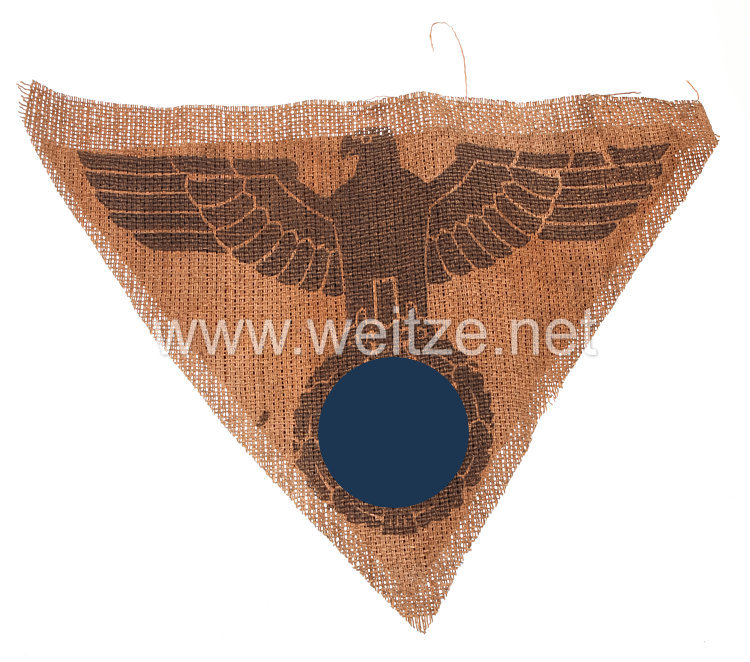
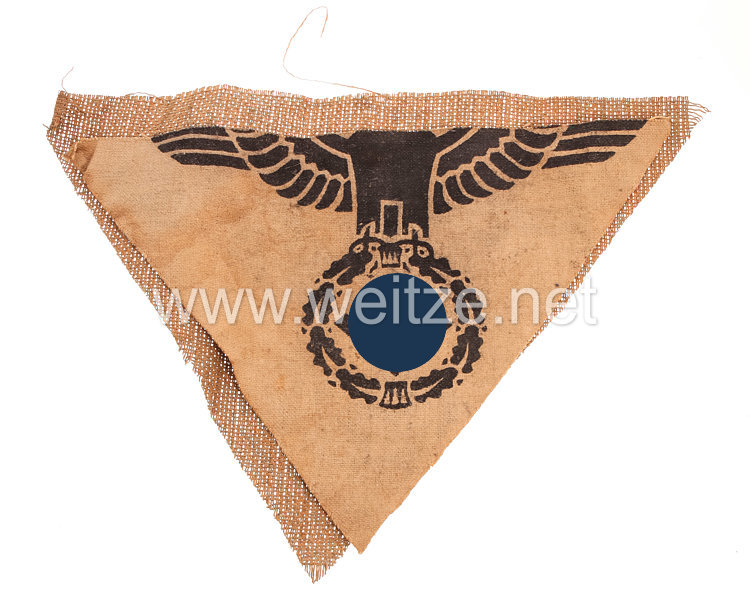
Wehrmacht - Army Ration Bag Eagle

2 national eagles on linen, condition 2-.
449695
60,00

Wehrmacht - Army Ration Bag Eagle

The Wehrmacht Army Supply Sack with sewn-on national eagles represents a characteristic component of military equipment and supply logistics of the German Army during World War II. These linen sacks were produced in large quantities and served to organize and transport foodstuffs within the military supply chain.

The national emblems on this supply sack display the Wehrmacht eagle, which was introduced as the official national insignia of the German armed forces from 1935 onwards. The eagle with outstretched wings, holding a swastika in its talons, was affixed to various military equipment items. The attachment of such national insignia to supply sacks served primarily to clearly mark them as military property and was intended to prevent confusion with civilian goods or misuse.

The supply organization of the Wehrmacht was a complex system that was constantly being developed during the war. Linen sacks of this type were used at various levels of the supply chain – from central supply depots through field kitchens to troop units at the front. The use of linen as a material was practically justified: it was durable, relatively light, breathable for storing certain foodstuffs, and could be cleaned when necessary.

According to Army Service Regulations (H.Dv.), precise provisions were established for the marking, use, and administration of army property. Supply sacks had to be appropriately marked to enable proper inventory management. The national eagles were typically sewn or stamped on, with quality and execution varying depending on the time of manufacture and the producing company.

The food supply economy of the Wehrmacht was already extensively organized in peacetime but had to be considerably expanded with the outbreak of war in 1939. Various agencies were responsible for the procurement, storage, and distribution of food. Sacks of this type were used to transport a wide variety of goods – from grain and flour to potatoes, canned goods, and other non-perishable foods.

During the course of the war, the supply situation deteriorated progressively. While troop provisions functioned relatively well in the early war years, the increasing overextension of supply lines, transport problems, and material shortages led to considerable difficulties. Nevertheless, the organization of provisions remained a central aspect of military logistics until the late war period.

The production of such supply sacks was carried out by various civilian supplier companies that manufactured for the Wehrmacht within the framework of the war economy. The national eagles were either machine-sewn or hand-sewn. Quality and execution varied depending on the time of production – early war years often show more precise workmanship than later productions under increasing material shortages.

From a collection-historical perspective, such supply sacks are today important witnesses to military everyday culture and logistics. They document the practical aspects of warfare beyond weapons and tactical operations. The preservation of such objects makes it possible to draw a more complete picture of military organization.

The provenance and contemporary handling of such objects requires particular sensitivity. As relics of a criminal dictatorship and a war of aggression, they must be understood and presented in their historical context. Their value lies exclusively in their function as historical sources for documentation and critical examination of this era.