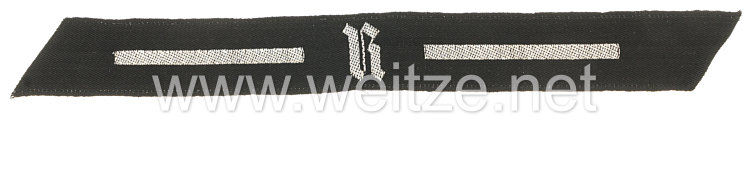
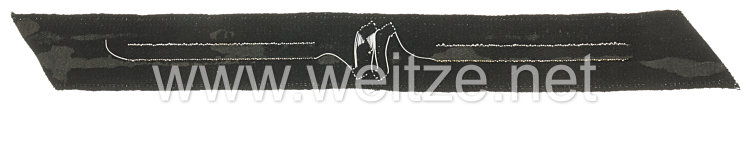
RAD Armband for Leader "R" for Leader in Rheinland
The RAD armband for leaders in the Rhineland represents a significant piece of equipment from the Reich Labor Service (Reichsarbeitsdienst, RAD) during the National Socialist era. The Reich Labor Service was established as a compulsory institution on June 26, 1935, through the “Law for the Reich Labor Service,” having already existed since 1931 as the Voluntary Labor Service (Freiwilliger Arbeitsdienst, FAD).
The designation "R" for Rhineland refers to one of the geographical divisions of the RAD. The Reich Labor Service was organized into various Arbeitsgaue (labor districts) that corresponded to the territorial administrative units of the German Reich. The Rhineland represented a strategically and symbolically important region that gained particular significance for the National Socialist regime after its remilitarization in March 1936.
The described Bevo metal-thread woven construction represents the high-quality manufacturing method for leader armbands. The Barmer Bandweberei Ewald Vorsteher (BEVO) was one of the main suppliers of woven insignia for various National Socialist organizations. The metal-thread weaving technique, which incorporated actual metal threads into the fabric, was reserved for leader ranks and differed significantly from the simpler versions for enlisted personnel.
The armband was worn on the left upper arm and served for immediate identification of wearers according to their regional affiliation. Leader ranks in the RAD encompassed various levels, from Truppführer (troop leader) to Reichsarbeitsführer (Reich Labor Leader). The armbands were an essential component of the uniform and were subject to strict wearing regulations detailed in the corresponding RAD service regulations.
The unworn condition of the described specimen is notable, as many of these insignia were actually worn during their intended period of use. The shortening to 24 cm indicates that the piece was possibly prepared for mounting on a uniform without ever being deployed. The original standard length of armbands was typically about 45-50 cm to allow sewing onto various arm circumferences.
The RAD had several main tasks: conducting public construction projects, providing pre-military training for German youth, and imparting National Socialist ideology. In the Rhineland, RAD units were particularly engaged in fortification work on the Westwall as well as agricultural and infrastructure projects. From 1939 onward, the RAD increasingly played a role in war preparation and later in direct war support.
The rank structure of the RAD was modeled on the Wehrmacht but used its own designations. Leaders wore special uniform features, including the metal-thread armbands that marked their position within the hierarchy. These distinctions were part of a comprehensive system of visual communication of rank and function that was characteristic of all National Socialist organizations.
After the end of World War II, the RAD was dissolved by the Allies. Its insignia and uniform parts became collector's items that are now found in military history collections and museums. They serve as material witnesses to an organization through which millions of young Germans passed and which formed an integral part of the National Socialist system.
The preservation of such objects in collections has important documentary and educational value. They enable historians and the public to study and understand the material culture of National Socialism. At the same time, they require responsible handling that considers the historical context and avoids any glorification.
The specific marking for the Rhineland reflects the RAD's organizational structure, which divided Germany into regional labor districts. Each district had its own identifying letter or designation, allowing for administrative organization and regional identification of units and their leaders. This system of regional identification was typical of the highly bureaucratized nature of National Socialist organizations.