Prussian Order Pour le Mérite for Arts and Sciences

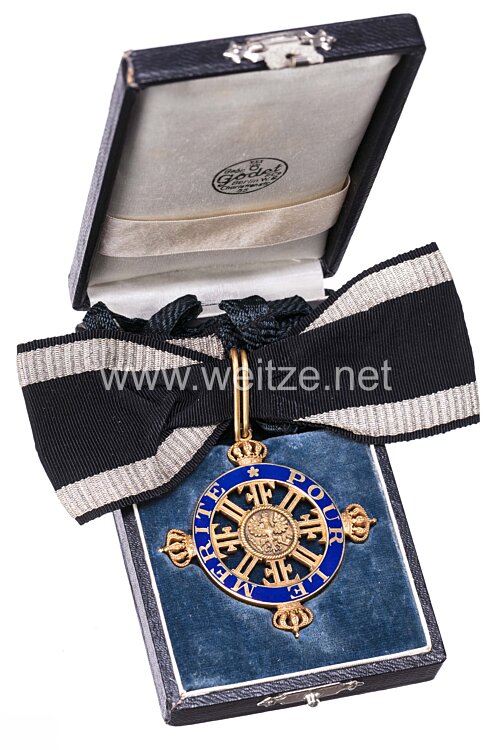
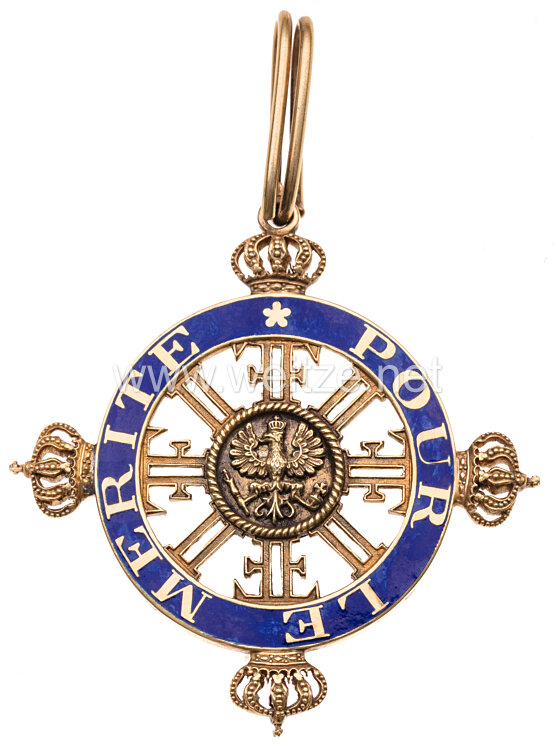
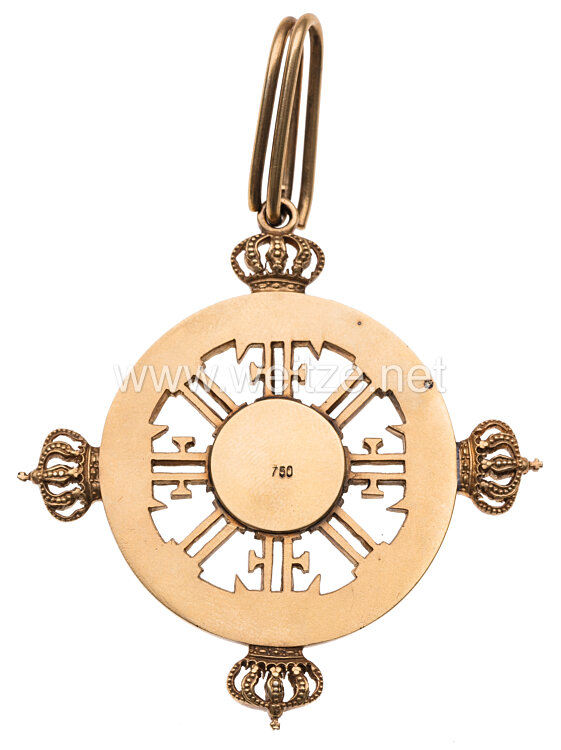
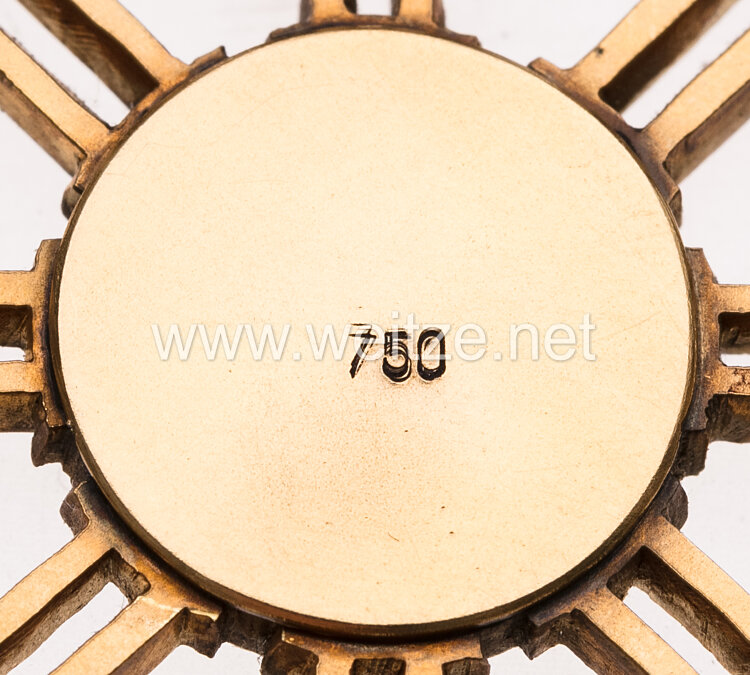
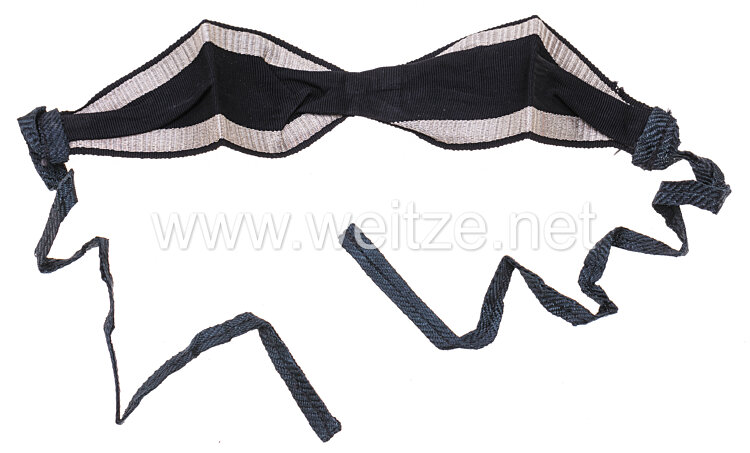
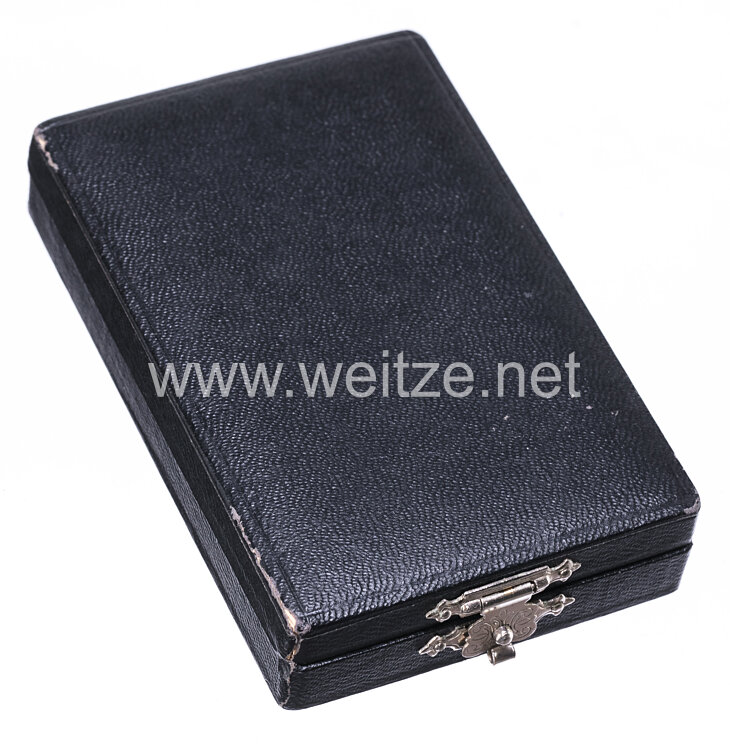
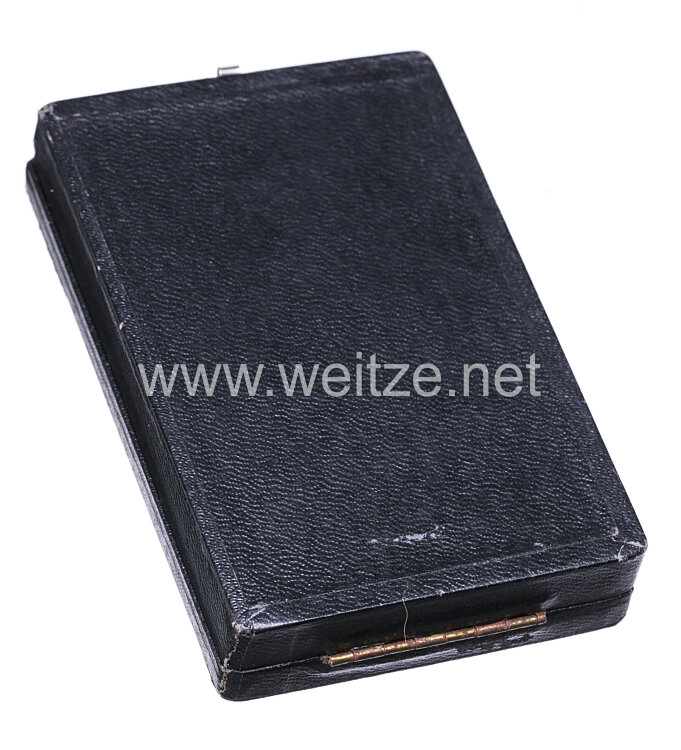
This is a manufacture from the Weimar Republic. Manufactured by the firm Godet, Berlin, circa 1925/30. Gold. Round, openwork medallion, on the sides four openwork gold crowns, dark blue enameled inscription ring with golden inscription "POUR LE MERITE", at the top a five-petaled flower. Within the ring in gold small, round medallion with relief Prussian eagle and mirror monogram "F II", the smooth reverse stamped "750". With ribbon ring. Dimensions 55 x 52 mm. Weight 30 g. Complete in original presentation case, interior with maker "Gebr. Godet, Berlin W.2 Charlottenstr. 35". Complete with original fabricated neck ribbon. Minimally worn in excellent condition.

Alexander von Humboldt suggested to Friedrich Wilhelm IV in 1842 to establish a “Peace Class” of the order under the designation Pour le Mérite for Sciences and Arts for the three divisions Humanities, Natural Sciences and Medicine, and Fine Arts.
In the Weimar Republic between 1924 and 1933 only 30 orders were awarded in total; the first award was made in 1924 to Albert Einstein.
282995

Prussian Order Pour le Mérite for Arts and Sciences

The Order Pour le Mérite for Sciences and Arts represents one of the most distinguished honors ever established in the German-speaking world for outstanding achievements in the realms of science and the arts. Its origins trace back to 31 May 1842, when King Friedrich Wilhelm IV of Prussia, acting upon the advice of the renowned naturalist Alexander von Humboldt, founded what became known as the Peace Class of the military Pour le Mérite. While the original order, instituted by Frederick the Great in 1740, exclusively recognized military merit, this new class was designed to honor accomplishments in three equal sections: Humanities, Natural Sciences, and Fine Arts. Theological sciences were expressly excluded from consideration.

The decoration was awarded to men and women who had acquired a distinguished reputation through widely recognized merits in science or art. Among the first recipients in 1842 were such luminaries as the philosopher Friedrich Wilhelm Joseph Schelling and the jurist Friedrich Carl von Savigny. Throughout the decades of the Prussian monarchy, the order was bestowed upon an impressive roster of intellectual giants, including the composer Johannes Brahms, the naturalist Charles Darwin, the Italian composer Giuseppe Verdi, and the industrial pioneer Werner von Siemens.

The end of the First World War and the collapse of the monarchy in 1918 marked a critical turning point in the order's history. The new Weimar Constitution, specifically Article 109 of 31 July 1919, prohibited state orders, threatening the continued existence of this venerable institution. To preserve it, the order was reconstituted as a free association of scholars and artists. The Prussian State Ministry approved new statutes on 4 March 1924, though awards had already resumed in 1923. The constitutional constraints had far-reaching consequences: the order could now only hold the status of a "badge" and could be awarded exclusively to German nationals, whereas during the Imperial era foreign dignitaries had also been eligible for recognition.

A remarkable feature of the order was that only 30 historical order badges existed, which remained the property of the Prussian State. These were returned upon the death of a holder and re-awarded to new members. The manufacture of these precious insignia was entrusted to renowned Berlin jewelers. Early pieces were crafted by Hossauer, while later production was undertaken by various makers including Gebr. Godet and J. Wagner & Sohn. Military-era pieces were made in gold until 1916, after which they were produced in gilt silver by decree. The civilian pieces manufactured after 1924 were produced in gold and bore the hallmark "750" for 18-karat gold.

During the Weimar Republic, the award was conferred with exceptional restraint. Among the first recipients in 1923 were Albert Einstein, the poet Gerhart Hauptmann, and the sculptor Hugo Lederer. The composer Richard Strauss was honored in 1924. A historic milestone came in 1929 with the election of Käthe Kollwitz as the first woman admitted to the order. Other notable members included the conductor Wilhelm Furtwängler, elected in 1929, and the sculptor Ernst Barlach, honored in 1933.

The Nazi seizure of power in 1933 ushered in a dark period for the order. The regime prohibited all new elections with the stated aim of allowing the decoration to die out. Members such as Einstein, Kollwitz, and Barlach were deemed politically unsuitable by the authorities. The order remained inactive throughout the entire Nazi period and the immediate post-war years until 1952.

On 31 May 1952, exactly 110 years after its foundation, the order was re-established on the initiative of Federal President Theodor Heuss. It was revived as an independent organization with state recognition, with the Federal President serving as Protector. The new statutes permitted a maximum of 40 German and 40 foreign members. Early post-war members included the biochemist Otto Heinrich Warburg, the physicist Otto Hahn, the composer Paul Hindemith, and the painter Emil Nolde, all elected in 1952. Thomas Mann was also among those honored. Albert Einstein was invited to renew his membership but declined.

Membership in the order operates on a distinctive principle: new members are co-opted by existing members, and self-application is not possible. Today, the Order Pour le Mérite for Sciences and Arts stands as one of Germany's most prestigious non-state honors and is administered by the Federal Commissioner for Culture and Media. An annual public session is held in Berlin in the presence of the Federal President, while the 30 historical badges continue to be returned upon death and re-awarded to new recipients.

r