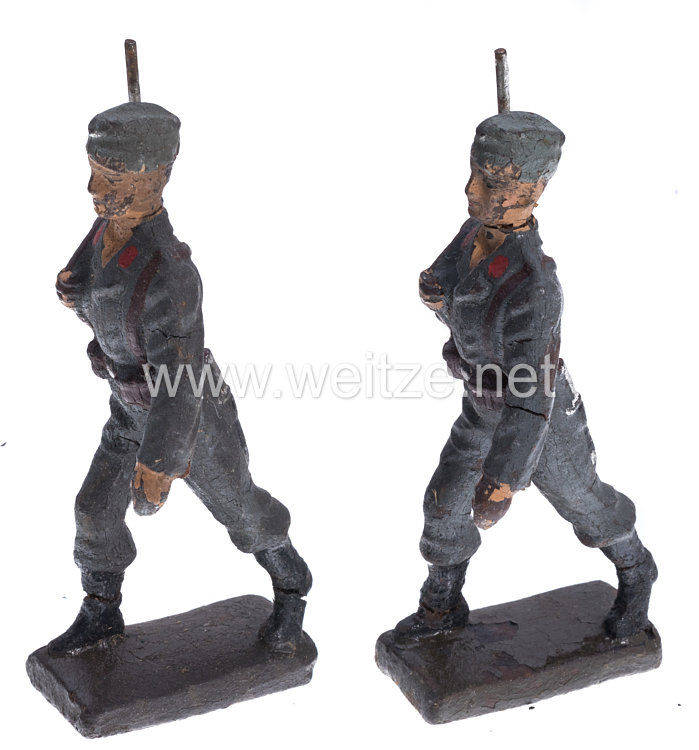
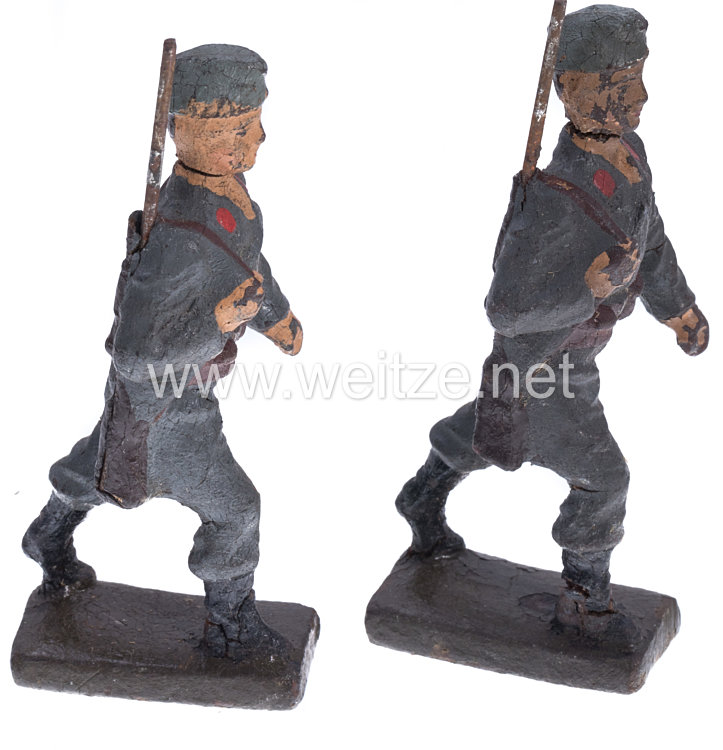
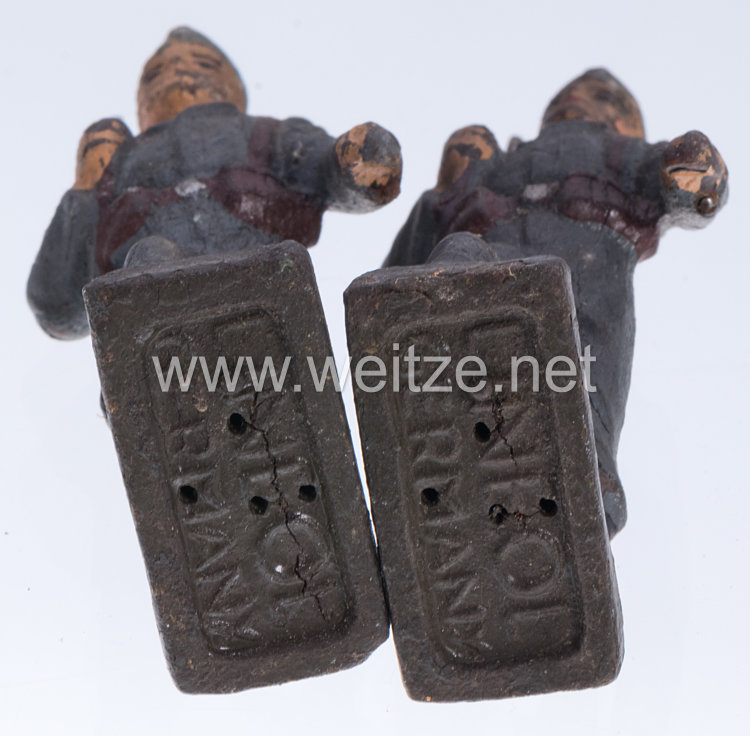
Lineol - Luftwaffe 2 Flak Soldiers with Garrison Caps Marching

7.5 cm, Condition 2-.
343695
35,00

Lineol - Luftwaffe 2 Flak Soldiers with Garrison Caps Marching

Lineol Luftwaffe Anti-Aircraft Soldiers: Toys and Propaganda in the Third Reich

These Lineol figures represent two marching Luftwaffe Flak soldiers wearing Schiffchen (side caps) and belong to a product line manufactured between the early 1930s and the end of World War II. Standing at 7.5 cm tall, these figures correspond to the typical Lineol scale, which differed from the smaller 5.5 cm figures and allowed for more impressive displays of military scenes.

Lineol GmbH, founded in 1906 in Brandenburg an der Havel by Oskar Wiederholz, developed into one of Germany's most significant manufacturers of composition figures. Unlike traditional lead soldiers, Lineol figures were made from a composition material – a mixture of sawdust, glue, chalk, and other binding agents. This manufacturing technique allowed for more detailed forms and was more cost-effective than lead production. The figures were pressed into molds, dried, and then hand-painted, with the painting often carried out by home workers.

The Flak (abbreviation for Flugabwehrkanone – anti-aircraft gun) formed an essential component of the German Luftwaffe during World War II. The anti-aircraft artillery was responsible both for defending Reich territory against Allied bombing raids and for supporting ground troops at the front. Flak units were subordinated to the Luftwaffe, although they primarily operated on the ground. The soldiers wore the characteristic Luftwaffe blue uniform, which distinctly differed from the field-gray uniforms of the Army.

The Schiffchen, also referred to as the flight cap or field cap, was a standard headgear of the Luftwaffe. This practical cap could be folded and stored in the uniform pocket. It was worn during service, training, and daily duties, while steel helmets were often preferred for official occasions or combat operations. Lineol's depiction of these soldiers with Schiffchen suggests a representation during march or garrison duty.

During the Nazi era from 1933 onward, the toy industry received particular political significance. The National Socialists recognized the propagandistic value of military toys for the military education of youth. Lineol increasingly produced figures representing the various branches of the newly built Wehrmacht. The accurate reproduction of uniforms and equipment was intended to inspire admiration for the military among children and prepare them for a militarized society.

Lineol's product range included not only soldier figures but also guns, vehicles, and entire scenery setups. The Flak soldiers could be combined with corresponding anti-aircraft guns that Lineol also carried in its assortment. Particularly popular were the 8.8 cm Flak models, which represented the famous German multi-purpose gun used both in air defense and as an anti-tank weapon.

The quality of Lineol figures varied significantly throughout the production years. The early pre-war figures were characterized by fine painting and detailed facial features. With the outbreak of war in 1939 and increasing resource scarcity, quality gradually deteriorated. Colors became simpler, details coarser, and toward the end of the war, production was severely restricted due to material shortages and bomb damage.

After World War II, the production of military toys in Germany was initially banned by the Allies. The Lineol factory in Brandenburg was located in the Soviet occupation zone and was expropriated. Only in the 1950s, after the founding of the Federal Republic, did the company resume production under new management, though it increasingly focused on civilian themes and sports figures.

Today, Lineol figures from the Third Reich era are sought-after collector's items. The condition rating "2-" indicates a well-preserved figure with slight signs of use. Collectors particularly value the originality of the painting, the completeness of the figure, and the absence of damage. The historical significance of these objects lies not only in their craftsmanship but also in their testimonial value regarding the militarization of society and the instrumentalization of childhood in National Socialist Germany.