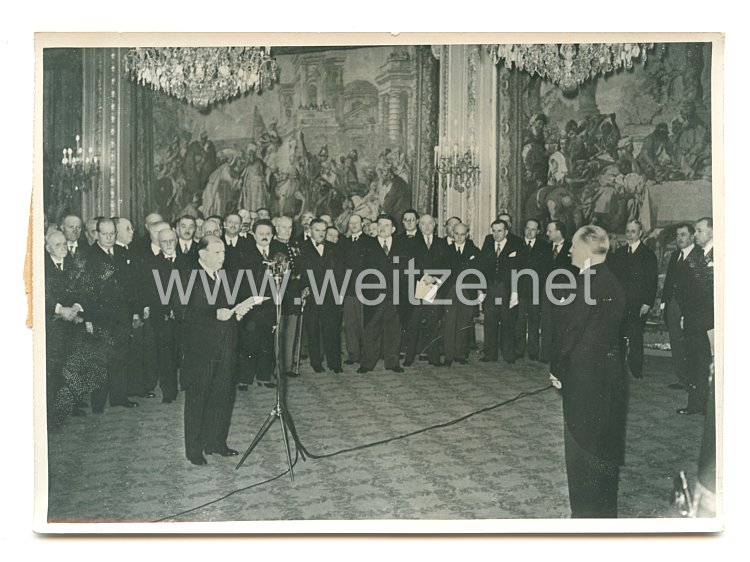
Third Reich Press Photo: President Lebrun Assumes the French Presidency for Another Seven Years. April 6, 1939

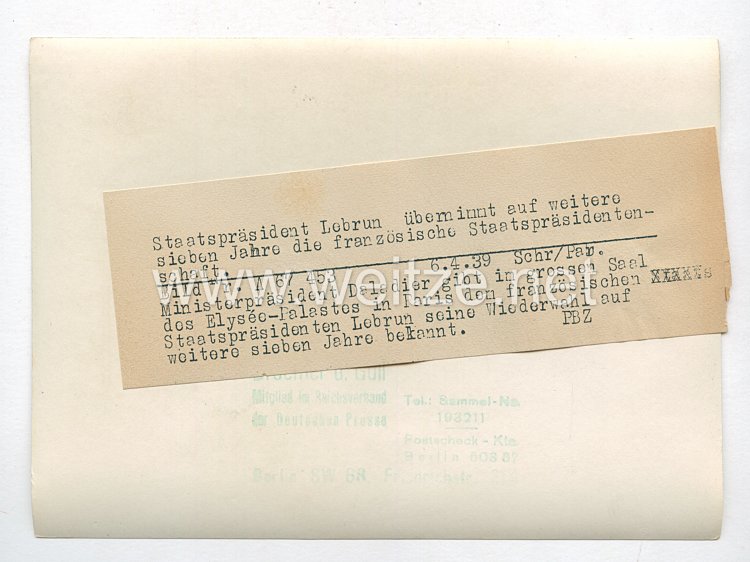
Dimensions approximately 13 x 18 cm, with text on reverse, used condition.
343395
15,00

Third Reich Press Photo: President Lebrun Assumes the French Presidency for Another Seven Years. April 6, 1939

Third Reich Press Photography: Albert Lebrun and the Final Term of the Third French Republic

This press photograph from April 6, 1939 documents a significant moment in the history of the Third French Republic: the re-election of Albert Lebrun as President for another seven-year term. This document is not merely a photographic record but a window into the complex political landscape of Europe just months before the outbreak of World War II.

Press Photography in Nazi Germany

Press photography played a central role in information control and propaganda in the Third Reich. After the Nazi seizure of power in 1933, the entire German press system was subjected to strict coordination (Gleichschaltung). The Reich Ministry of Public Enlightenment and Propaganda under Joseph Goebbels controlled all media content, including photographic coverage of foreign events.

Press photos were distributed by state-controlled news agencies such as the Deutsches Nachrichtenbüro (DNB) or specialized photo agencies. These photographs typically bore printed or stamped captions on the reverse side with dates, descriptions, and distribution instructions. Coverage of foreign heads of state, particularly from France, was conducted under strategic considerations and was part of the regime's foreign policy information strategy.

Albert Lebrun and the French Presidency

Albert Lebrun (1871-1950) served as President of the French Republic from 1932 to 1940. His re-election in April 1939 by the National Assembly occurred during a time of extreme international tension. The political situation was characterized by the increasing aggression of Nazi Germany: in March 1939, the Wehrmacht had occupied the remainder of Czechoslovakia and established the Protectorate of Bohemia and Moravia, definitively nullifying the Munich Agreement of 1938.

Lebrun's presidency was marked by political instability. The Third Republic suffered from frequent government changes and a divided political landscape between leftists, conservatives, and extremist movements. As President, Lebrun had primarily representative functions, while actual power rested with the Prime Minister. In April 1939, Édouard Daladier served as Prime Minister, attempting to strengthen France in the face of the German threat.

The International Situation in Spring 1939

German press coverage of Lebrun's re-election in April 1939 must be seen in the context of tense Franco-German relations. After the occupation of Czechoslovakia, it had become clear that Hitler's expansionist policy could not be stopped through appeasement. France and Britain began to consolidate their military alliances and issue guarantee declarations for threatened states such as Poland.

For German propaganda, reporting on French politics was ambivalent: on one hand, France was portrayed as a decadent democracy weakened by internal strife; on the other hand, as a potential military threat against which Germany must defend itself. Neutral reporting on state ceremonies such as Lebrun's assumption of office served to maintain an appearance of normal diplomatic relations.

Historical and Collector Context

Press photographs from the Third Reich era are important historical documents today. They provide insights into the media landscape of the Nazi period and show how events were presented to the German public. The format of approximately 13 x 18 cm was a standard size for press photos of this era, allowing for rapid distribution and use in newspapers.

The reverse caption is particularly valuable for historians and collectors, as it provides information about origin, dating, and original purpose. Signs of use such as creases, stamps, or annotations bear witness to actual use in editorial offices and are part of the object's history.

Epilogue

The seven-year term for which Lebrun was elected in April 1939 was never to be completed. With the German invasion of Poland on September 1, 1939, World War II began, and in June 1940, France capitulated. Lebrun remained formally in office initially but had to effectively resign after the establishment of the Vichy Regime under Marshal Pétain. The Third Republic ended, and the press photo of April 6, 1939, thus documents one of the last symbolic acts of a state form that collapsed just months later. It is a silent witness to a world on the eve of catastrophe.

r