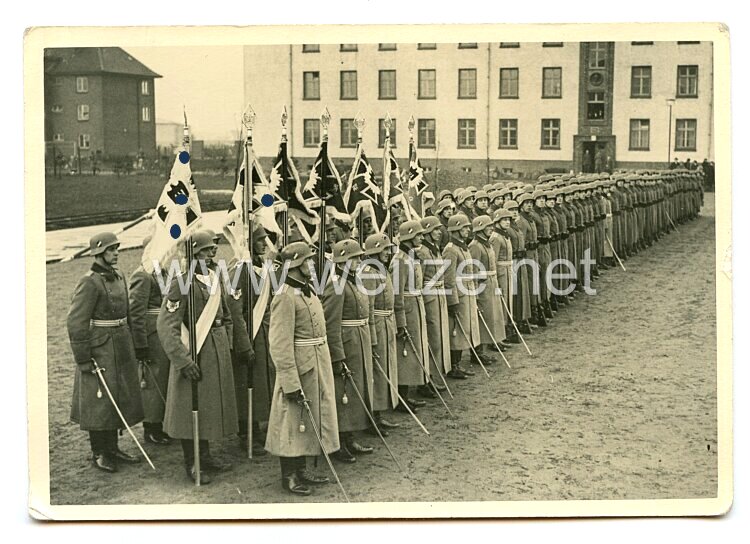
Wehrmacht Heer Photograph, Standard Bearer with Ringkragen Collar
This historical postcard depicts a flag bearer (Fahnenträger) of the Wehrmacht Heer in uniform wearing the characteristic collar insignia (Ringkragen), a distinctive identification feature of the German armed forces during World War II.
The Ringkragen or collar patches were an essential component of Wehrmacht uniforms, serving to identify branch of service, rank, and specific functions. Flag bearers held a special position within the military hierarchy, as they were entrusted with the honor duty of carrying and protecting the unit colors or standard.
In German military tradition, which dates back to the 19th century, the flag held immense symbolic significance. It represented the honor of the unit and served as a rallying point in battle. The loss of a flag was considered the greatest disgrace for a military unit. For this reason, flag bearers were carefully selected and had to distinguish themselves through exceptional bravery, reliability, and impeccable conduct.
The Wehrmacht, officially established in 1935 following the reintroduction of universal conscription by the National Socialist regime, adopted many traditions from the Reichswehr and the Imperial Army. Uniform design followed precise regulations laid down in the Army Service Regulations (Heeresdienstvorschriften) and special clothing directives.
The collar insignia visible in the photograph typically featured Waffenfarben (branch colors) that indicated affiliation with a particular branch of service. Infantry wore white branch colors, artillery red, cavalry golden yellow, and armored units pink. This color coding enabled quick visual identification of unit affiliation.
Photographs like this were frequently produced as field postcards or personal mementos. During World War II, photography was an important medium for documenting military service and maintaining connections with home. Soldiers often had themselves photographed in full uniform to demonstrate their position and pride in service to their families.
The designation postcard size refers to the standard format of approximately 9 x 14 cm, which was common in the first half of the 20th century. This size was practical for mailing and storage in private photo albums. The stated condition 2 indicates, according to common collector categories, a good state of preservation with possibly minor signs of use.
From a military-historical perspective, such photographs are valuable primary sources. They document not only the uniforms and equipment of the Wehrmacht but also provide insight into military culture, soldiers' self-representation, and the visual propaganda of the era. The formal pose and careful presentation of the uniform in such photographs reflect the importance attached to military traditions and ceremonies.
The historical contextualization of such objects requires differentiated consideration. They are testimonies of a time when the Wehrmacht served as an instrument of a criminal regime and participated in numerous war crimes. At the same time, as historical documents, they have scholarly value for research into uniform studies, military history, and everyday culture.
For collectors of military-historical photographs, images of flag bearers are particularly interesting because they are rarer than ordinary portrait photos. The special function of the subject and the clear visibility of uniform details make such photographs valued study objects for research into Wehrmacht uniforms.
These photographic documents serve as important teaching materials in museums and educational institutions, helping to convey the historical reality of the period and promote critical examination of German military history during the National Socialist era.