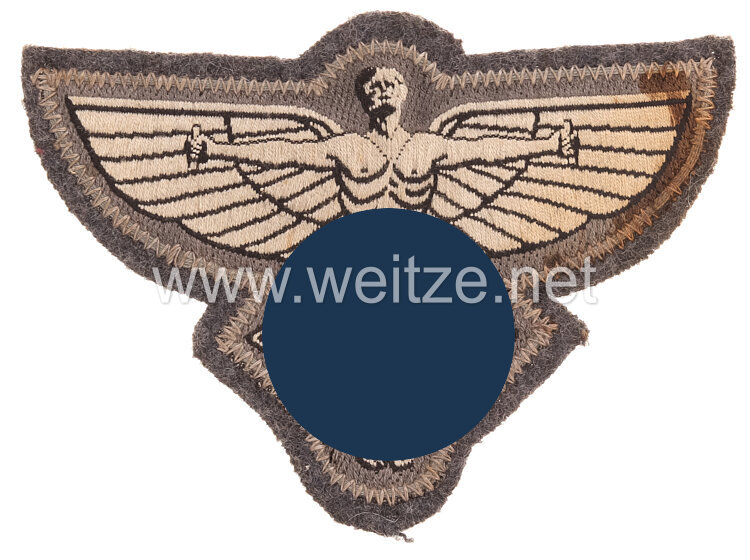
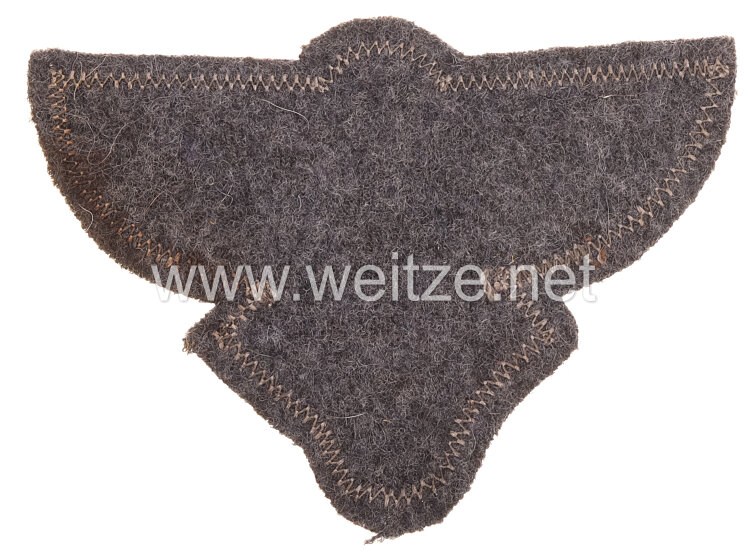
National Socialist Flyers Corps (NSFK) Breast Eagle for Service Tunic

Bevo-woven execution on gray cloth, condition 2.
455294
250,00

National Socialist Flyers Corps (NSFK) Breast Eagle for Service Tunic

The breast eagle of the Nationalsozialistisches Fliegerkorps (NSFK) represents a significant rank insignia worn on the service tunic of members of this paramilitary organization. The example described here is executed in the typical Bevo weaving technique on gray cloth, representing a characteristic manufacturing method for uniform insignia of that era.

The National Socialist Flying Corps was established on April 17, 1937, through the merger of the Deutscher Luftsportverband (DLV) and came under the direct supervision of the Reich Aviation Ministry. The organization primarily served pre-flight training and was intended to create a reservoir for the rapidly expanding Luftwaffe. Korpsführer Friedrich Christiansen, who later also held the rank of General der Flieger, led the organization.

The NSFK uniform closely followed military models and was designed to emphasize the character of an elite organization. The gray service tunic was the standard uniform for members of the corps. The breast eagle was worn on the left chest to visibly indicate membership in the organization.

The Bevo weaving technique was developed and perfected by the company Bandfabrik Ewald Vorsteher from Wuppertal. This method enabled the mechanical production of complex insignia with fine details. Unlike embroidered or handcrafted variants, Bevo insignia could be produced cost-effectively in large quantities, which was of great importance for the mass outfitting of paramilitary organizations. The weaving technique produced a flat but detailed image in which the threads were woven directly into the backing material.

The eagle motif itself followed National Socialist design guidelines. The eagle with outstretched wings held a swastika in its talons and looked to the right (heraldically). This representation differed in details from the eagles of other NS organizations, with the specific design for the NSFK regulated by official regulations. The use of gray cloth as a background corresponded with the color of the service uniform and created a harmonious overall impression.

At its peak, the NSFK was one of the largest aviation mass organizations in Germany. It was divided into various Luftgaue (air districts) that were organized territorially. Training included theoretical instruction, gliding, powered flight, and technical training. Many later Luftwaffe pilots received their first aviation training in the NSFK, giving the organization an important role in war preparation.

The uniform and insignia regulations of the NSFK were revised and refined several times. The breast eagle was part of the basic equipment and was mandatory to wear. There were differences in material and design between leaders and enlisted ranks, with higher ranks sometimes able to use higher-quality, hand-embroidered variants.

During World War II, the role of the NSFK increasingly changed. While training was initially the focus, auxiliary services for the Wehrmacht were later undertaken, including air defense tasks and the recovery of crashed aircraft. The organization existed until the collapse of the German Reich in May 1945.

After the war, all National Socialist organizations were dissolved and banned by the Allies. The collection and trade of objects such as the described breast eagle today operate within a legal framework that varies from country to country. In Germany, symbols with swastikas are generally subject to § 86a StGB, although exceptions for historical research, education, and collecting are possible under certain conditions.

From a military-historical perspective, such insignia document the uniforming practices and organizational structure of paramilitary associations in National Socialism. They are testimonies to the mobilization and ideological penetration of broad sections of the population for military purposes.