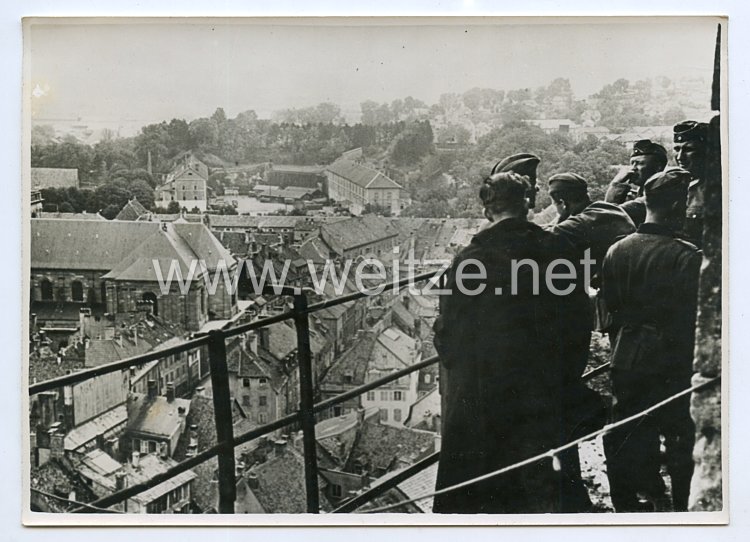
Third Reich Press Photograph. After the Armistice. July 25, 1940.

Dimensions approx. 13 x 18 cm, with description on reverse, used condition. 
324394
15,00

Third Reich Press Photograph. After the Armistice. July 25, 1940.

Press Photography in the Third Reich: Documentation of the July 1940 Armistice

This press photograph from July 25, 1940 documents a significant chapter in European history immediately following the Armistice of Compiègne, signed on June 22, 1940, between the German Reich and France. Such press photographs were central tools of the Nazi propaganda machine and served to deliberately control public opinion both domestically and abroad.

Historical Context

The Battle of France (Westfeldzug) began on May 10, 1940, with the German invasion of Belgium, the Netherlands, Luxembourg, and France. Within just six weeks, German Wehrmacht forces succeeded in defeating French and British troops. On June 14, 1940, the Wehrmacht marched into Paris, and on June 22, the armistice was signed in the historic railway carriage at Compiègne – the same location where Germany had signed the capitulation in 1918.

The timing of this photograph, approximately one month after the signing, falls within a phase of consolidation of the German occupation in France. The country was divided into an occupied zone in the north and west, and the so-called Zone libre under the Vichy government of Marshal Philippe Pétain.

Press Photography as a Propaganda Instrument

The Nazi leadership recognized early the importance of visual media for propaganda purposes. The Reich Ministry of Public Enlightenment and Propaganda under Joseph Goebbels strictly controlled all aspects of media production and distribution. Press photographers, known as war correspondents (Kriegsberichter), were officially accredited with the Wehrmacht and wore uniforms with special insignia.

These photographers accompanied troops to the front and documented military operations, victory celebrations, and the allegedly positive reception of German occupation by local populations. Images were centrally collected, censored, and then distributed through various channels: to German and international newspapers, illustrated magazines such as the “Berliner Illustrirte Zeitung” or “Signal” magazine, as well as for newsreels.

Technical and Formal Characteristics

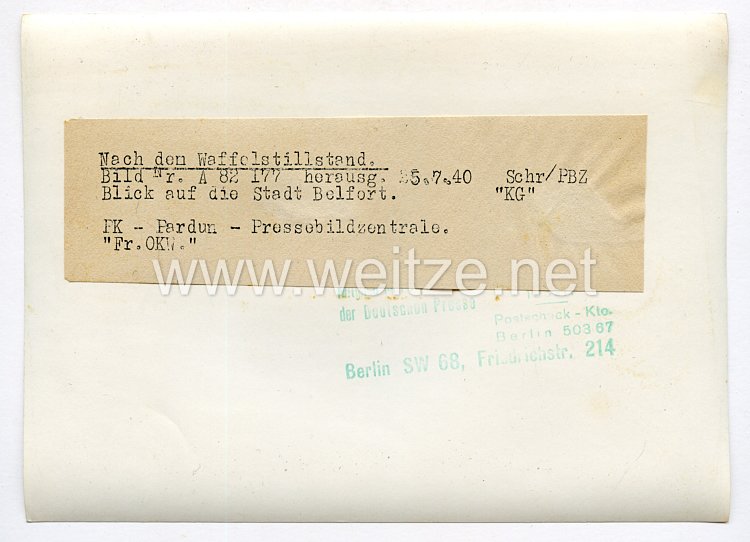
The format of approximately 13 x 18 cm corresponds to the standard sizes for press photographs of that era. The reverse inscription was a characteristic feature of such photographs and typically contained information such as date, location, image content, and sometimes the number of the picture agency or photographer. These details served cataloging purposes and enabled editorial offices to use and caption the images correctly.

The photographs were usually developed on baryta paper, a high-quality photographic paper with a layer of barium sulfate, known for its excellent image quality and durability. The “used condition” indicates actual use in editorial offices – such photos often show editing marks, creases, or stamps.

The Picture Agency Infrastructure

The distribution of press photographs occurred through a sophisticated system. The Wehrmacht's Propaganda Companies (PK) collected the material, which was then distributed through central offices such as the Presse-Hoffmann archive, the Scherl-Bilderdienst, or directly through the Propaganda Ministry. Every image had to pass censorship and could only be published with official approval.

Historical Significance and Source Value

Today, such press photographs are important historical sources, though they must be analyzed critically. They do not show objective reality but rather a carefully staged version of events that served the regime's ideological goals. Nevertheless, they offer insights into propaganda strategies, the visual culture of the time, and sometimes – unintentionally – information about daily life during the war.

For historians, details at the image margins, non-staged elements, and comparison with other sources are particularly revealing. The reverse notations can provide additional information about distribution channels and editorial use.

Collector Value and Ethical Considerations

Militaria from the Nazi era, including press photographs, are today preserved by collectors, museums, and research institutions. Handling such objects requires historical sensitivity and clear contextualization of their propagandistic function. They serve to document and educate about the mechanisms of totalitarian rule and should be understood as a warning against the instrumentalization of media.