Reichsarbeitsdienst (RAD) Single Shoulder Board for an Arbeitsführer Administrative Official/Administration
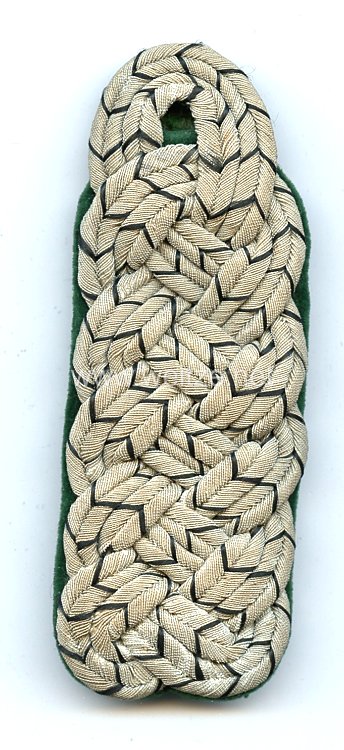
This shoulder strap represents a significant aspect of the uniforming of the Reichsarbeitsdienst (RAD), a paramilitary organization of National Socialist Germany. This single shoulder piece was worn by an Arbeitsführer (Work Leader) in the administration or as an official (Amtswalter) and displays the characteristic dark green velvet base that was typical for this service position.
The Reichsarbeitsdienst was officially established on June 26, 1935, through the “Reich Labor Service Law” as an independent organization, having evolved from the voluntary Freiwilligen Arbeitsdienst (FAD). Under the leadership of Konstantin Hierl, who held the title of Reichsarbeitsführer (Reich Labor Leader), the RAD became a compulsory organization for all young Germans. Men aged 18 to 25 were required to serve six months of labor service before they could be drafted into military service.
The rank structure of the RAD was modeled on military precedents but used its own terminology. The Arbeitsführer corresponded approximately to the rank of lieutenant in the Wehrmacht and represented an important leadership level. Within the RAD, there were various areas of employment: in addition to the active labor units, there existed an extensive administrative apparatus responsible for organization, supply, and administrative tasks. The Amtswalter and administrative personnel wore special rank insignia that distinguished them from the leaders of active labor units.
The shoulder straps of the RAD were manufactured according to precise regulations. The dark green base (often described as “bottle green” or “hunter green”) was characteristic of the Reich Labor Service and differed significantly from the branch colors of the Wehrmacht. The use of velvet as base material was reserved for leadership ranks and signified elevated status within the organization. Simple labor service men wore no shoulder straps, while foremen and higher ranks were identified by increasingly elaborate shoulder boards.
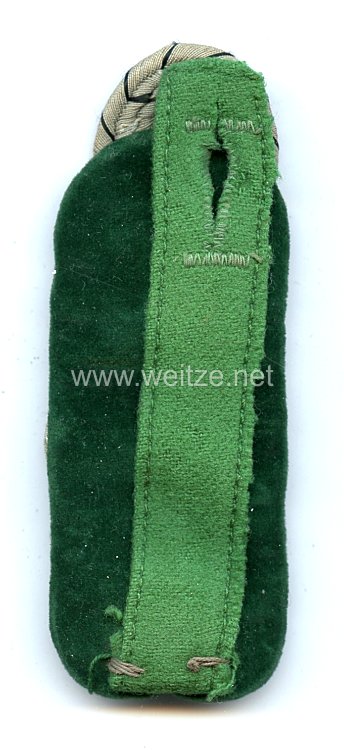
The attachment by means of a loop corresponded to the construction common at the time and enabled the mounting and removal of shoulder straps on the uniform. This was practical since uniform pieces needed to be cleaned or different rank insignia exchanged upon promotions. The shoulder straps were typically worn on the RAD service tunic, which in its design incorporated elements of military uniforms but was characterized by the distinctive earth-brown color and specific RAD insignia.
The administrative sector of the RAD encompassed numerous tasks: from assignment administration to the procurement of materials and provisions to personnel management. Arbeitsführer in these positions were often responsible for larger administrative units and required corresponding organizational abilities. They were not primarily responsible for the direct supervision of work columns but ensured the administrative functionality of the organization.
The historical significance of the RAD must be evaluated ambivalently. On one hand, the organization was officially employed for work projects such as land reclamation, road construction, and infrastructure measures. On the other hand, the RAD served the ideological indoctrination of young people and their pre-military training. The strictly hierarchical structure and military-style drill systematically prepared young men for war service. During World War II, RAD units were increasingly deployed for military auxiliary services, including the construction of fortifications and sometimes even for combat operations.
The used condition of the present shoulder strap attests to actual use during the period of service. Such original pieces are today important contemporary historical documents that provide insight into the organizational structure and uniforming of the Third Reich. They are preserved by museums and collections for research and educational purposes to objectively document and understand the history of this period.
After 1945, the Reichsarbeitsdienst, like all National Socialist organizations, was dissolved. Its symbols and insignia were banned. The historical reappraisal of this organization remains important for understanding the totalitarian structures of the Nazi state and the systematic registration and mobilization of society for war preparation.