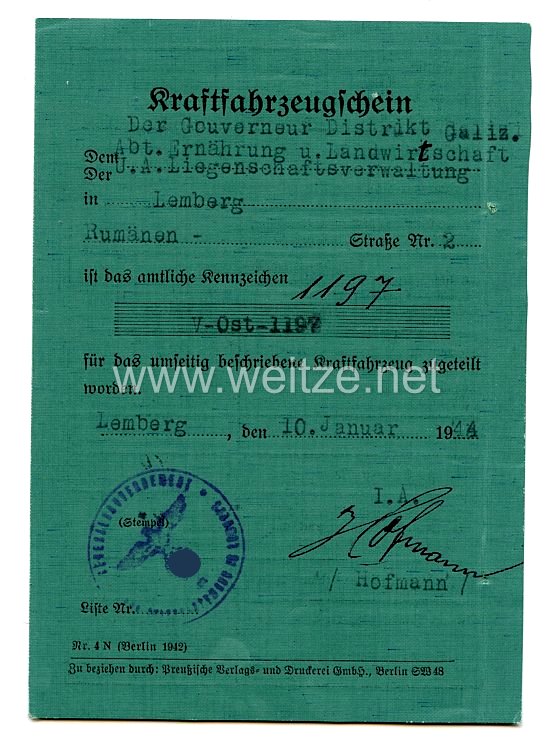
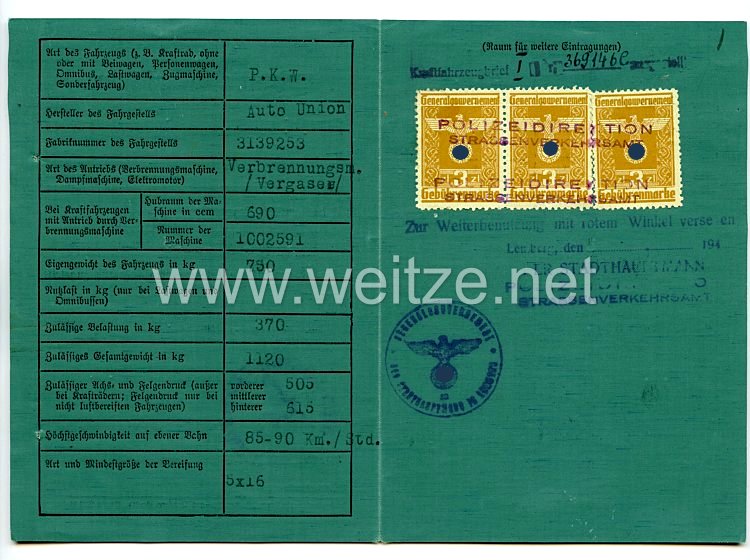
Third Reich - Motor Vehicle Registration Document for a Man from Lemberg in the Generalgouvernement for a Passenger Car of the Auto Union Brand

issued on January 10, 1944 in Lemberg, revenue stamps from the Road Traffic Office, condition.
416093
100,00

Third Reich - Motor Vehicle Registration Document for a Man from Lemberg in the Generalgouvernement for a Passenger Car of the Auto Union Brand

This motor vehicle registration certificate from the General Government represents a significant historical document that provides insight into the administrative penetration of German-occupied territories during World War II. Issued on January 10, 1944 in Lemberg (today Lviv, Ukraine) for an Auto Union passenger car, this document records the control and regulation of civilian transportation in the occupied eastern territories.

The General Government was established following the German invasion of Poland in September 1939 through a decree by Adolf Hitler dated October 12, 1939. It comprised those parts of Poland that were neither directly annexed to the German Reich nor assigned to the Soviet occupation zone. Lemberg, a historically significant city with a rich multicultural past, became part of the District of Galicia after the German attack on the Soviet Union in June 1941, which was incorporated into the General Government in August 1941.

The issuance of a motor vehicle registration certificate at this time and location was far from a mere formality. The German occupation authorities had established a comprehensive system of registration and control that extended to all aspects of public life. The Road Traffic Office that issued this document was part of the German administrative structure and operated under regulations of the Reich Ministry of Transport, which were also applied in the occupied territories.

The Auto Union brand was one of the most significant German automobile manufacturers of the pre-war and wartime periods. Created in 1932 through the merger of four Saxon automobile manufacturers (Audi, DKW, Horch, and Wanderer), the company produced both civilian and military vehicles. During the war, civilian automobile production was largely discontinued and converted to armaments manufacturing, yet existing vehicles remained in use, particularly by individuals in important positions or with corresponding privileges.

Ownership of a passenger car in occupied Lemberg in 1944 was extraordinary and suggests a privileged status of the holder. During this period, fuel supply was strictly rationed, and the use of motor vehicles was subject to severe restrictions. Only individuals with war-essential duties, members of the German administration, or persons with special permits could obtain gasoline at all. The revenue stamps affixed to the document prove the formal legality of the procedure and compliance with prescribed administrative processes.

Administrative practice in the General Government largely followed regulations applicable in the German Reich. The Reich Road Traffic Regulations and associated ordinances regarding motor vehicle registration were applied, with certain adaptations, in the occupied territories as well. This served not only traffic safety purposes but primarily the control and surveillance of mobility in the occupied territories.

January 1944 marks a critical phase of the war on the Eastern Front. The Red Army had already achieved significant territorial gains, and the liberation of Lemberg was imminent – the city was captured by Soviet troops in July 1944. The issuance of such a document in this late phase of the war demonstrates that the German administration continued to maintain bureaucratic routines despite the deteriorating military situation.

For historical research, such documents are of inestimable value. They not only document the administrative penetration of occupied territories but also provide insight into the lived reality of people under German occupation. The combination of German administrative structure, the mention of a German automobile manufacturer, and the geographical location in Lemberg makes this motor vehicle registration certificate a complex testament to the history of occupation.

Such everyday documents supplement our understanding of occupation policy in the East and show how German authorities attempted to impose their concepts of order even in conquered territories. They are material witnesses to a period of extreme violence and systematic oppression, during which meticulous bureaucratic procedures were simultaneously maintained – a paradox characteristic of the National Socialist system of rule.

The document also reflects the ethnic and social complexities of wartime Lemberg. The city, which had changed hands multiple times in preceding years, was home to Polish, Ukrainian, Jewish, and German populations. By 1944, however, the Jewish community had been largely annihilated in the Holocaust, and the German occupation had fundamentally altered the city's demographic and social fabric. The registration of a vehicle for someone from Lemberg indicates either a local collaborator, a German settler, or someone serving the occupation administration.