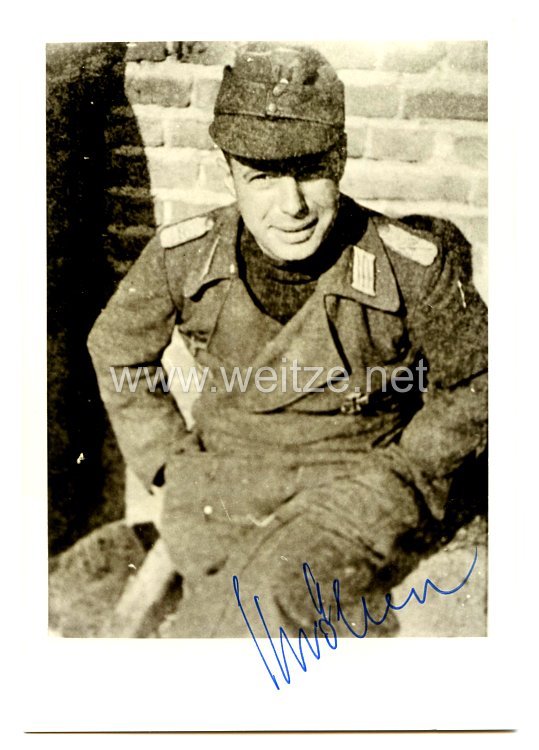
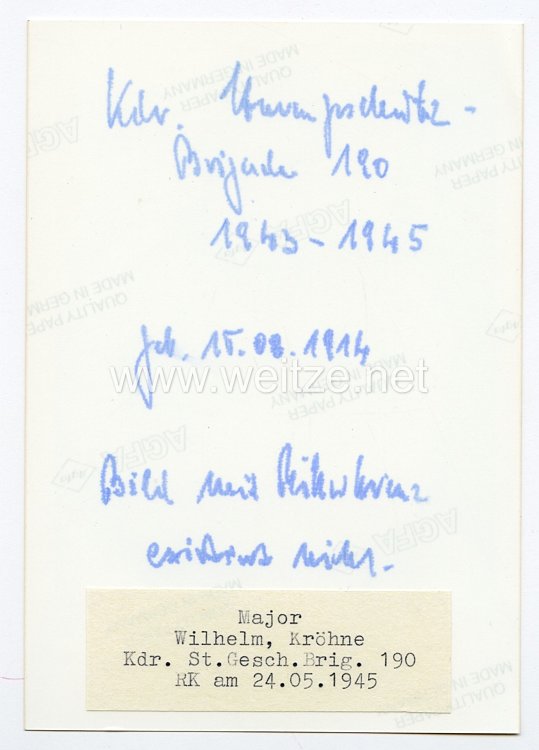
Army - Postwar Signature of Knight's Cross Recipient Wilhelm Kröhne

Photograph dimensions approximately 10 x 14.5 cm. This photograph is a print, post-1945, condition 2.
412893
30,00

Army - Postwar Signature of Knight's Cross Recipient Wilhelm Kröhne

This post-war signature of Knight's Cross recipient Wilhelm Krähne on a photographic print represents a significant category of military-historical collectibles from the period after 1945. Such signed photographs of holders of high military decorations from the Third Reich became sought-after objects for military historians and collectors in the post-war era.

Wilhelm Krähne was a German officer of the Wehrmacht who was awarded the Knight's Cross of the Iron Cross during World War II. The Knight's Cross of the Iron Cross represented one of the highest military decorations of National Socialist Germany and was instituted on September 1, 1939, by Adolf Hitler as a renewal of Prussian tradition. It was awarded for extraordinary bravery in combat or outstanding military leadership achievements.

The practice of collecting signed photographs of former soldiers and officers developed into an established field of militaria collecting in the post-war decades. After 1945, many former soldiers maintained correspondence with collectors and historians interested in the military history of World War II. This correspondence frequently led to veterans signing photographs upon request and sending them to interested parties.

The authenticity of such post-war autographs can be verified through various characteristics. These include the properties of the photographic paper used, which was typically produced after 1945, the nature of the signature, which often differed from wartime signatures, and any accompanying correspondence or mailing envelopes. The object described here is explicitly identified as a post-war print, indicating the photographic reproduction of an older image.

The condition rating of 2 suggests, according to common evaluation scales for military-historical objects, a good to very good state of preservation, possibly with minor signs of use but without significant damage. The dimensions of approximately 10 x 14.5 cm correspond to a common format for collector photographs of that period, well-suited for postal shipping and storage in collector albums.

In the historical context, it should be noted that Knight's Cross recipients occupied a complex social position in the immediate post-war period. While their military achievements in combat were undisputed, their role in the context of World War II and the National Socialist regime came under increasing critical scrutiny. Many former officers attempted to separate their military careers from political ideology, a distinction that remains controversially discussed in historical research.

The tradition of autograph collecting in the military-historical field had precursors in the interwar period but reached its peak only in the 1960s through 1990s. Collectors corresponded worldwide with former soldiers, and an international market for such signed documents and photographs developed. Collectors' motives varied from purely historical interest to documentation of military careers to personal admiration for military achievements.

From a scholarly perspective, such objects provide insights into several historical phenomena: first, into post-1945 commemorative culture; second, into the self-perception of former Wehrmacht members; and third, into the development of collecting in the field of military-historical objects. They document how the past was processed and commercialized in post-war society.

Evaluating such objects requires differentiated historical knowledge and authentication capabilities. Forgeries are not uncommon in the field of military autographs, making provenance research and expertise indispensable. Serious collections document the origin of their objects and contextualize them within the appropriate historical framework.

The phenomenon of post-war correspondence between veterans and collectors represents an important source for understanding how World War II was remembered and interpreted in subsequent decades. These interactions reveal changing attitudes toward military service, heroism, and historical responsibility across different generations and national contexts.