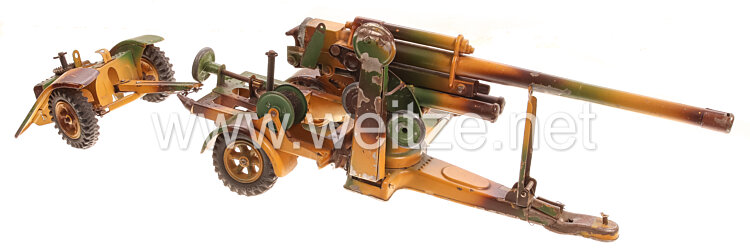
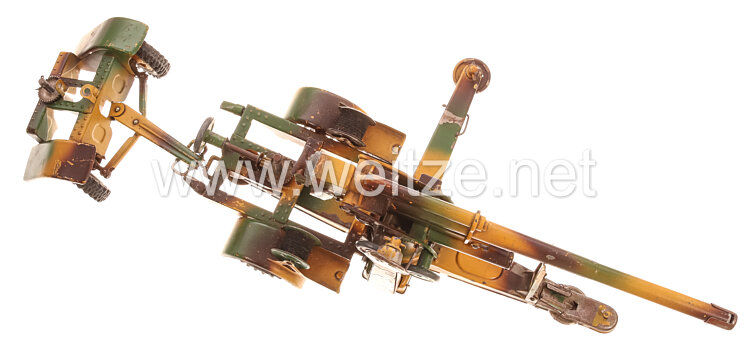
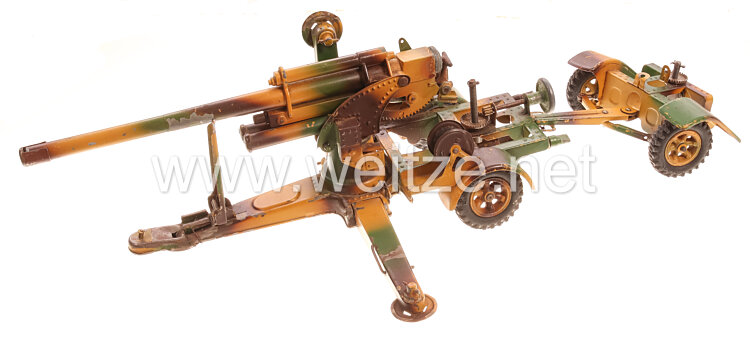
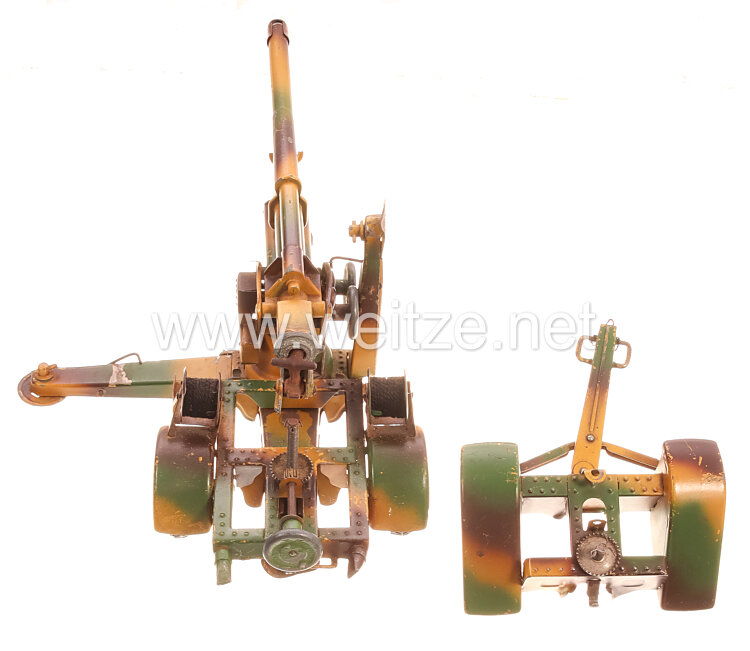
Tin Toy - 8.8cm Flak with Limber, Lineol

, with two limbers, “push” limber wheels, stamped “Lineol”, minor paint flaking, some areas with surface rust, small parts missing, Condition 2-
453493
750,00

Tin Toy - 8.8cm Flak with Limber, Lineol

The described object is a tin toy manufactured by the German company Lineol, depicting an 8.8 cm Flak (anti-aircraft gun) with limbers. This toy represents one of the most famous and feared weapon systems of World War II and stands as an example of the military toy industry in Germany during the 1930s and 1940s.

The company Lineol was founded in 1906 by Oskar Wiederholz in Brandenburg an der Havel and developed into one of the leading manufacturers of composition figures and military toys. The name “Lineol” derived from “Lino-Elastikum,” a special composite material made from linseed oil putty, kaolin, chalk, and glue, particularly used for toy figures. From the 1930s onward, the company expanded its range to include tin toys, which encompassed military vehicles and artillery pieces.

The 8.8 cm Flak 18/36/37, colloquially known simply as the “Eighty-Eight,” was a German anti-aircraft gun developed by Krupp beginning in 1928. The first production version, the Flak 18, entered service in 1933 and represented a milestone in weapons technology. With an initial muzzle velocity of approximately 820 m/s and a maximum effective ceiling of over 8,000 meters, it was ahead of its time. The improved versions, Flak 36 and 37, followed in the later 1930s.

The limber (Protze) included in this toy set refers to a two-wheeled ammunition cart that served as a towing attachment and for transporting the guns. In the military practice of the Wehrmacht, heavy anti-aircraft guns were pulled either by horses or increasingly by motorized prime movers such as the Sd.Kfz. 7. The limber typically contained ammunition and tools and was an indispensable component of mobile artillery.

The production of military toys by companies like Lineol served several purposes. On one hand, it satisfied commercial demand for contemporary toys that reflected the military reality of the era. On the other hand, this production fit into the concept of defense education (Wehrerziehung), which gained particular significance during the National Socialist period. Children were to be familiarized with military structures and equipment from an early age.

The technical details of the toy display typical features of Lineol production: the stamping with the company name, the use of tin for larger vehicles and guns, and the characteristic construction with movable wheels, here described as “push limber wheels.” The condition with minor paint flaking and surface rust, as well as missing small parts, is typical for toys that were actually played with rather than merely kept as collectibles.

After World War II, the production of military toys in Germany was initially banned by the Allies. Lineol largely ceased production under Soviet occupation; parts of the company were dismantled. A new company was later established in West Germany, but the heyday of military toy production had passed.

Today, Lineol products are sought-after collectibles of interest both from a toy-historical and contemporary-historical perspective. They document not only the craftsmanship quality of German toy manufacturers but also the social and political conditions of their time of origin. Collectors and museums preserve these objects as testimonies to a complex historical era.

The 8.8 cm Flak itself became one of the Wehrmacht's most versatile weapons and found highly effective use not only in its original role as an anti-aircraft gun but also as an anti-tank weapon. Its effectiveness against Allied tanks, particularly in North Africa under Erwin Rommel, made it legendary. This dual-purpose capability was reflected in the development of later weapon systems.

From a collector's perspective, such Lineol pieces represent an important intersection of toy manufacturing history, military history, and social history. They provide material evidence of how military technology was miniaturized and commercialized, and how warfare was normalized in everyday life and children's play during this period.