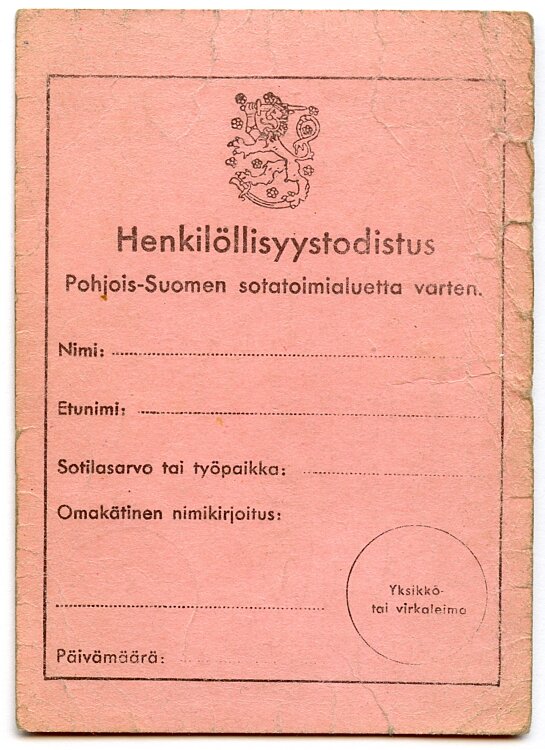
Identity Pass for the Northern Finland Operations Area

for a Hauptmann (Captain), issued on January 8, 1942 by the field post office Fp.-Nr.12195 (Staff/Gebirgs-Träger-Batl.56 - Mountain Supply Battalion 56), bilingual form in German and Finnish; heavily used condition.
156893
110,00

Identity Pass for the Northern Finland Operations Area

This Pass for the North Finland Operations Area from 1942 represents a significant historical document of German-Finnish military cooperation during World War II. This bilingual identity document, issued in German and Finnish, documents the complex military collaboration between the Wehrmacht and Finnish forces in the far north of Europe.

The document was issued on January 8, 1942 for a Hauptmann (Captain) by Feldpostnummer 12195 (Field Post Number 12195), which was assigned to the staff of Gebirgs-Träger-Bataillon 56 (Mountain Supply Battalion 56). This unit belonged to the Wehrmacht and was specially trained for deployment in the extreme Arctic terrain of northern Norway and Finland. The Mountain Supply Battalions were specialized units responsible for transporting equipment and supplies in inaccessible mountainous terrain—an indispensable task in the inhospitable landscape of Lapland.

Following the German invasion of the Soviet Union in June 1941, the Continuation War between Finland and the USSR developed. Finland saw this as an opportunity to reclaim territories lost in the Winter War of 1939-1940. Germany and Finland became brothers-in-arms, though not formally allied—Finland described itself as a “co-belligerent” rather than an Axis ally.

The North Finland Operations Area encompassed the northernmost regions of Finland, particularly Lapland, as well as adjacent areas of northern Norway. Here operated the German Army High Command Norway (AOK Norwegen), which included the Mountain Corps Norway and later the XIX Mountain Army Corps. At their peak, approximately 200,000 German soldiers were stationed in this region. Their main tasks consisted of securing the nickel mines near Petsamo, attacking the ice-free port of Murmansk, and disrupting the vital Murmansk Railway.

The necessity for special passes like the present one arose from the complex legal situation in this territory. German troops operated on Finnish sovereign territory, which required special regulations and identification documents. The bilingual pass enabled the bearer to identify himself to Finnish authorities and civilians and to prove his legitimate presence in the operations area. These documents regulated freedom of movement, access to military facilities, and cooperation with Finnish authorities.

Mountain Supply Battalion 56 was part of the specialized mountain troops trained for combat under extreme climatic conditions. The Arctic winter with temperatures of minus 40 degrees Celsius, the months-long polar night, and the difficult terrain placed extraordinary demands on men and materiel. The supply battalions were responsible for logistics over impassable terrain, often using pack horses, sledges, and later reindeer adopted from the local population.

The issuance date of January 1942 falls in a phase when German-Finnish operations in the north had ground to a halt after the initial successes of summer 1941. The offensive against Murmansk had failed, and the front froze for the coming years into a grinding war of attrition. German troops settled in for a longer stay, necessitating the formalization of administrative structures and identity papers.

Field post numbers served to maintain the secrecy of military units and their locations. Through the field post system, soldiers could correspond with home without revealing their actual location from the address. FP number 12195 is identified in historical records with the staff of Mountain Supply Battalion 56, allowing precise identification of the issuing authority today.

The rank of Hauptmann (Captain) for whom this pass was issued corresponds to a mid-level officer rank, typically commanding a company or performing staff functions. As a member of the battalion staff, the bearer likely had organizational or logistical duties within the framework of supplying the mountain troops.

The described “heavily used condition” of the document testifies to its practical use under the harsh conditions of the northern theater of war. Such passes had to be presented regularly and were carried under extreme weather conditions, leading to corresponding signs of wear.

After Finland signed an armistice with the Soviet Union in September 1944, German troops had to withdraw from Finland. This led to the Lapland War between former brothers-in-arms, during which the Wehrmacht pursued a scorched-earth policy and destroyed large parts of northern Lapland. Documents like this pass became relics of a failed cooperation and one of the harshest theaters of war in World War II.

Today, such documents serve as important sources for military historians studying the German-Finnish cooperation, the organization of Wehrmacht units, and daily life in one of the most extreme operational areas of the Second World War. They provide insights into administrative practices, military organization, and the challenges of coalition warfare in the Arctic environment.