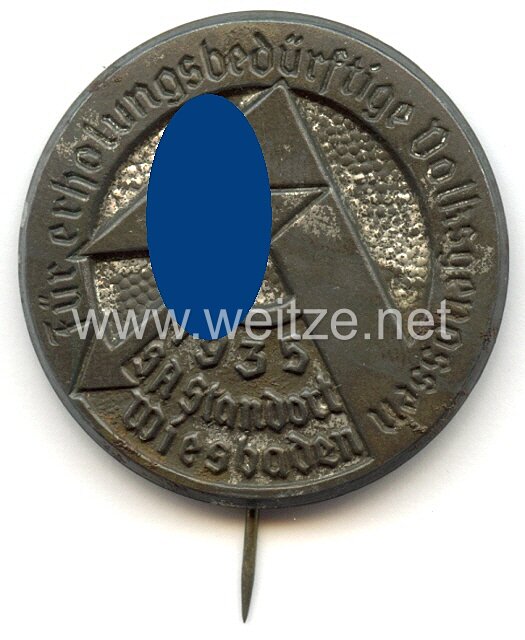
SA - "For Volksgenossen in Need of Recreation" SA Standort Wiesbaden 1935

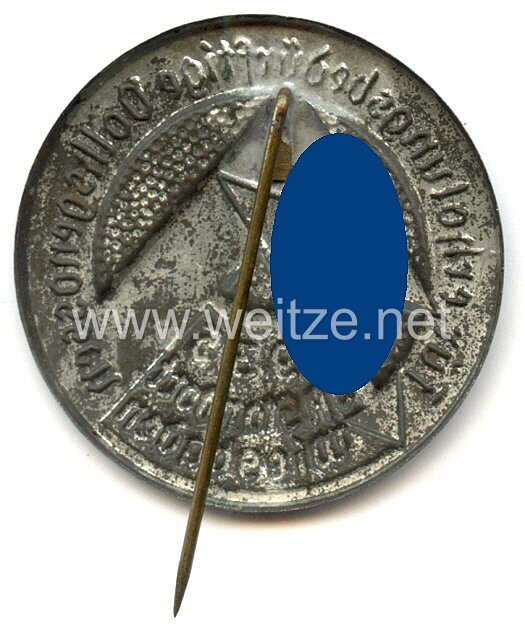
Sheet metal badge, with pin, condition 2.
286492
50,00

SA - "For Volksgenossen in Need of Recreation" SA Standort Wiesbaden 1935

This badge bears the inscription “Für erholungsbedürftige Volksgenossen” (For comrades in need of recreation) and was issued by the SA (Sturmabteilung) at the Wiesbaden location in 1935. It is a tin metal badge with a pin fastening, created within the context of National Socialist welfare and social policy of the 1930s.

The Sturmabteilung, founded in 1921, evolved from a paramilitary combat organization of the NSDAP into a mass organization with several million members by the mid-1930s. After the so-called Röhm Affair in June 1934, during which the SA leadership was eliminated, the organization lost its political power but remained as a social and propaganda institution.

From 1933 onwards, the SA increasingly engaged in various social and public welfare activities. This reorientation was part of the National Socialist Volksgemeinschaft ideology (people's community), which claimed to overcome social differences and provide for the welfare of all “Volksgenossen.” The SA organized recreational activities, holiday trips, and convalescence stays, particularly for workers and less affluent population groups.

The SA location Wiesbaden was part of the organization's regional structure. Wiesbaden, as the capital of the Prussian province of Hessen-Nassau and a traditional spa town, was particularly suitable as a location for recreational measures. The city had numerous spa facilities and appropriate infrastructure.

Such badges were typically issued during collections or events to solicit donations for social purposes. Wearers demonstrated their support for recreation programs and their belonging to the “Volksgemeinschaft.” The year 1935 marks a phase of consolidation of the Nazi regime, during which such welfare campaigns were intensively used to legitimize and popularize the dictatorship.

The production from tin metal was typical for collection badges of this period, as it enabled cost-effective mass production. The pin construction allowed easy attachment to clothing. Such badges were often produced in large quantities and distributed in exchange for donations.

Nazi welfare policy was closely linked to the NSV (Nationalsozialistische Volkswohlfahrt - National Socialist People's Welfare), but other organizations like the SA also conducted their own campaigns. These measures served multiple purposes: they were meant to strengthen the population's loyalty, convey the image of a caring government, and simultaneously advance the ideological penetration of society.

Recreational measures in the Third Reich were, however, selective and exclusionary. Only “Volksgenossen” classified as “Aryan” were eligible for such benefits. Jews, political opponents, and others persecuted by the regime were systematically excluded. The apparent care was thus inseparable from National Socialist racial policy and ideology.

From a military-historical perspective, such badges document the transformation of the SA from a combat organization to an institution that also assumed civilian and social functions. They show how the Nazi regime instrumentalized various organizations for its propaganda and social policy.

Today, such badges are important historical sources that provide insight into everyday history and propaganda mechanisms of the Third Reich. They document how the regime attempted to consolidate its rule through apparent charitable acts and the integration of broad segments of the population.

r