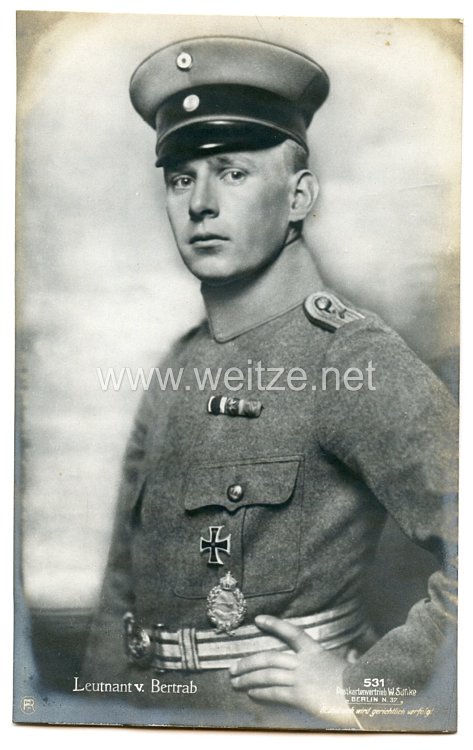
WWI Aviation - Photo Postcard - German Flying Ace “Leutnant von Bertrab”

on Sanke card no. 531, unused, condition 2.
416692
35,00

WWI Aviation - Photo Postcard - German Flying Ace “Leutnant von Bertrab”

This Sanke postcard No. 531 featuring the portrait of Lieutenant von Bertrab belongs to one of the most significant series of propaganda postcards from World War I. These cards not only document military aviation history but also illustrate how the German Empire venerated its pilots as heroes and utilized them for propaganda purposes.

The Gustav Liersch & Co. publishing house from Berlin, known by the photographer's name Sanke, produced an extensive series of photographic postcards of German fighter pilots during World War I. These cards, numbered and systematically catalogued, were manufactured in millions of copies between 1914 and 1918. The Sanke cards evolved into an important medium of home front propaganda and contributed significantly to the heroization of the air force.

German fighter pilots of World War I enjoyed an almost mythical status among the population. In contrast to the anonymous mass dying in the trenches, aerial combat offered a seemingly chivalrous form of warfare. Pilots such as Manfred von Richthofen, Oswald Boelcke, and Max Immelmann became folk heroes whose portraits were distributed on countless postcards. These cards served both as collectibles and as means to maintain morale on the home front.

The photographic design of Sanke cards followed a characteristic pattern: professional studio photographs showed the officers in uniform, often with their decorations, against a neutral background. The cards typically bore the pilot's name, rank, and sometimes their achievements, such as the number of victories. The numbering of the cards enables precise cataloguing and dating of these historical documents today.

The German Air Service evolved during the course of the war from a purely reconnaissance unit to an independent branch of the armed forces. The first fighter squadrons (Jastas) were established in 1916, after the necessity of specialized combat units had become apparent. The fighter wings gained great recognition through their characteristic aircraft paintwork and their pilots' successes. The most famous was Jagdgeschwader 1, also known as the “Richthofen Wing” or “Flying Circus.”

Postcards like this one fulfilled multiple functions: they served military propaganda, were popular collectibles, were sent as field post, and contributed to the legend-building around the “Knights of the Air.” The home population could establish a personal connection to distant war events through collecting and exchanging these cards. For relatives of soldiers at the front, they offered a piece of identification with military successes.

The condition designation “Condition 2” indicates a well-preserved card with minimal signs of wear. The fact that the card is unused means it was never used for postal purposes, which increases its collector value. Many of these cards were indeed never sent but rather glued into albums or kept as loose collections.

From a cultural-historical perspective, these postcards document the transformation in warfare and war perception. The air force was the most modern and technologically advanced branch of the military in World War I. Pilots were portrayed as elite, as embodiments of courage, technical skill, and chivalrous virtues. This representation stood in stark contrast to the brutal reality of industrialized warfare.

Today, Sanke cards are important collectibles and research sources for military historians, aviation historians, and experts in propaganda history. They provide insights into the visual culture of World War I, the personalization of military propaganda, and the construction of heroic figures in wartime. Completely preserved series are extremely rare and correspondingly valuable.

The systematic recording and numbering of Sanke cards makes them a well-documented area of military memorabilia. Collectors and researchers can trace the chronological development of the series using the card numbers and draw conclusions about production periods and the relative importance of various pilots in contemporary perception.

These historical artifacts represent a unique intersection of photography, propaganda, and popular culture during one of history's most transformative conflicts. They remain tangible connections to an era when aviation was still new and thrilling, and when individual pilots could achieve celebrity status in ways that would become impossible in later, more mechanized conflicts.