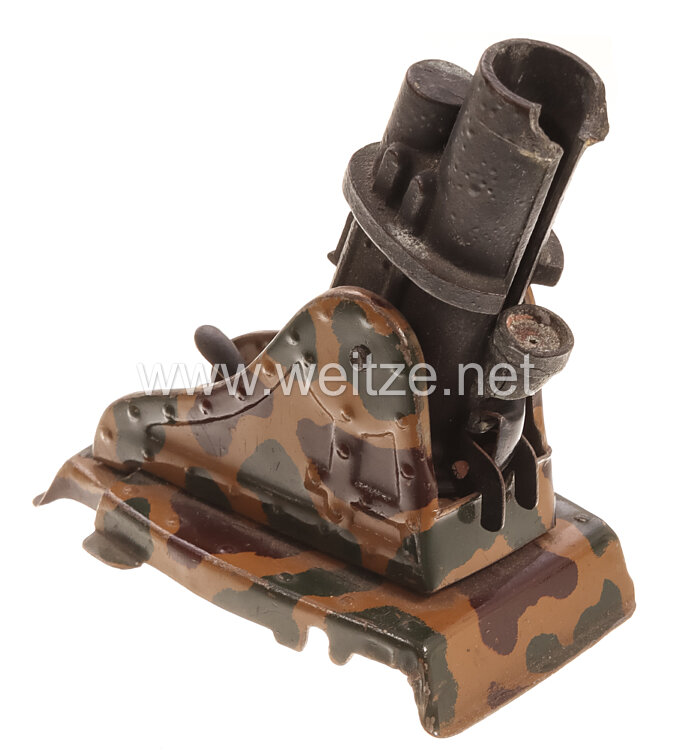
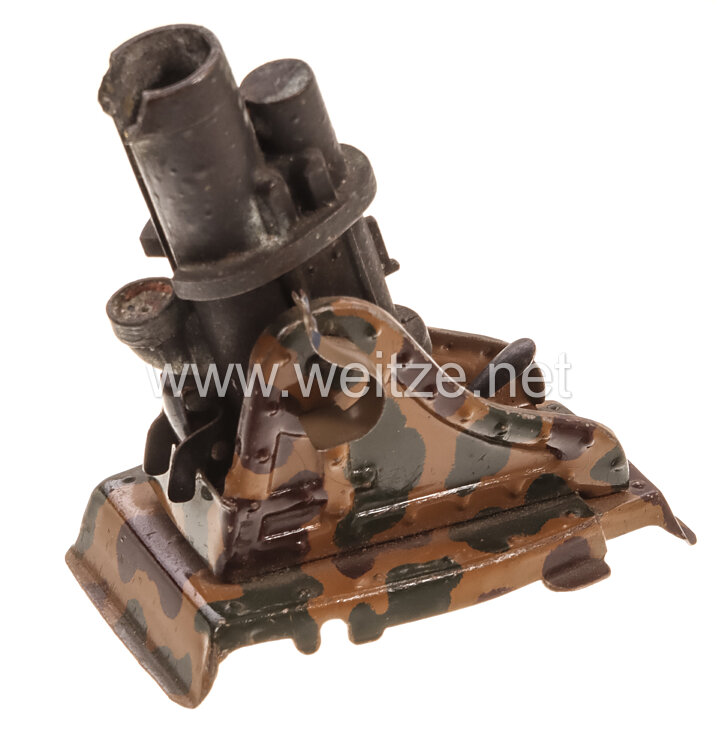
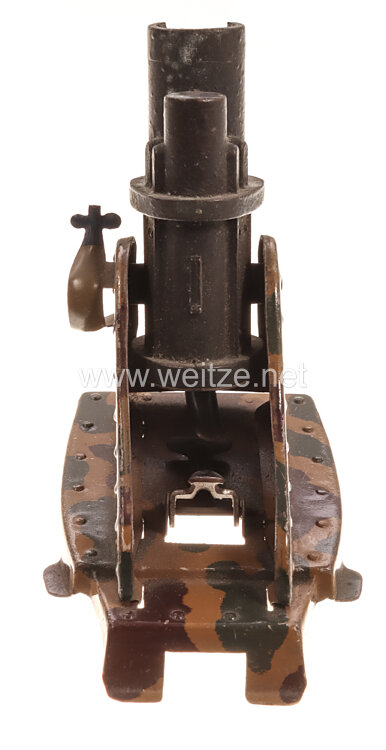
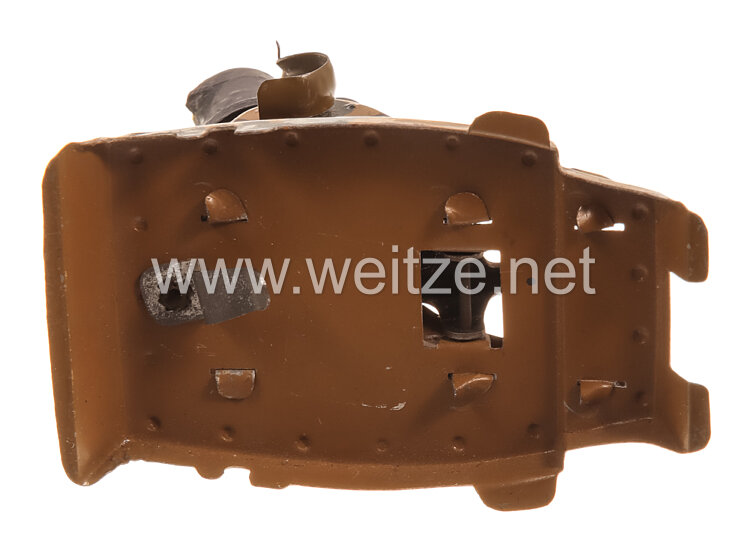
Tin Toy - Army Grenade Mortar

Length: 8.0 cm, Width: 4.5 cm, Height: 8.5 cm, Condition 3
456692
80,00

Tin Toy - Army Grenade Mortar

This tin toy mortar of the Wehrmacht represents a fascinating category of military toys produced during the National Socialist era in Germany. With its compact dimensions of 8.0 cm length, 4.5 cm width, and 8.5 cm height, this object embodies the typical manufacturing techniques of the German toy industry of the 1930s and early 1940s.

Historical Context of Military Toy Production

The manufacture of military toys had a long tradition in Germany dating back to the 19th century. Centers of tin toy production were located in Nuremberg, Fürth, and the Thuringian region. Companies such as Lineol, Elastolin, Hausser, and various smaller manufacturers specialized in producing military toys. After the Nazi seizure of power in 1933, the production of military toys acquired particular ideological significance.

The Nazi regime actively promoted the production of war toys as part of its pre-military education of youth. Toy mortars, tanks, soldier figures, and other military miniature models were intended to familiarize children early with military equipment and foster a positive attitude toward the military. These toys were not only sold in retail stores but also distributed through organizations like the Hitler Youth and the Deutsches Jungvolk.

The Mortar as Military Model

The depicted mortar is based on actual weapon systems of the Wehrmacht. The German army employed various mortars during World War II, including the light 5 cm Granatwerfer 36, the medium 8 cm Granatwerfer 34, and the heavy 12 cm Granatwerfer 42. These indirect fire weapons were important infantry support arms and were deployed on all theaters of war.

Mortars were particularly effective in trench warfare and for engaging targets behind cover due to their high rate of fire, steep trajectory, and relative mobility. The toy versions naturally simplified technical details but retained the characteristic shape with the barrel, baseplate, and bipod mount.

Manufacturing Technique and Materials

Tin toy production utilized lithography and stamping processes. Thin sheet steel was first printed, often with camouflage patterns or in field gray, the characteristic color of the Wehrmacht. Subsequently, the parts were die-cut, stamped, and riveted or soldered together. This manufacturing method enabled cost-effective mass production while maintaining relatively accurate representation.

During the war, however, material shortages increasingly occurred. Metals were needed for armaments production, which severely restricted toy manufacturing from about 1942 onward. Many manufacturers had to cease production entirely or switch to substitute materials such as wood or composition (sawdust-glue mixtures).

Collector Value and Condition

The stated Condition 3 corresponds in collector terminology to a medium state of preservation. The object likely shows signs of use, possibly paint chips, slight rust or oxidation traces, and perhaps minor deformations. Nevertheless, all essential parts are present and the basic structure remains intact.

Military toys from the Nazi era are collected today from various perspectives: as cultural-historical evidence of the propaganda and educational methods of the Third Reich, as examples of toy industry history, or within the context of military historical collections. The scholarly and museum approach to such objects requires critical contextualization that considers both the craftsmanship quality and the problematic ideological dimension.

Propaganda and Education

The production and distribution of military toys was part of a comprehensive system of militarization of society. Children's play was not viewed as politically neutral but as an opportunity to instill specific values and attitudes. The Reich Youth Leadership issued recommendations for “valuable” toys, which included military models. Contemporary pedagogical literature emphasized that such toys would prepare boys for their future role as soldiers.

Trade journals and catalogs from the period show the wide range of military toys available. Besides mortars, there were entire sets of artillery pieces, fortifications, aircraft, and warships. These toys were often remarkably detailed and reflected current developments in military technology.

Conclusion

This tin toy mortar is more than just a historical children's toy. It documents the penetration of everyday life with military ideology in National Socialist Germany and demonstrates how children were systematically introduced to military equipment. As a historical object, it offers important insights into the mechanisms of Nazi propaganda and the omnipresence of military symbolism in society at that time.