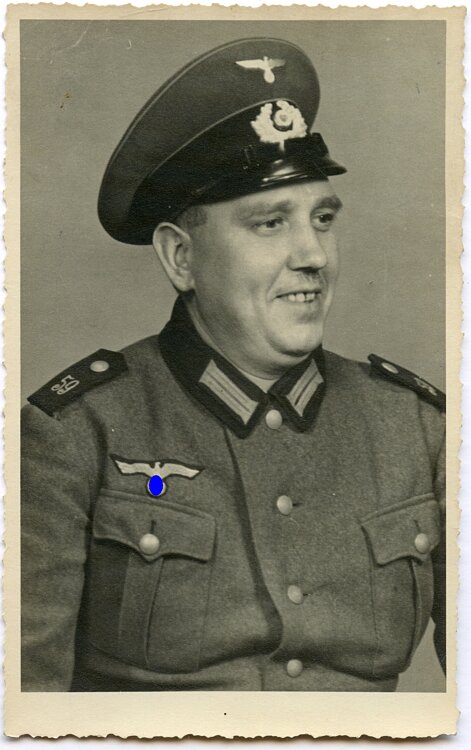
Portrait Photograph of a Wehrmacht Member with Visor Cap

Postcard size, 59, condition 2.
185291
10,00

Portrait Photograph of a Wehrmacht Member with Visor Cap

This object is a portrait photograph of a Wehrmacht member in postcard format, showing a soldier wearing a peaked cap (Schirmmütze). Such photographic documents held immense personal and military significance during World War II (1939-1945) and represent important historical sources today.

The Wehrmacht peaked cap was an essential component of the German military uniform, varying in details such as piping, cockade, and eagle emblem depending on the branch of service. The Army (Heer) uniform typically displayed white piping, while the Air Force (Luftwaffe) featured golden-yellow and the Navy (Kriegsmarine) used golden-yellow or white decorations. The peaked cap was worn according to military service regulations (Heeresdienstvorschrift) and the dress code for the army, and was considered a symbol of military dignity and discipline.

Portrait photographs in postcard format were extraordinarily popular during the Wehrmacht era. Soldiers frequently had themselves photographed in photo studios or by military photographers to send these images to family members, fiancées, or wives. The postcard format (approximately 9 x 14 cm) was standardized and allowed easy mailing through the field post (Feldpost). Personal messages could be written on the back, making these photographs an important means of communication between the front and home.

The photographic representation in uniform with peaked cap followed certain conventions. Soldiers typically presented themselves in immaculate dress uniform, often with visible rank insignia, medals, and decorations. The peaked cap was worn correctly positioned, demonstrating military discipline and pride in one's affiliation with the Wehrmacht. These photos served not only for personal remembrance but also for self-presentation and maintaining morale.

Photography in the Third Reich was strictly regulated. The Reich Ministry of Public Enlightenment and Propaganda under Joseph Goebbels controlled image production and distribution. While private portrait photographs were less censored than front-line shots, they too were subject to certain restrictions. Photographs showing military weakness or defeats were undesirable.

The condition rating of 2 for this photograph indicates a well-preserved state with possibly minor signs of use. Many of these historical photographs have survived the decades in family albums, estates, or collections. Their preservation is of great importance for historical research, as they offer authentic insights into uniforming, military culture, and the personal fates of soldiers.

From a military-historical perspective, such portrait photographs are valuable sources for researching Wehrmacht uniforms, military hierarchy, and social structures within the armed forces. They document the various ranks, service branches, and temporal developments in uniform design. For genealogists and historians, they can provide clues about units, deployment locations, and individual life stories.

The scholarly evaluation of such objects requires a critical and contextualized approach. These photographs are testimonies of a criminal dictatorship and a war of aggression that cost millions of lives. Their viewing must always consider the historical crimes of the Wehrmacht and the Nazi regime. At the same time, they document individual fates and the lived reality of an entire generation.

Today, such photographs are found in museums, archives, private collections, and in the antiques trade. They serve historical education, scholarly research, and memorial culture. Their preservation and contextualized presentation contribute to understanding this dark epoch of German history.