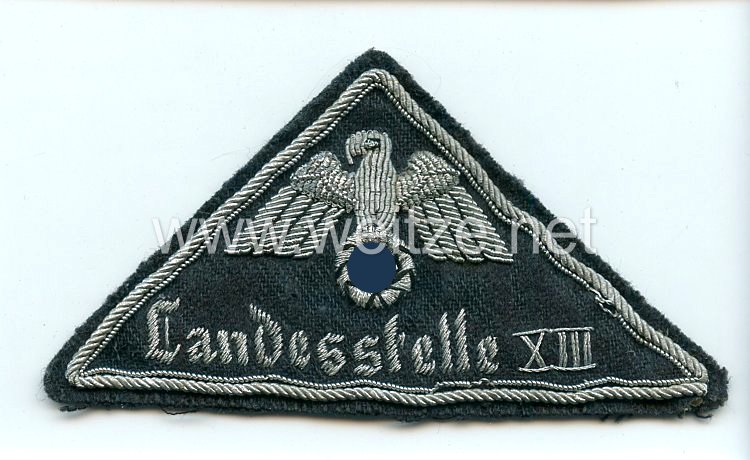
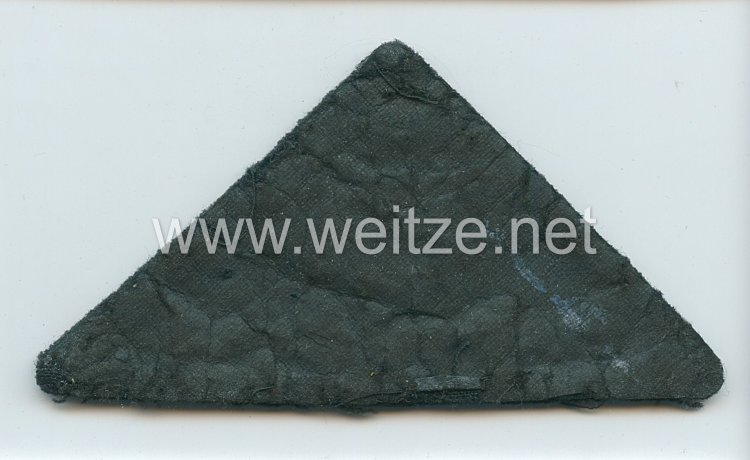
German Red Cross (DRK) Sleeve Eagle for Führer - Landesstelle XIII
The German Red Cross (DRK) sleeve eagle for leaders of Regional Office XIII represents a significant example of paramilitary uniform insignia from the National Socialist era. This particular badge was crafted in high-quality hand-embroidered metal thread, indicating its status as a leader's insignia.
The German Red Cross underwent fundamental restructuring and coordination after the Nazi seizure of power in 1933. Through the DRK Law of December 9, 1937, the organization was fully integrated into the National Socialist state and placed under the Reich Ministry of the Interior. Reich Medical Leader Dr. Gerhard Wagner initially assumed the presidency, followed after his death in 1939 by Reich Physician SS Ernst-Robert Grawitz.
The organizational structure of the DRK was divided into Regional Offices (Landesstellen) corresponding to the administrative districts of the time. Regional Office XIII encompassed the territory of Württemberg-Hohenzollern with headquarters in Stuttgart. Each Regional Office had its own administration and leadership structure, with the leaders of these units wearing special rank insignia.
The sleeve eagle was an essential identifying feature on DRK uniforms. Unlike the simpler, machine-made or printed versions for lower ranks, leader insignia were distinguished by their elaborate handwork. The metal thread embroidery typically used aluminum threads on a dark blue base fabric, creating distinct contrast and a representative appearance.
DRK uniform regulations were detailed in several service instructions. The Service Clothing Regulations of April 1, 1938, established uniform rules for the first time regarding the wearing and design of all insignia. The eagle was worn on the left upper sleeve, with the position precisely prescribed. For leaders above certain ranks, the high-quality hand-embroidered version was mandatory.
The production of such insignia was carried out by specialized companies holding state licenses. Well-known manufacturers included factories in Wuppertal, Berlin, and Munich. The quality of embroidery and materials used varied by manufacturer, with metal thread versions being among the highest quality variants.
The eagle's design corresponded to National Socialist iconography: a left-facing eagle with spread wings, holding a swastika in its talons. For the DRK, however, this eagle was specifically designed for the organization and differed in details from Wehrmacht or Party insignia.
The role of the DRK during World War II was complex. Officially operating as a humanitarian organization, it was deeply embedded in the structures of the NS regime. The leaders of the Regional Offices were responsible for organizing medical services, ambulance transport, and care for the wounded. They also coordinated the training of nursing assistants and other medical personnel.
After the war's end in 1945, all insignia with National Socialist symbolism were banned. The DRK was refounded in the western occupation zones and freed from all NS elements. In the Soviet occupation zone, the German Red Cross of the GDR emerged as a separate organization.
Today, such historical insignia are collector's items whose possession in Germany is legal, provided they are not publicly used to glorify National Socialism. They serve as material witnesses to a dark period in German history and the instrumentalization of humanitarian organizations by the NS regime.
The condition designation “2” corresponds in collector's nomenclature to a very good to good state of preservation, in which the object shows only minor signs of use. For hand-embroidered metal thread insignia, this means that the embroidery is largely intact, the threads have retained their luster, and the base fabric has no major damage.