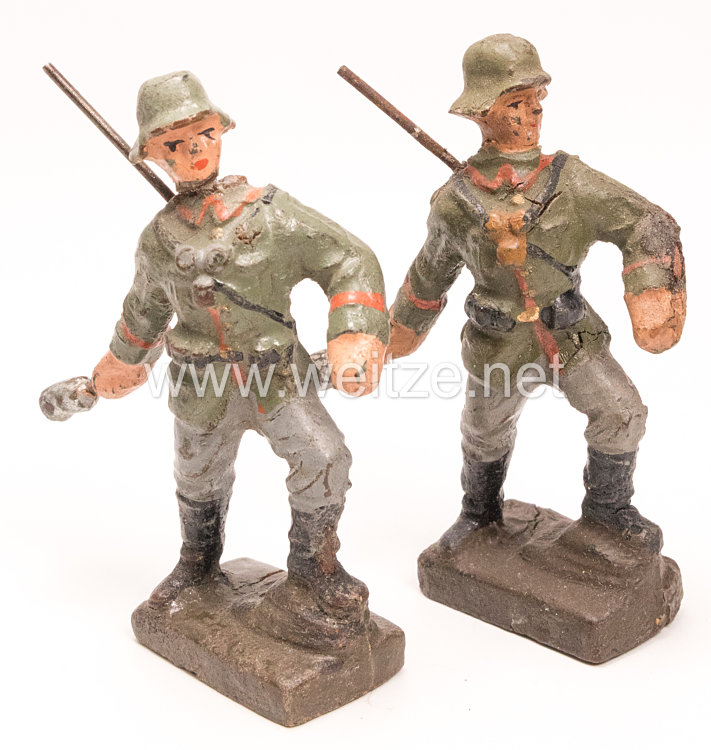
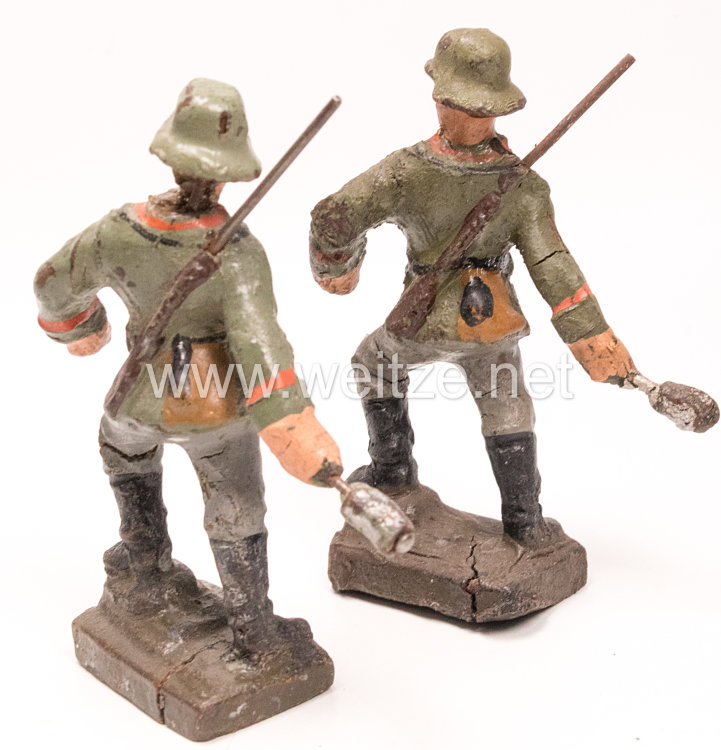
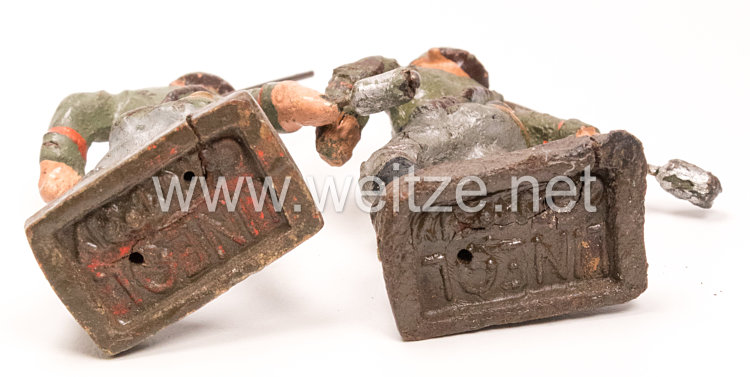
Lineol - Army 2 Soldiers Throwing Hand Grenade
Lineol Military Figures: Wehrmacht Soldiers Throwing Hand Grenades
The described Lineol figures represent two soldiers of the German Wehrmacht depicted in the characteristic throwing motion of hand grenade deployment. Standing 6.5 centimeters tall, these figures belong to the classic composition figures that the Nuremberg-based company Lineol (officially: Lineol GmbH) manufactured between the 1930s and 1940s.
The Lineol Company and Its History
Lineol was founded in 1906 by Oskar Wiederholt in Brandenburg an der Havel and later relocated to Nuremberg. The name “Lineol” derives from “Linie” (line) and “Ol” (a shortened form or fantasy name). Lineol developed into one of Germany's most significant toy figure manufacturers, competing directly with the company Elastolin (Hausser). Both firms used a similar composition material made from casein, chalk, kaolin, glue, and other binding agents, which was modeled onto wire armatures and subsequently hand-painted.
During the 1930s, throughout the National Socialist period, Lineol produced extensive series of Wehrmacht soldiers representing various military branches and combat actions. These figures served not merely as toys but also as instruments for militarizing youth and promoting military ideals.
Hand Grenades in World War II
The depicted throwing motion refers to the deployment of hand grenades, which played an important role in the German Army. The most famous German hand grenade was the Stielhandgranate 24 (M24), colloquially known as the “potato masher.” Developed from 1924 onward, it remained in service throughout World War II. With its characteristic wooden handle approximately 40 centimeters long and an explosive head, it differed markedly from the more compact Allied hand grenades.
Training in hand grenade throwing constituted an essential component of basic military training. Soldiers had to learn to throw the grenade at a specific angle to achieve maximum range and effectiveness. The average throwing distance was approximately 30 to 40 meters. The fuse had a burning time of about 4.5 seconds.
Collector Aspects and Condition
The designation “Condition 2” in the object description corresponds to the standard collector grading for Lineol figures. In collector terminology, this indicates a very good to good state of preservation with possibly minor signs of use but without significant damage. The original paint should be largely intact, with slight wear being acceptable.
Lineol figures from the pre-war and wartime periods are sought-after collector's items today. Their quality often surpassed the competition through finer modeling and more detailed painting. The figures were produced in various series, with Army figures forming the largest group. Besides the Wehrmacht, figures of other service branches such as the Luftwaffe and Navy were also manufactured.
Historical Context and Cultural Significance
These toy figures document a problematic aspect of German history. They reflect the militarization of society and demonstrate how military values were instilled from childhood. Simultaneously, they are important contemporary historical documents providing insights into uniforms, equipment, and tactical representations of that era.
After World War II, Lineol production was initially discontinued. Later, manufacturing resumed under changed conditions, with no more Wehrmacht military figures being produced. Today, Lineol figures are regarded as historical collectibles and serve scientific and museum documentation of this epoch.
For collectors and historians, these figures offer valuable insights into the material culture of the 1930s and 1940s, as well as into the representation of military scenes in the popular culture of that time.