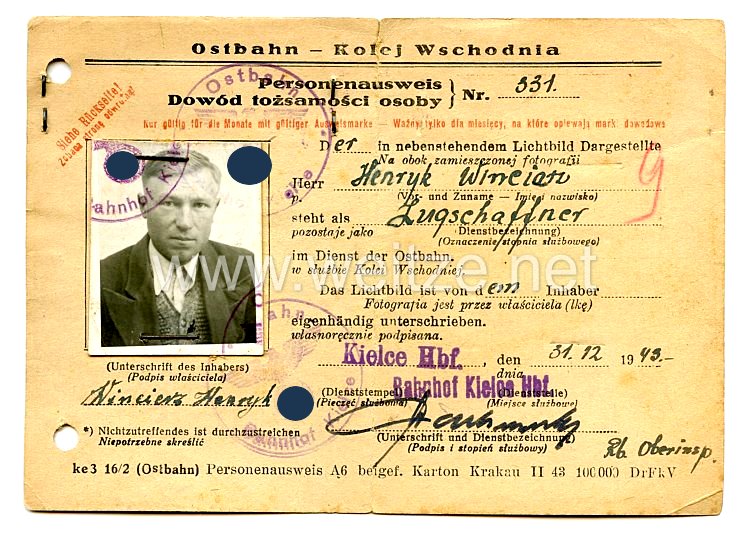
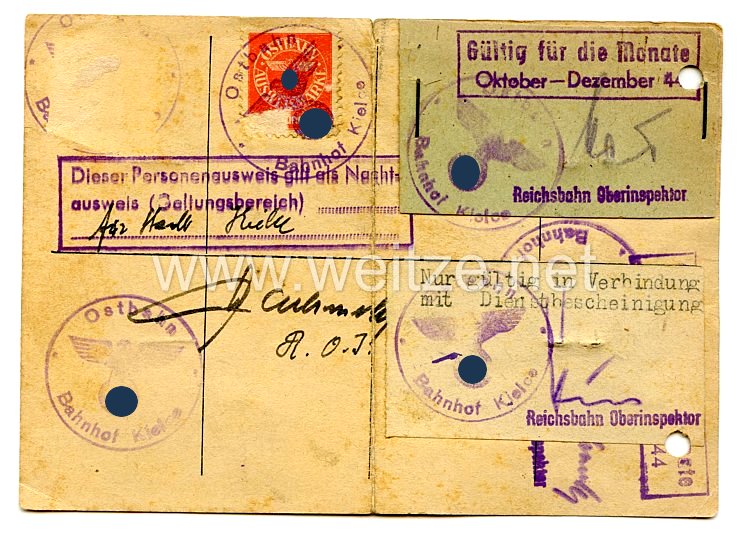
Third Reich - Ostbahn - Kolej Wschodnia Personnel Identity Card for a Man
This Ostbahn (Kolej Wschodnia) personal identification card from the Third Reich represents a significant artifact of German occupation administration in occupied Poland during World War II. The document was issued on December 31, 1943, in Kielce and served as an official identification for a man employed as a train conductor.
The Ostbahn, officially designated as the General Directorate of the Eastern Railway (Gedob), was the German railway administration established after the occupation of Poland in 1939. It assumed control over the Polish railway network in the General Government and the incorporated eastern territories. The Ostbahn played a central role in the German occupation infrastructure and was responsible for military supply, freight transport, and tragically, also for deportations as part of the Holocaust.
The bilingual design of the identification card in German and Polish reflects the administrative practices of the German occupation authorities. While German dominated as the official language, the parallel Polish inscription was necessary because a large portion of railway personnel was recruited from the local Polish population. The German occupation forces depended on the cooperation of Polish specialists to maintain railway operations.
The place of issue, Kielce, was an important city in the General Government and was located on major railway connections. The city served as a transportation hub and had strategic importance for German warfare on the Eastern Front. Kielce Station, whose stamp appears on the document, was an important transit station for military and civilian transports.
The function of train conductor in the hierarchy of railway administration carried considerable responsibility. Train conductors were responsible for the safe execution of train journeys, supervision of personnel, and adherence to schedules. In the wartime context of 1943, this also meant participation in a transport system that served both military and criminal purposes.
The issue date of December 31, 1943 falls during a critical phase of World War II. At this time, the Wehrmacht had already suffered severe setbacks on the Eastern Front, particularly the defeat at Stalingrad in early 1943. The importance of railway logistics for German warfare had increased immensely, as it represented the only reliable means of transporting troops, weapons, and supplies.
The administrative structure of the Ostbahn was tightly organized and militarily oriented. It reported directly to the Reich Ministry of Transport and worked closely with the Wehrmacht. The General Directorate was headquartered in Kraków and administered a network of over 6,000 kilometers of railway lines. The organization was divided into several directorates, each responsible for different geographical areas.
Identification cards of this type were essential for the identification and legitimization of railway employees. They provided access to railway stations, trains, and other railway facilities that were under strict guard. The documents typically contained personal information, a photograph, job designation, and the issuing authority.
Working conditions for Polish personnel under German administration were often precarious. Although they were indispensable for maintaining operations, Polish railway workers were subject to discriminatory regulations and received lower wages than their German colleagues. At the same time, they were under constant surveillance pressure, as the occupation forces feared sabotage acts and resistance activities.
The Polish resistance did indeed conduct numerous operations against railway infrastructure. The Armia Krajowa (Home Army) and other underground organizations regularly sabotaged tracks, bridges, and trains to hinder German supply lines. This made work in railway service dangerous and politically delicate.
Documents like this personal identification card provide valuable insights into occupation administration and the everyday structures of German rule in Poland. They document collaboration, economic exploitation, and the complex reality of life under occupation.