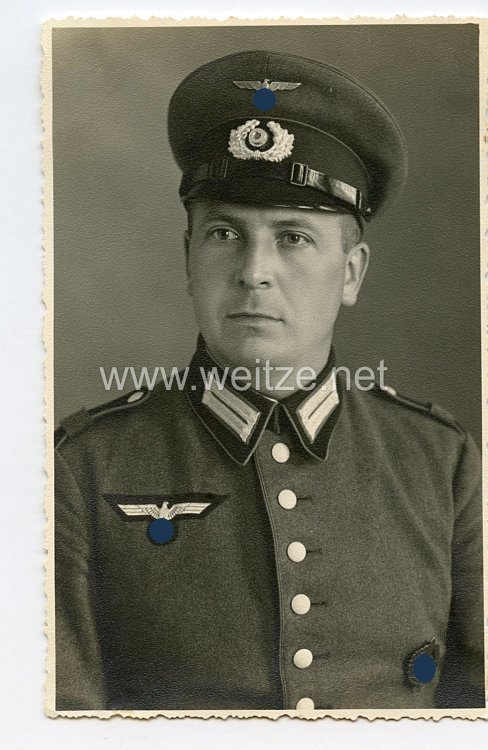
Wehrmacht Heer Portrait Photograph, Soldier wearing Waffenrock Tunic with SA Sports Badge

Postcard size, condition 2.
403589
10,00

Wehrmacht Heer Portrait Photograph, Soldier wearing Waffenrock Tunic with SA Sports Badge

This portrait photograph depicts a soldier of the Wehrmacht Heer (German Army) wearing a Waffenrock, a traditional dress uniform tunic that held special significance in the military dress regulations of the Third Reich. Of particular interest is the visible SA Sports Badge (SA-Wehrsportabzeichen), which reflects the complex relationship between the Sturmabteilung (SA) and the Wehrmacht.

The Waffenrock was the walking-out dress uniform of the Wehrmacht and differed significantly from the field-gray field blouse worn during daily service and combat operations. The Waffenrock for enlisted men and non-commissioned officers was typically dark green (field-gray) with a high stand-up collar and featured shoulder straps indicating the wearer's branch of service and rank. This uniform was primarily worn for official occasions, parades, and portrait photographs, as in the present case.

The SA Sports Badge was established on November 8, 1933, by SA Chief of Staff Ernst Röhm. It was available in bronze and silver grades and was awarded for athletic performance in paramilitary exercises. The requirements for earning the badge included various disciplines such as cross-country marches, shooting exercises, hand grenade throwing, and other physical training activities. The badge was intended to document and promote the paramilitary training of SA members.

After the Röhm Crisis of 1934 and the so-called “Night of the Long Knives,” the position of the SA changed fundamentally. The Wehrmacht, which had previously viewed the SA as a potential rival, was declared the sole bearer of arms for the nation. Nevertheless, the SA Sports Badge continued to exist and could still be worn by Wehrmacht members, provided they had earned it before their military service or during SA membership.

The authorization to wear SA badges on Wehrmacht uniforms was regulated by various dress regulations. The Army Regulations Gazette (Heeresverordnungsblatt) and corresponding service regulations specified which awards and badges could be worn, in what form, and at which location on the uniform. The SA Sports Badge was worn on the right breast, below the breast pocket.

Photographs like the present one were extremely popular in the Third Reich. Soldiers frequently had themselves photographed in photo studios wearing their best uniform to send these images to family and relatives. The postcard format was particularly widespread, as it was ideal for mailing and could be kept in family albums. These photographs served not only as personal mementos but also as self-presentation and demonstration of pride in military service.

The combination of Waffenrock and SA Sports Badge in a photograph suggests that the depicted soldier was likely a member of the SA or participated in its sports competitions before being called up to the Wehrmacht. In the 1930s, the SA was a mass organization with millions of members, and many young men underwent its paramilitary training before being conscripted for regular military service.

The preservation of such photographs in condition 2 (good to very good) is remarkable, as many of these private documents were lost due to war damage, flight, or deliberate destruction after 1945. Today, these photographs are important sources for contemporary history, providing insight into uniform studies, badge practices, and the social history of the Wehrmacht.

From a military-historical perspective, such photographs document the strict hierarchy and pronounced honor system of the Wehrmacht. Every detail of the uniform, every badge and decoration had a precise meaning and had to be worn according to exact regulations. The careful presentation in photographs reflects the self-image and esprit de corps of that era.

For collectors and historians, such photographs are valuable study objects that help reconstruct uniform variants, badge wearing practices, and the development of military dress regulations. They complement written sources and enable a differentiated understanding of military everyday culture in the Third Reich.

r