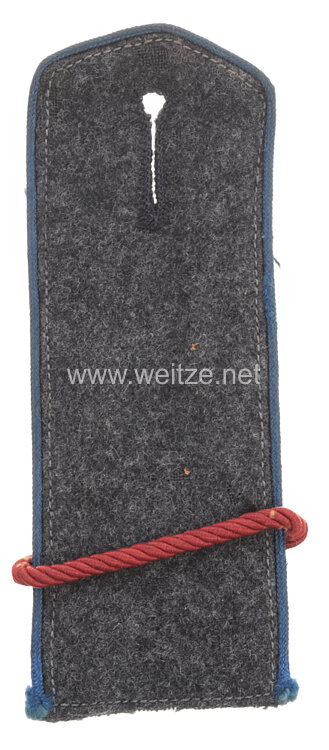
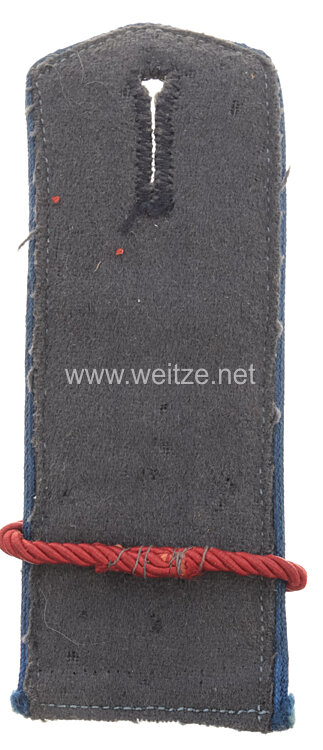
DLV Deutscher Luftsport Verband: Single Shoulder Strap for Enlisted Men
The shoulder strap of the Deutscher Luftsport Verband (DLV - German Air Sports Association) for enlisted ranks from around 1934/35 represents a significant chapter in the history of German aviation and paramilitary organizations of the interwar period. This single shoulder strap made of heavy cloth without metal fittings is a rare testimony to a transitional period when Germany was rebuilding its military aviation under the guise of civilian organizations.
The Deutscher Luftsport Verband was officially founded on March 25, 1933, immediately following the Nazi seizure of power. The organization emerged from the merger of various German air sports associations and served as a cover organization for the secret training of aircraft crews and ground personnel. The Treaty of Versailles of 1919 had strictly prohibited Germany from possessing a military air force, which is why the National Socialists used civilian air sports as a cover to train a new generation of air force personnel.
The DLV's uniform system was based on military models but deliberately used civilian designations and design elements. The shoulder straps for enlisted ranks were typically made of heavy, dark blue cloth and bore no metal fittings or rank insignia. This clearly distinguished them from the shoulder straps of higher ranks, which were often adorned with metal braids, buttons, or other rank indicators. The simple design of the enlisted ranks' shoulder straps reflected the hierarchical structure of the organization and marked the wearer as a simple member without leadership position.
The period around 1934/35 was particularly significant for the DLV. During this phase, the organization expanded rapidly and consolidated its structures. Under the leadership of Hermann Göring, who was already Reich Minister of Aviation, the DLV served as an important recruitment and training instrument. The organization operated glider schools, powered flight training facilities, and theoretical courses, all of which served the later integration into the newly established Luftwaffe.
However, the DLV's existence as a separate organization was temporally limited. With the official announcement of the Luftwaffe on March 1, 1935, the DLV increasingly lost its importance as a cover organization. Many of its functions, particularly in the area of military training, were taken over directly by the new Luftwaffe. Although the DLV formally continued to exist until 1937, it then focused more on civilian air sports and pre-military youth training.
The material quality of the shoulder straps varied depending on the time of manufacture and availability. The heavy cloth from which this shoulder strap was made was characteristic of the organization's early years, when there was no shortage of materials. Manufacturing was usually carried out by specialized uniform tailors working according to prescribed guidelines. Attachment to the uniform typically occurred by sewing or by means of buttons.
As a single piece, this shoulder strap is particularly noteworthy, as shoulder straps were normally worn in pairs. The loss of one shoulder strap during wear was not uncommon, especially during practical activities in flight operations or training exercises. The survival of individual shoulder straps to the present day makes them valuable historical artifacts for collectors and museums.
The rarity of such DLV equipment items from the early period is explained by several factors. First, the active phase of the DLV as a relevant organization was relatively short. Second, many uniform parts were destroyed or disposed of after 1945. Third, parts of the DLV equipment were often transferred to other uses or recycled for textiles, especially in the material-scarce war and post-war years.
Today, such objects serve as important study items for researching German aviation history and the rearmament policy of the 1930s. They document the systematic circumvention of the Versailles Treaty provisions and the preparation for the coming war. For military historical research, they provide insights into organizational structures, uniform regulations, and the material culture of paramilitary associations in the interwar period.