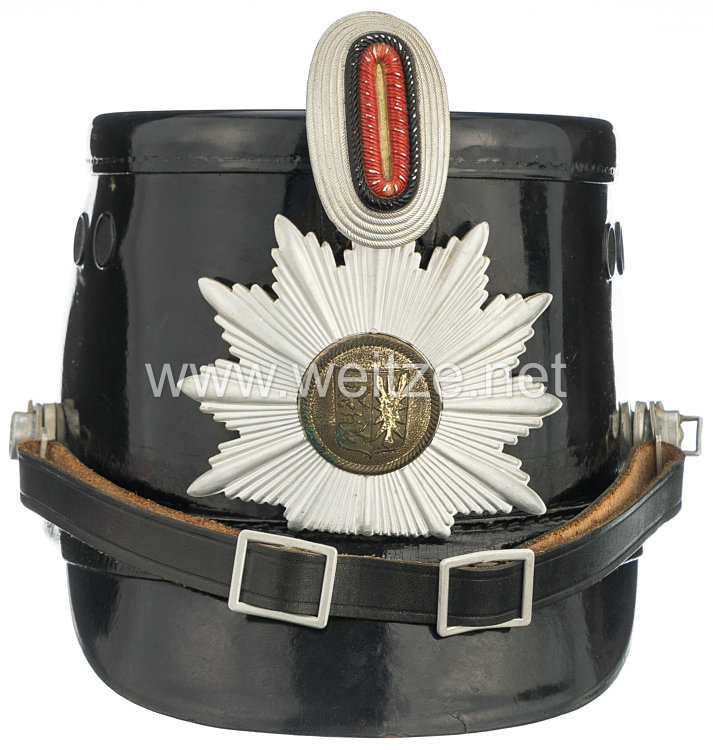
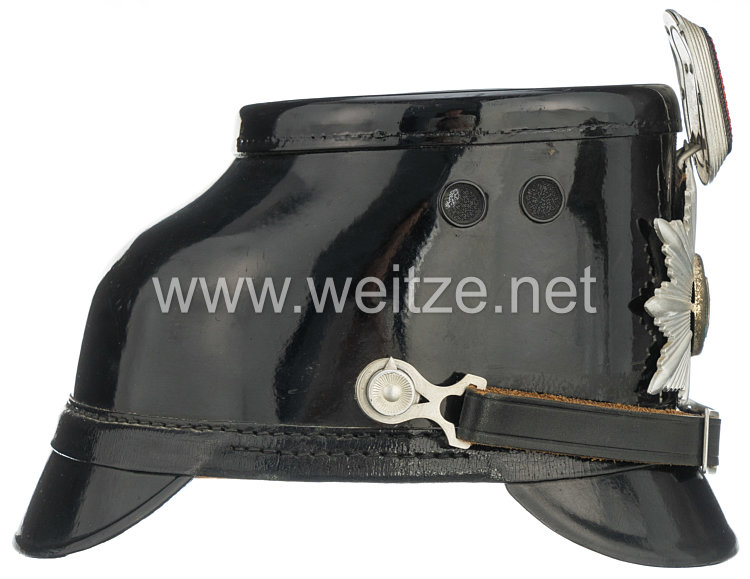
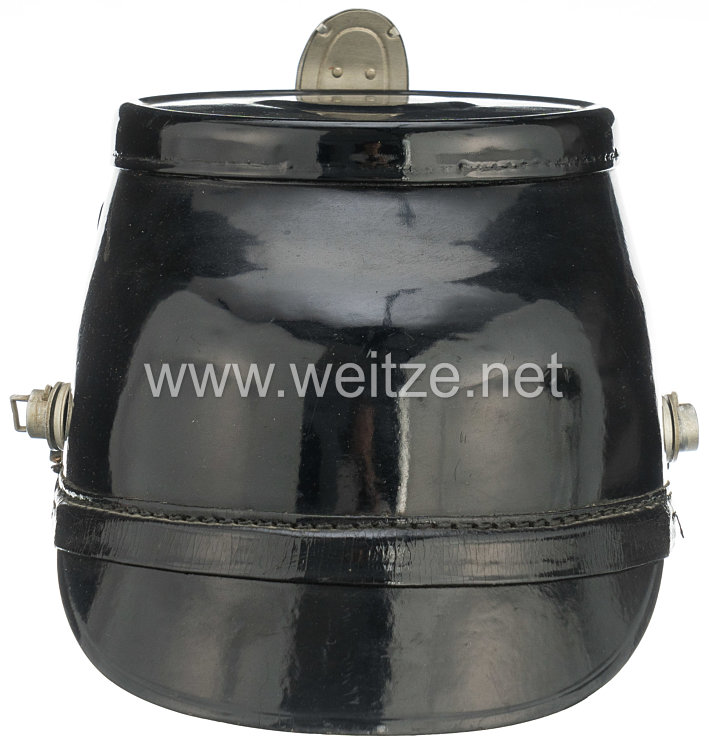
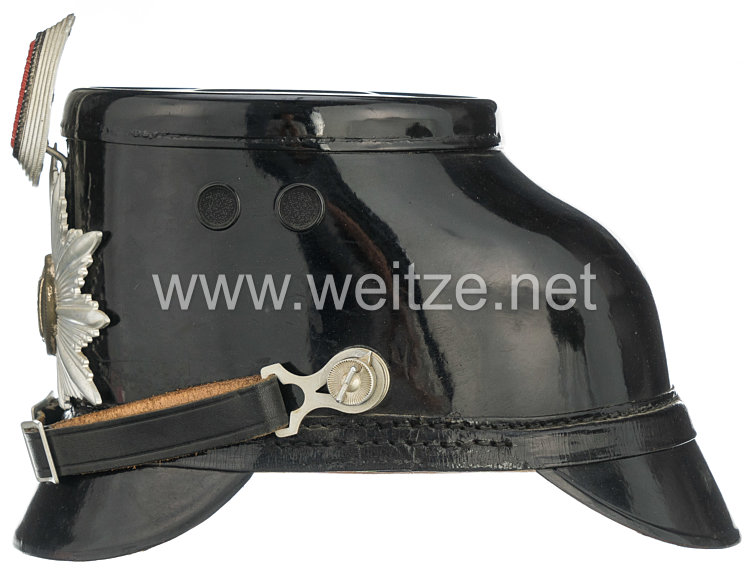
Federal Republic of Germany (FRG) Police Shako for Enlisted Men, State of Schleswig Holstein
The police shako from Schleswig-Holstein dating from the mid-1950s represents an important transitional period in the history of German police uniforms after World War II. This headgear for enlisted personnel of the Schleswig-Holstein state police documents the efforts of the young Federal Republic of Germany to establish a new police identity that both connected to traditional German police traditions and clearly distanced itself from the National Socialist past.
Historical Context of the Post-War Period
Following Germany's unconditional surrender in May 1945, the Allied occupation powers assumed complete control over German territory. Police authority initially rested with the military governments of the four occupation zones. In the British occupation zone, which included Schleswig-Holstein, the gradual reconstruction of German police forces under British supervision began as early as 1945. The British Military Government placed particular emphasis on decentralizing police structures and avoiding any paramilitary elements.
With the founding of the Federal Republic of Germany on May 23, 1949, and the young republic's increasing sovereignty, the federal states received police authority. Schleswig-Holstein, Germany's northernmost state, was among the first states to develop an independent uniform concept for its state police, oriented toward democratic principles and community-oriented policing.
The Shako as a Traditional Element
The choice of the shako as police headgear was not a random decision. The shako, originally a military headgear of Hungarian origin, had a long tradition in Germany's police and military forces since the early 19th century. Unlike the peaked caps used during the National Socialist era, the shako symbolized a return to civilian police traditions of the 19th and early 20th centuries. The Prussian protection police had already worn shakos during the Weimar Republic, making this headgear a symbol of constitutional, civilian policing.
Material and Manufacturing
The described shako was manufactured from vulcanized fiber, a pressed, hardened paper material treated with zinc chloride. This material was particularly popular in the post-war period as it was inexpensive, lightweight, yet dimensionally stable. During the economically difficult years of reconstruction, vulcanized fiber represented a practical alternative to more expensive materials such as leather or metal. The black color corresponded to the traditional coloring of German police uniforms and was intended to convey authority and seriousness.
Symbolism and Insignia
The silver-colored police star on the front of the shako was the central identifying symbol of the German police in the post-war period. This symbol was deliberately chosen to establish continuity with democratic police traditions while clearly distinguishing itself from National Socialist symbols. At the center of the star was the coat of arms of Schleswig-Holstein, showing the two Schleswig lions and the Holstein nettle leaf. This combination of federal symbol and state coat of arms illustrated the federal structure of the Federal Republic.
Wearing and Function
The leather chin strap, attached to buttons, served to secure the headgear in wind and weather as well as during physical activity. The lacquered cockade on the shako was another traditional element that traced back to Prussian and German police traditions. The internally lined interior provided wearing comfort and helped absorb perspiration.
Uniform Reforms of the 1950s
The wearing period around 1955 falls during a phase of intense discussions about modernizing police uniforms in the Federal Republic. While some federal states maintained the traditional shako, others were already beginning to switch to modern peaked caps. The shako was increasingly seen as impractical and outdated, especially for daily patrol duty. Nevertheless, it remained in use in many federal states until the 1960s for parades and official occasions.
Significance for Police History
This shako from Schleswig-Holstein stands as an example of the challenges faced by the young Federal Republic in developing a new state identity. The police played a key role in this process, as they represented the most visible symbol of state authority in citizens' daily lives. The choice of uniforms had to perform a difficult balancing act: on the one hand, it should connect to democratic traditions; on the other hand, a clear distance from the Nazi dictatorship had to be recognizable. The shako with its traditional elements and emphasis on regional identity through the Schleswig-Holstein coat of arms embodies this compromise.
Today, these early police shakos of the Federal Republic are important contemporary historical documents that provide insight into uniform history and the political symbolism of the post-war period.