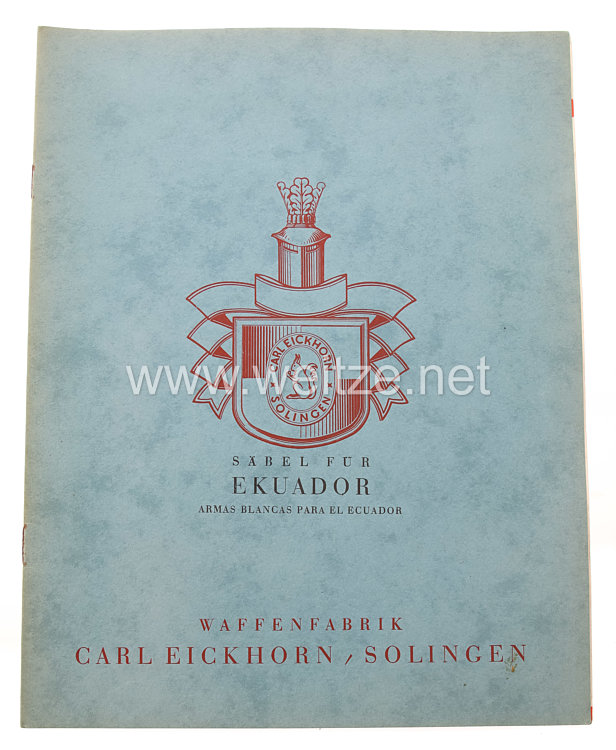
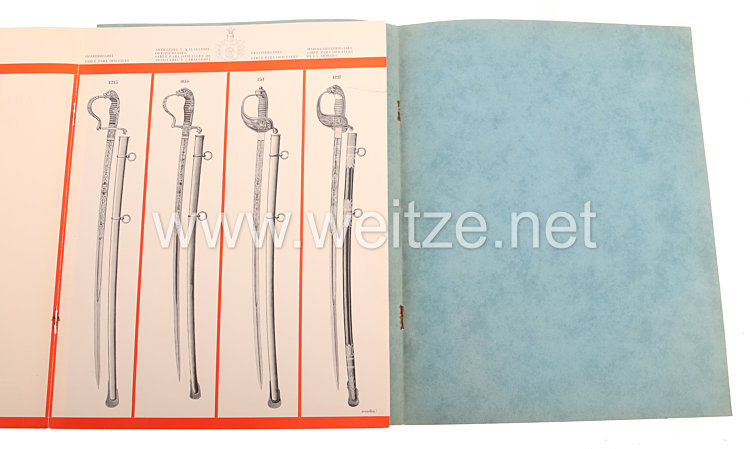
Third Reich Carl Eickhorn Solingen Original Sales Brochure “Sabers for Ecuador”

circa 1931. Sales folding brochure depicting the available edged weapons. Condition 2.
424888
70,00

Third Reich Carl Eickhorn Solingen Original Sales Brochure “Sabers for Ecuador”

The Carl Eickhorn company of Solingen was among the most significant manufacturers of edged weapons in the German Reich and enjoyed international recognition for its high-quality military swords and daggers. This sales brochure for sabers for Ecuador from around 1931 represents a remarkable testimony to the German arms export industry during the interwar period.

Carl Eickhorn was founded in 1865 in Solingen and quickly developed into one of the leading producers of edged weapons for military and civilian purposes. Solingen, also known as the “City of Blades,” had been the center of the German cutlery industry for centuries. The Eickhorn company not only supplied the German armed forces but exported its products worldwide. Its customers included numerous foreign governments and military administrations in Europe, Latin America, Asia, and Africa.

During the 1920s and early 1930s, Germany found itself in a politically and economically difficult situation. The Treaty of Versailles of 1919 had imposed strict restrictions on the German armaments industry. The production of war materials for domestic use was heavily regulated, which meant that many German weapons manufacturers were increasingly dependent on export markets. This led to intensive business relationships with Latin American countries that sought to modernize their armed forces and often preferred German quality products.

Ecuador had maintained close military relations with European countries, particularly Germany, since the 19th century. The Ecuadorian army modeled its organization, training, and equipment strongly on the Prussian-German example. German military advisors were sent to Ecuador, and Ecuadorian officers frequently completed their training in Germany. These connections led to extensive weapons deliveries, including edged weapons for officers and non-commissioned officers of the Ecuadorian armed forces.

Sales brochures and pamphlets like this document were important marketing tools for weapons manufacturers. They were distributed to foreign military attachés, procurement commissions, and government representatives. Such sales catalogs typically contained detailed illustrations of available models, technical specifications, information about materials, decorations, and often price lists. They were professionally designed to demonstrate the high quality and variety of the product range.

The sabers for Ecuador offered in such brochures were specifically tailored to the requirements and regulations of the Ecuadorian armed forces. They included various models for different branches of service and ranks: officers' sabers for infantry, cavalry, and artillery, non-commissioned officers' sabers, and possibly also parade swords for higher officers. Each model followed Ecuador's specific uniform regulations and could feature national symbols such as the Ecuadorian coat of arms, national colors, or specific branch insignia.

The manufacturing quality of Eickhorn products was legendary. The blades were forged from high-quality Solingen steel, the fittings were often made of brass or silver-plated metal, and the grips were covered with snake leather, sharkskin, or other high-quality materials. The scabbards were typically made of sheet steel and equipped with leather covers or patent leather finishes. Many blades bore etchings with military motifs, mottoes, or the Eickhorn company name.

The year 1931 marks a significant period in Ecuador's history and in the international armaments industry. Ecuador was in a phase of military modernization, partly motivated by ongoing border disputes with Peru, which later escalated in the Ecuadorian-Peruvian War of 1941. The rearmament and re-equipment of the armed forces was therefore a priority of the Ecuadorian government.

Such sales documents are now rare items of considerable historical and collector value. They provide important insights into the business practices of the armaments industry, international trade relations, and the military equipment of various countries. For military historians and collectors of edged weapons, they are indispensable reference materials that help in identifying and dating original pieces. This example in condition 2 (very good) is particularly valuable, as many such papers have been lost over time or damaged through use.

The Eickhorn company itself continues to exist in modified form today and still produces high-quality knives and military equipment. Its historical products from the era of the Empire, the Weimar Republic, and the Third Reich are highly valued by collectors worldwide and document an important chapter of German industrial history and international military relations.