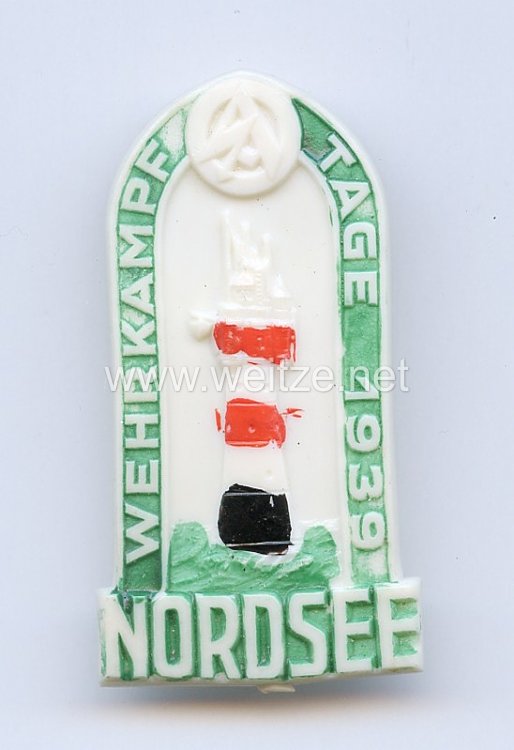
SA - Wehrkampftage 1939 North Sea - Bremen July 7-9, 1939
This badge documents the SA Wehrkampftage (SA Military Sports Competition Days) held from July 7-9, 1939 in the North Sea region centered in Bremen. This event was part of a comprehensive system of paramilitary competitions organized by the Sturmabteilung (SA) in the years before World War II.
The SA Wehrkampftage were athletic-military events regularly conducted from the mid-1930s onward. They served the purposes of physical training, paramilitary education, and ideological instruction of SA members. These competitions typically included disciplines such as cross-country marches, shooting exercises, hand grenade throwing, close combat, and other military skills. The events also had an important propaganda function and were meant to demonstrate the SA's military readiness and combat preparedness.
In the summer of 1939, just weeks before the beginning of World War II on September 1st, these military sports days took place in Bremen. The choice of Bremen as the venue underscores the importance of this port city for the National Socialist regime. The designation "Nordsee" (North Sea) in the title indicates the regional character of the event, which presumably involved SA units from northern Germany.
The badge itself is made of colored plastic, which was characteristic of this time period. From the second half of the 1930s, plastic (often referred to as "Bakelite" or similar materials at the time) was increasingly used for badges, as it was more cost-effective than metal processing and facilitated industrial mass production. This was particularly important for event badges that were produced in large quantities for participants and visitors.
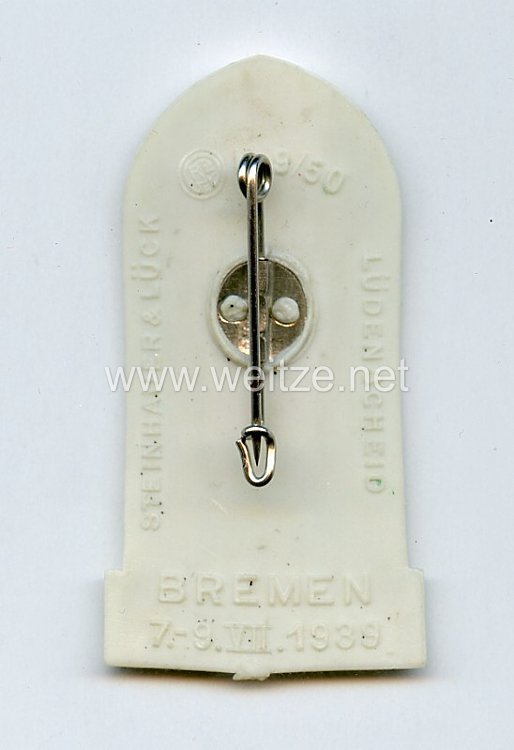
The manufacturer's marking RZM M9/50 refers to the Reichszeugmeisterei (RZM), the central procurement and control office of the NSDAP for uniforms, badges, and equipment. The RZM system was introduced in 1929 and served standardization and quality control purposes. The designation "M9" indicated the category for event and traditional badges, while the number "50" identified the specific manufacturing company.
The manufacturer Steinhauer & Lück from Lüdenscheid was one of the significant producers of badges and medals in the Third Reich. Lüdenscheid in the Sauerland region had a long tradition in metal processing and housed numerous companies that manufactured military decorations, badges, and uniform accessories. Steinhauer & Lück was among the RZM-licensed manufacturers and produced various types of SA, NSDAP, and Wehrmacht badges.
The Sturmabteilung had already experienced a significant loss of power in 1939 compared to its heyday in the early 1930s. After the so-called "Röhm Affair" of 1934, in which the SA leadership was eliminated, the organization was increasingly overshadowed by the SS and the Wehrmacht. Nevertheless, the SA remained as a mass organization and continued to conduct its military sports events, which also served pre-military training purposes.
The timing of this event in July 1939 is particularly significant historically. At this point, preparations for the German invasion of Poland were already well advanced. The Wehrkampftage took place during a phase of intense military rearmament and immediately before the outbreak of war. Such events served not only practical training purposes but also the psychological preparation of the population for war.
Participant badges like this were typically awarded to active competitors or were available for participants and visitors to the event. They document the comprehensive badge and decoration culture of the National Socialist system, in which virtually every event, every organization, and every achievement was honored with corresponding symbols and insignia.
Today, such badges are important contemporary historical documents that provide insight into the organizational structure, propaganda, and everyday culture of the NS regime. They are preserved in collections and museums and serve historical research and education about this dark period of German history.