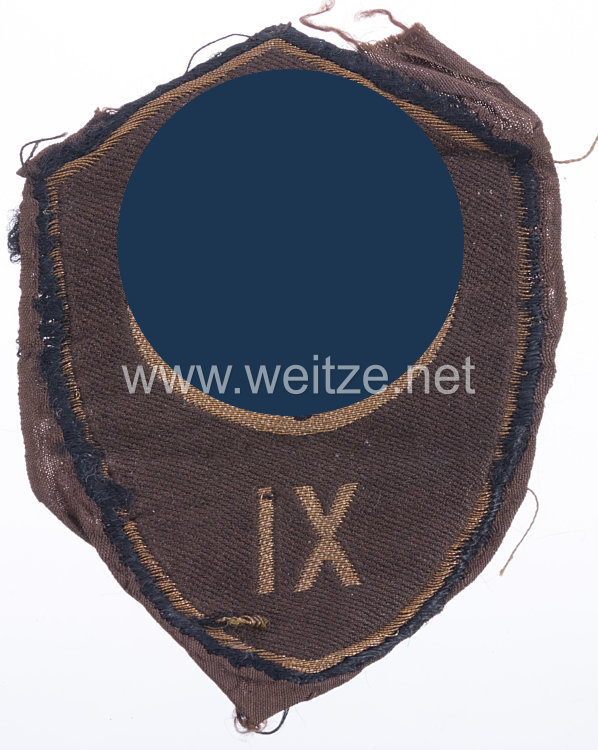
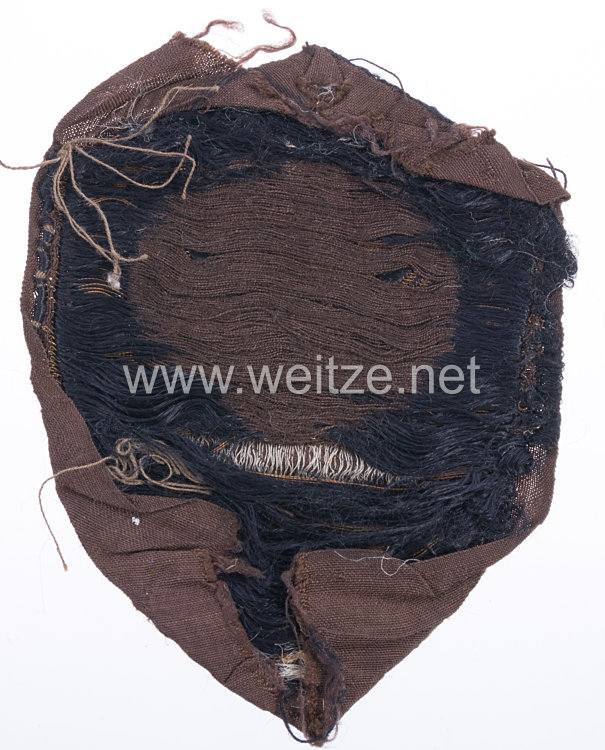
RAD Female Sleeve Shield “IX” worn by Women in the rank of Stabsführerin, Stabsoberführerin and Stabshauptführerin

Bevo-woven construction. Worn, District “Westfalen”, Condition 2. Very Rare.
350887
750,00

RAD Female Sleeve Shield “IX” worn by Women in the rank of Stabsführerin, Stabsoberführerin and Stabshauptführerin

The sleeve insignia described here represents a significant and rare relic from the history of the Reichsarbeitsdienst (RAD - Reich Labor Service) during the National Socialist era. It is a sleeve shield bearing the designation “IX”, worn by female leaders holding the ranks of Stabsführerin, Stabsoberführerin, or Stabshauptführerin, and assigned to the Westphalia district.

The Reichsarbeitsdienst was established in 1935 as mandatory service for all young Germans and was a paramilitary organization directly subordinate to the Führer and the Reich government. While the RAD was initially designed primarily for young men, a compulsory labor service for young women was also introduced in 1939, called RAD-weiblich or RADwJ (Reich Labor Service for Female Youth).

The Bevo weaving technique used for this sleeve shield was a special weaving method employed by the company Bandfabrik Ewald Vorsteher from Wuppertal-Barmen, which produced high-quality, machine-woven insignia. This technique enabled the production of detailed and durable emblems distinguished by their quality and precision. Bevo insignia were considered standard issue for many military and paramilitary organizations of the Third Reich.

The Roman numeral IX on the sleeve shield designated the Arbeitsgaugruppe IX (Labor District Group IX), which was administratively assigned to the Westphalia region. The RAD was divided into various Arbeitsgaue (labor districts) and Arbeitsgaugruppen (labor district groups), each covering specific geographical regions. The structure of the RAD-weiblich followed a similar organization to that of the male RAD, with leadership ranks organized in parallel.

The Stabsführerin was a senior leadership rank in the RAD-weiblich, comparable to an officer rank. Above this were the Stabsoberführerin and Stabshauptführerin, which belonged to the highest service grades that women could achieve in the Reich Labor Service. These leaders were responsible for the organization, training, and supervision of the female labor maidens and played an important role in the hierarchical structure of the organization.

Female members of the RAD wore a special uniform that differed from the male version. It typically consisted of a brown skirt, a white blouse, and a characteristic brown jacket. The various sleeve insignia and rank badges were attached to precisely defined locations on the uniform according to uniform regulations and served for immediate identification of rank, function, and regional affiliation.

The Westphalia district encompassed large parts of western Germany and had several labor districts under its administration. The organizational structure of the RAD was strictly hierarchical and modeled on military examples, although the service was officially designated as a civilian labor organization.

The tasks of the RAD-weiblich differed from those of the male divisions. While the men were mainly engaged in earthworks and construction, road building, and agricultural projects, the female labor maidens were primarily deployed in agriculture, domestic service, and childcare. Later, especially during World War II, they were increasingly also used for war-essential activities.

The rarity of such sleeve insignia, particularly for higher leadership ranks in the female RAD, is explained by several factors. First, the number of women in these high ranks was naturally limited. Second, after the war's end, many uniform pieces and insignia from the Third Reich were systematically destroyed. Third, the wearers were often eager not to document their past in this organization.

As a historical artifact, such a sleeve shield offers important insights into the organizational structure, hierarchy, and material culture of the Reich Labor Service. It documents the role of women in the paramilitary structures of National Socialist Germany and shows how female citizens were also integrated into the system of total mobilization.

The preservation of such historical objects is significant for scholarly research and memory culture, even though their origin from a criminal regime must be critically contextualized. They serve as material witnesses to a dark period of German history and help to understand the structures and functioning of totalitarian systems.