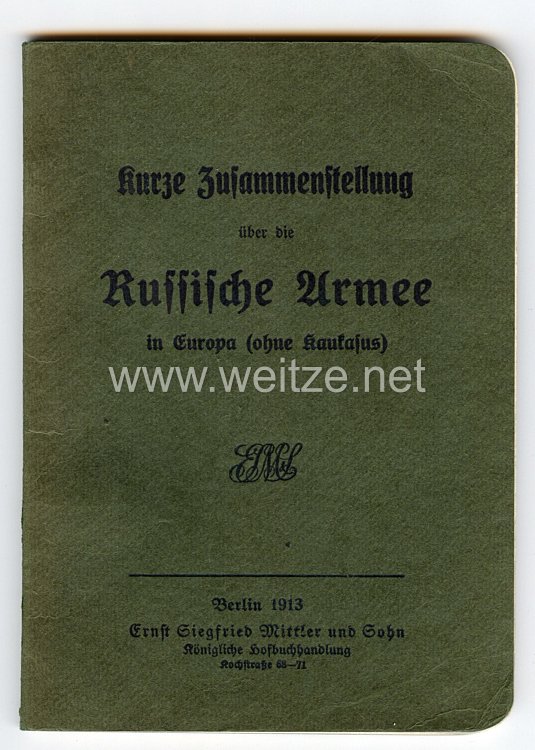
Brief Compilation on the Russian Army in Europe (excluding Caucasus)

Published by Berlin Mittler & Sohn, from 1913, 45 pages, 5 colored uniform plates, format 15.5 x 11cm, condition 2
420787
50,00

Brief Compilation on the Russian Army in Europe (excluding Caucasus)

This military specialist publication from 1913 represents a significant document of German military intelligence work on the eve of World War I. Published by the renowned Ernst Siegfried Mittler & Sohn publishing house in Berlin, the leading military publisher of the German Empire, this work documents the contemporary state of knowledge regarding the organization and equipment of Russian armed forces.

The Mittler & Sohn publishing house, founded in 1789, had established itself since the early 19th century as the semi-official publisher of the Prussian and later German Army. The publishing house not only produced service regulations and military manuals but also educational works about foreign armed forces. These publications served the training of officers and the study of potential adversaries as part of military planning.

In the context of the years before 1914, the systematic study of foreign armies gained enormous importance. The German Empire found itself in an increasingly tense foreign policy situation, characterized by the alliance constellation of the Triple Entente between France, Russia, and Great Britain. The Russian Army was considered by the German General Staff as one of the main opponents in a future conflict, explaining the intense interest in detailed information about the organization, strength, and equipment of these forces.

The deliberate limitation to European forces, excluding the Caucasus, reflects strategic considerations. For a potential war in Europe, primarily those Russian units were relevant that could be quickly relocated to the western border of the Tsarist Empire. The Caucasian troops played a role primarily in confrontations with the Ottoman Empire.

Particularly valuable are the five colored uniform plates included with this publication. Such plates served to identify enemy units in the field and were an essential tool for reconnaissance and intelligence evaluation. The Russian Army had conducted a comprehensive uniform reform in 1907-1909, replacing traditional dark uniforms with field-gray suits. Nevertheless, many regiments retained distinctive insignia, collar patches, and shoulder straps in different colors that enabled identification.

The 45-page work likely provided a compact overview of the Russian Army's structure. Following the reforms of War Minister Vladimir Alexandrovich Sukhomlinov (1909-1915), the Russian Army comprised approximately 1.4 million men in peacetime, which could multiply to over 5 million through mobilization in wartime. The army was organized into military districts, with the western districts of Warsaw, Vilna, Kiev, and St. Petersburg being the most strategically important for a war against the Central Powers.

The compact format of 15.5 x 11 cm suggests that this publication was designed as a practical reference work for officers that could be easily carried. Such compendia were typical of military specialist literature of that era and supplemented the more extensive, multi-volume works on foreign armies.

The timing of publication in 1913 is noteworthy: The German Empire was in the midst of a phase of intensive military armament. The Army Bill of 1913 had significantly increased the peacetime strength of the German Army. Simultaneously, Russia was systematically modernizing its armed forces following the defeat in the Russo-Japanese War (1904-1905) and the Revolution of 1905. German military planners followed this development with great attention, as it changed the strategic balance in Europe.

Publications like this formed the basis for operational planning by the Great General Staff. The famous Schlieffen Plan and its modifications under the younger Moltke were based on assumptions about the mobilization speed and deployment plans of the Russian Army. It was calculated that Russia would need about six weeks to reach its full war strength – an assessment that proved too optimistic.

Today, such publications represent valuable sources for military historical research. They document not only the state of knowledge about foreign armies but also the perceptions and enemy images that shaped military thinking. As collectibles, well-preserved copies with original color plates are particularly sought after, as many of these works were worn out in practical use or lost in the turmoil of two world wars.

r