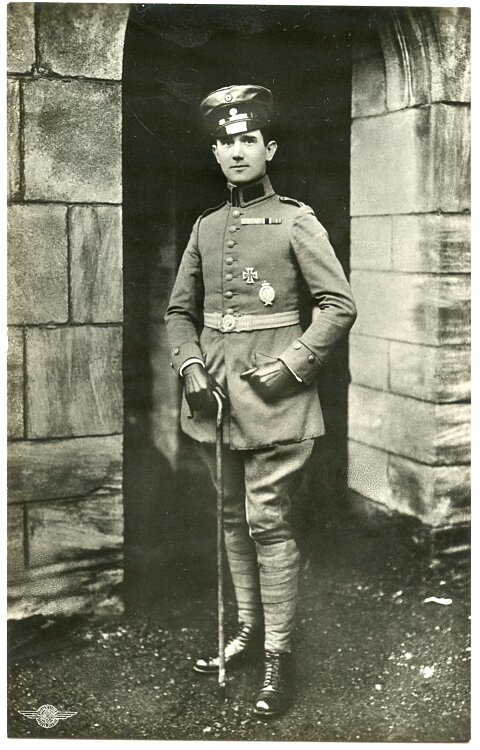
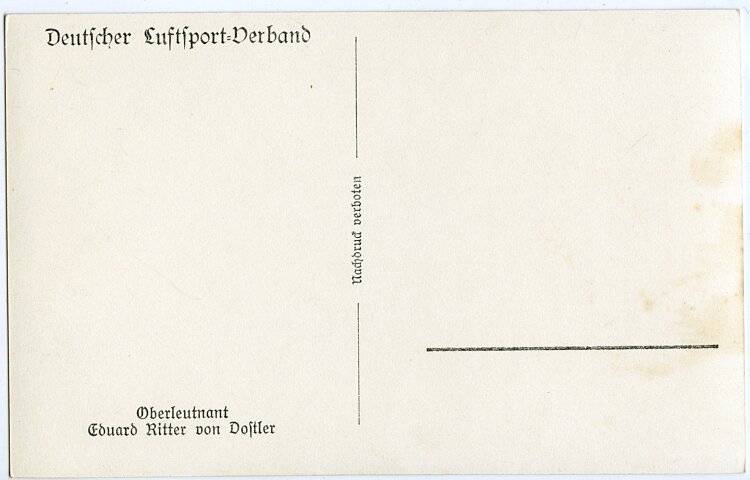
World War I Aviation - German Flying Aces “Oberleutnant Eduard Ritter von Dostler”

on DLV card, unused, condition 2
169087
20,00

World War I Aviation - German Flying Aces “Oberleutnant Eduard Ritter von Dostler”

This DLV postcard (Deutscher Luftsportverband - German Air Sports Association) commemorates Oberleutnant Eduard Ritter von Dostler, one of the notable German fighter pilots of World War I. Such postcards were widely distributed during the interwar period, particularly in the 1930s, serving to honor and remember the aviation heroes of the Great War.

Eduard Ritter von Dostler was born on May 3, 1892, in Prien am Chiemsee, Bavaria, and developed into one of the most successful Bavarian fighter pilots. He initially entered the Bavarian Army and served as an infantry officer before volunteering for the aviation service. After completing his training as a combat pilot, Dostler was assigned to a combat squadron in 1916 and later transferred to fighter squadrons.

Dostler achieved his greatest successes as commander of Jagdstaffel 6 (Jasta 6) and later Jagdstaffel 34. Between 1917 and 1918, he achieved a total of 26 confirmed aerial victories, making him one of the successful fighter pilots of his era. For his exceptional achievements, he was awarded the Pour le Mérite on June 4, 1918, the highest military decoration of the German Empire, also known as the “Blue Max.”

The Deutscher Luftsportverband (DLV), founded in 1933, played a central role in reviving German aviation after the restrictions imposed by the Treaty of Versailles. The DLV officially functioned as a civilian sports organization but simultaneously served as cover for the secret training of military pilots. In this context, postcards and propaganda materials were produced that honored World War I heroes and promoted enthusiasm for aviation.

These cards featuring portraits of fighter aces like Dostler were part of a larger series depicting various aviation heroes of World War I. They were frequently distributed at aviation events, in airmen's clubs, or through the DLV itself. The cards served multiple purposes: they honored veterans, inspired the younger generation toward aviation, and created continuity between the Imperial German Air Service and the developing new air force.

The imagery of these cards typically followed a heroic pattern. The pilots were usually depicted in uniform, often with their decorations, sometimes against the backdrop of their aircraft. The reverse side of the cards frequently contained biographical information and a list of aerial victories achieved. The fact that this card is unused suggests it may have been kept as a collectible or archived in an album.

After the war, Dostler returned to Bavaria and remained connected to aviation. During the interwar period, former fighter pilots like him were important symbolic figures for the German aviation movement. They embodied technical mastery, courage, and national honor during a time when Germany was severely restricted militarily.

Such memorabilia are important historical documents today. They document not only the military history of World War I but also the culture of remembrance during the interwar period. The condition grade of 2 (very good) indicates that this card was well preserved, possibly in a collection, which underscores its historical and collectible significance.

The veneration of fighter pilots like Dostler must be understood in historical context. These men were regarded as modern knights who proved their valor in individual combat in the skies. However, the reality of aerial warfare was brutal, and many young pilots on all sides lost their lives. The romanticized portrayal on such postcards reflects contemporary perceptions but often obscures the harshness of actual warfare.

Today, collectors and military historians value such items as tangible connections to the past. They provide insights into how societies commemorated their military figures and how aviation culture developed during a pivotal period in history. The DLV cards, in particular, represent a specific moment when Germany was rebuilding its aerial capabilities while officially constrained by international treaties.