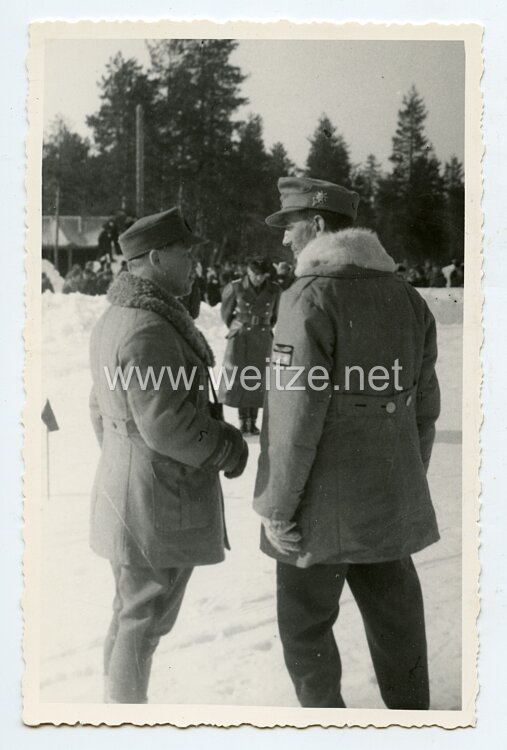
Wehrmacht Photograph of Colonel General Eduard Dietl Wearing Short Coat with Rank Insignia on Upper Arm
This historical photograph depicts Generaloberst Eduard Dietl, one of the most prominent German mountain troop commanders of World War II, wearing a short coat with clearly visible rank insignia on his upper arm. The image documents an important aspect of the Wehrmacht's military uniform culture and provides insight into the career of one of the Third Reich's most highly decorated officers.
Eduard Dietl was born on July 21, 1890, in Bad Aibling, Bavaria. His military career began during World War I, where he served as an officer and received multiple decorations. During the interwar period, he continued his career in the Reichswehr and developed into a specialist in mountain warfare. With the establishment of the Wehrmacht from 1935 onwards, Dietl steadily advanced to higher command positions.
Dietl achieved his greatest military fame during Operation Weserübung, the German invasion of Norway in April 1940. As commander of the 3rd Mountain Division, he led the conquest of Narvik, a strategically important port in northern Norway. After initial successes, Dietl found himself in a precarious situation when Allied forces launched a counteroffensive. His troops were temporarily encircled and had to endure extreme Arctic conditions. Through skillful defense and the deployment of paratroopers for reinforcement, Dietl held his positions until the general Allied withdrawal in June 1940. This achievement earned him the Knight's Cross of the Iron Cross with Oak Leaves on May 19, 1940, making him the first Wehrmacht officer to receive this distinction.
On June 1, 1940, Dietl was promoted to General der Gebirgstruppe (General of Mountain Troops), and on June 19, 1942, he attained the rank of Generaloberst (Colonel General), the second-highest rank in the Wehrmacht hierarchy. At this time, he commanded the 20th Mountain Army in northern Norway and Finland, a significant formation responsible for defending the northern front sectors and securing the strategically important nickel mines near Petsamo.
The rank insignia on the upper arm visible in the photograph are characteristic of certain Wehrmacht uniform variants. While shoulder boards were the standard method for indicating rank, officers wore additional or alternative rank insignia on the sleeves of certain uniform pieces, particularly on coats and work uniforms. The short coat mentioned in the object description was a practical uniform variant worn especially for field service and in warmer weather conditions, as opposed to the long tunic or heavy winter coat.
The rank insignia of a Generaloberst consisted of braided aluminum piping on a red background (for General Staff officers) or the respective branch color. Generaloberste wore three crossed stars above crossed marshal's batons on their shoulder boards. The sleeve insignia followed a similar pattern, though the exact design could vary depending on the uniform type. The rank designations and their visual representation were precisely regulated in the Heeresdienstvorschrift (HDv), the Army Service Regulations.
Photographs such as this served several purposes during the war. They were used for propaganda to glorify successful commanders and document the regime's military achievements. At the same time, they held personal value for the officers themselves and their families. Many of these photographs were taken in professional studios or by war correspondents and subsequently reproduced. The format of 8.4 x 13.2 cm corresponds to a common postcard size of the era.
Eduard Dietl's life ended tragically on June 23, 1944, when his aircraft crashed in the mountains near Hermagor in Carinthia, Austria. He was traveling to a conference with Adolf Hitler at the Berghof. All occupants perished. The exact circumstances of the crash remained controversial; while officially considered an accident, there was speculation about technical failure or even sabotage. Dietl received a state funeral, and Hitler ordered that his name be held in honor within the Wehrmacht.
From today's perspective, such photographs are important historical documents. They allow researchers to study uniform development, military hierarchies, and the iconography of the Nazi regime. At the same time, they remind us of the complex history of individuals who served in a criminal system. The preservation and scholarly examination of such objects is essential for historical understanding, always considering the context of World War II and Nazi rule.