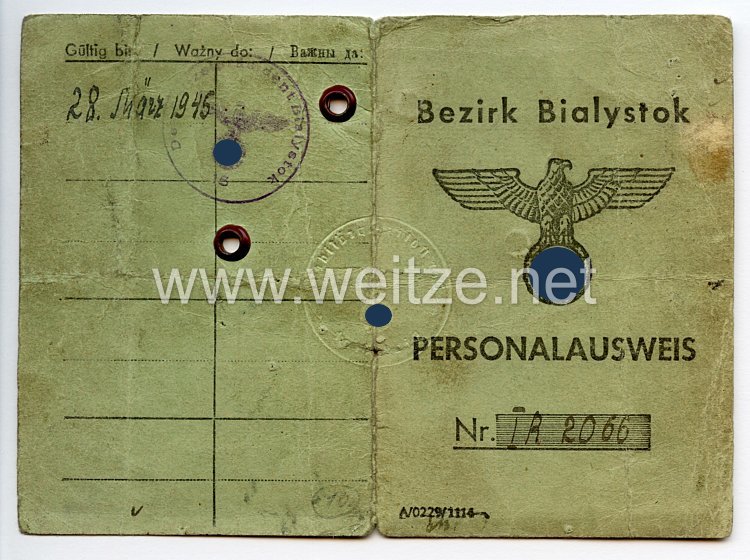
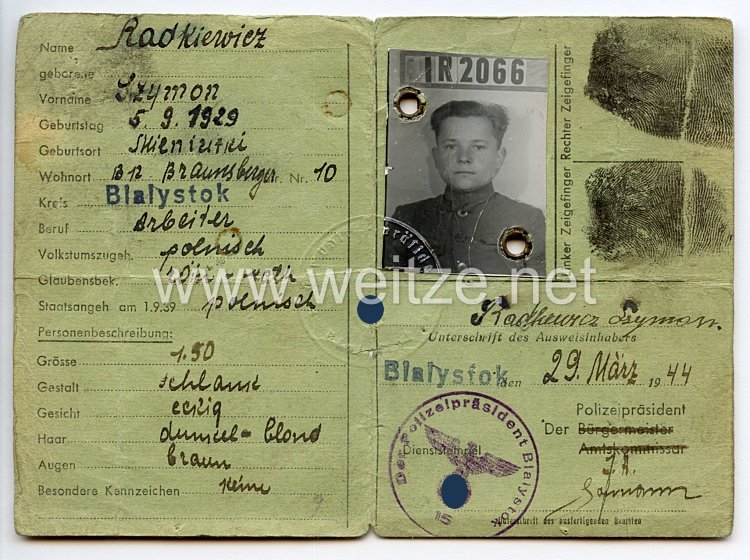
Third Reich / Occupied Eastern Territories - Bezirk Bialystok - Personal Identity Card for a Boy born in 1929

issued in Bialystok on March 29, 1944, with photograph and personal data, valid until March 28, 1945; used condition.
339386
160,00

Third Reich / Occupied Eastern Territories - Bezirk Bialystok - Personal Identity Card for a Boy born in 1929

This identity card from the District of Bialystok, issued on March 29, 1944, for a boy born in 1929, represents a significant historical document from the period of German occupation of eastern Poland during World War II. This identification document provides unique insights into the administrative organization and control mechanisms of the National Socialist occupation regime in the conquered eastern territories.

Following the German invasion of Poland in September 1939 and the subsequent campaign against the Soviet Union beginning in June 1941, large parts of eastern Poland came under German administration. The District of Bialystok occupied a special position in this system. Unlike other territories, it was neither directly incorporated into the German Reich nor assigned to the General Government, but rather placed under the administration of East Prussia under Gauleiter Erich Koch from August 1941 onwards. This special status reflected National Socialist plans to completely Germanize this area and later annex it to the German Reich.

The issuance of identity cards was a central instrument of the occupation administration for registering and controlling the population. Before the war, approximately 1.4 million people lived in the District of Bialystok, including Poles, Jews, Belarusians, and other ethnic minorities. The German occupation authorities introduced a strict system of registration and documentation intended to capture all inhabitants.

The issue date of the card - March 29, 1944 - holds particular historical significance. At this time, the German Reich was already in a critical phase of the war. Operation Bagration, the great Soviet summer offensive, would begin just a few months later in June 1944, leading to the liberation of Belarus and large parts of eastern Poland. The District of Bialystok was captured by the Red Army in July 1944, meaning this identity card was valid for only a few months before the area lost its administrative function under German control.

The validity period until March 28, 1945 would never be reached, as German authorities had to evacuate the area already in summer 1944. This makes such documents silent witnesses to the collapse of German occupation rule in the East.

For the Jewish population of the Bialystok District, the German occupation had catastrophic consequences. The Bialystok Ghetto, one of the largest in the occupied eastern territories, was established in August 1941 and existed until August 1943. Approximately 50,000 Jews were concentrated there before the ghetto was liquidated and its inhabitants deported to extermination camps. The fact that this card was issued in 1944 for a non-Jewish boy stands in the context of this tragic history of systematic annihilation.

The administrative structure of the occupation administration in the Bialystok District was complex. German officials took over all important administrative positions, while local auxiliaries were employed for subordinate tasks. The issuance of identity documents followed German regulations and forms that were used uniformly in the occupied territories.

Identity cards from this period typically contained a photograph, personal data such as name, date and place of birth, place of residence, occupation or, in the case of young people, status as a student or apprentice, as well as various stamps and signatures of the issuing authorities. Fingerprints were often also required. The documents had to be carried at all times, and checks by German security forces, police, or Wehrmacht were routine.

The used condition of the card indicates that it was actually utilized, possibly during daily checks, when receiving food rations, or when moving within the district. The population's freedom of movement was severely restricted, and any travel required special permits.

From a historical perspective, such documents are of invaluable importance for research. They document not only the bureaucratic processes of the occupation administration but also provide insight into individual fates. A boy born in 1929 would have been 14 or 15 years old at the time of issuance - an age at which many youths were conscripted for forced labor or suffered other repressions by the occupation forces.

Today, such documents serve as reminders of one of the darkest periods in European history and of the fate of people who had to live under German occupation. They are important sources for historians, museums, and memorial sites that document the history of World War II and the Holocaust and preserve it for future generations.

r