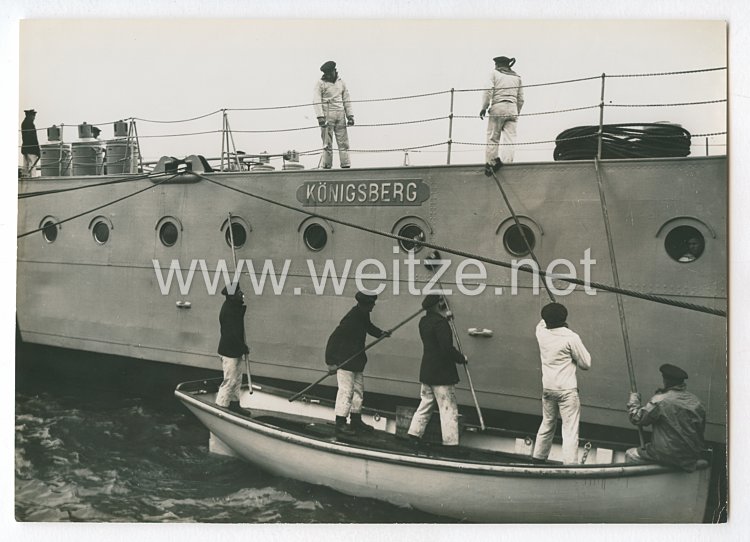
Reichsmarine Press Photo: The Königsberg Being Scrubbed

Dimensions approximately 17 x 24 cm, verso without inscription. Used condition.
343885
15,00

Reichsmarine Press Photo: The Königsberg Being Scrubbed

This press photograph shows the Königsberg, a light cruiser of the Reichsmarine, during deck cleaning operations. With dimensions of approximately 17 x 24 cm, this document represents a typical photographic medium of the interwar period, as produced by the Naval Press Office for publication purposes.

The Königsberg was the lead ship of its class and represented a significant milestone in German warship construction during the Weimar Republic. The vessel was laid down on March 26, 1926, at the Reichsmarine Shipyard Wilhelmshaven and launched on March 26, 1927. Commissioning took place on April 17, 1929. With a displacement of 6,650 tons and a length of 174 meters, the Königsberg represented the Reichsmarine's attempt to construct modern and capable warships despite the strict limitations of the Treaty of Versailles.

Press photographs like this one played a central role in the public relations of the Reichsmarine. The systematic documentation of naval daily life served several purposes: on one hand, it aimed to familiarize the German public with the new navy, while on the other, the visual propaganda sought to present the Reichsmarine as a modern, professional fighting force. Scenes such as deck scrubbing may appear mundane at first glance, but they document seamanship and military routine aboard ship.

Cleaning and maintenance were essential components of daily service on warships. The maritime tradition of “clearing for action” – the thorough cleaning of all areas – had both practical and disciplinary reasons. Salt water, weather conditions, and constant mechanical stress made continuous maintenance work indispensable. At the same time, communal work fostered the esprit de corps of the crew and was part of military order.

The Reichsmarine existed from 1919 to 1935 as the naval force of the Weimar Republic and early Third Reich. It emerged after World War I under the restrictive conditions of the Treaty of Versailles, which permitted Germany only a small defensive fleet. Personnel strength was limited to 15,000 men, and the tonnage and armament of ships were subject to strict restrictions. These limitations led to innovative technical solutions, such as those employed in the Königsberg class.

The Königsberg class comprised three ships: Königsberg, Karlsruhe, and Köln. These light cruisers were designed for reconnaissance missions, commerce raiding, and fleet operations. They were equipped with modern main armament of nine 15-cm guns and achieved a top speed of 32 knots. The ships were considered technically advanced and were observed with interest internationally.

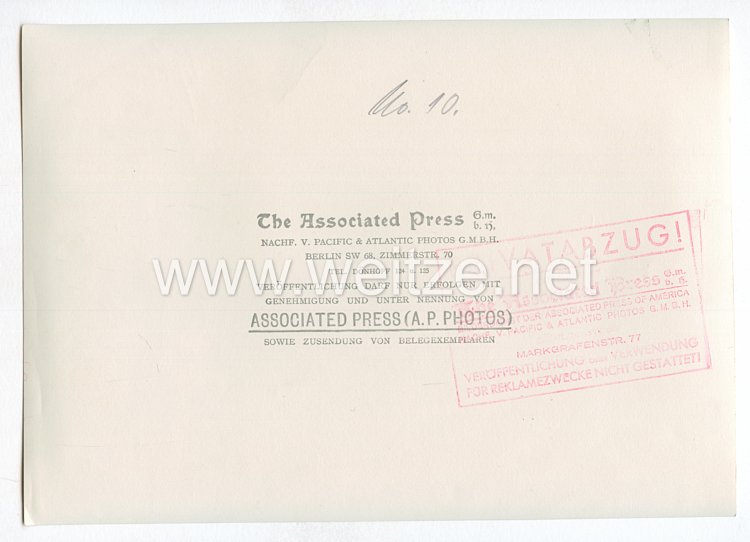
The absence of text on the reverse of this photograph is not unusual. Many press photos were sent to editorial offices as raw material or stored in archives. Stamps, captions, and censorship marks were often only applied to images actually intended for publication. The used condition of the photograph suggests it may have been employed in an editorial or archival context.

The history of the Königsberg ended dramatically in World War II. On April 10, 1940, the ship was attacked and severely damaged by British bombers in the fjords near Bergen during Operation Weserübung, the German invasion of Norway. The ship could not be salvaged and was abandoned. This loss occurred shortly after the outbreak of war and demonstrated the vulnerability of surface ships to air attacks.

Photographic documents like this press photo possess considerable historical value today. They offer authentic insights into naval life during the interwar period and document ships long since lost. For collectors, historians, and museums, such photographs constitute important primary sources that enrich military-historical research and maritime memory culture. The simple motif of deck scrubbing conveys the reality of life aboard ship beyond the dramatic naval battles and strategic operations that often dominate military history narratives.

r