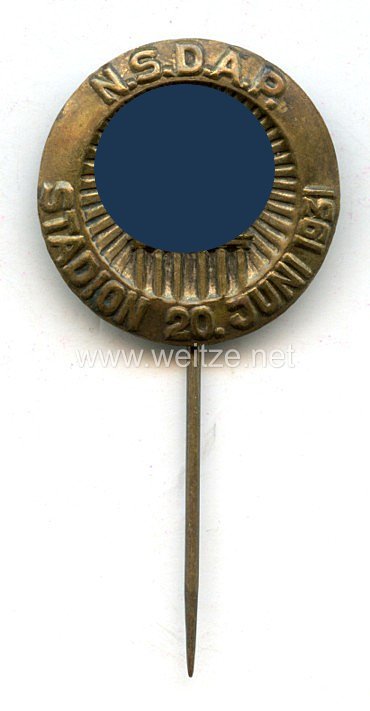
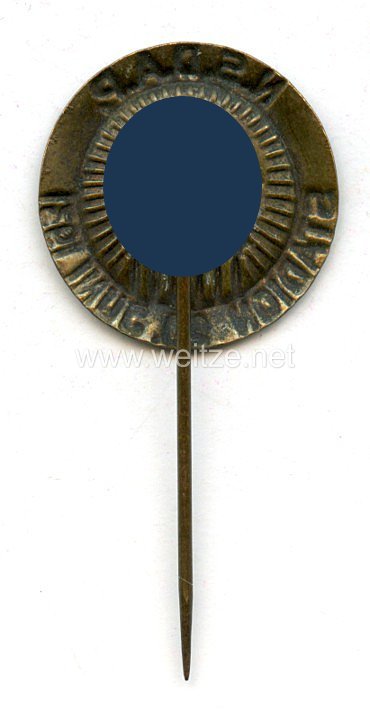
NSDAP - Stadium June 20, 1931
This tin badge commemorating the NSDAP Stadium event of June 20, 1931, manufactured by Hoffstätter Bonn, represents a significant chapter in the history of the National Socialist movement during the late Weimar Republic. Such badges document the systematic staging of mass events that constituted a central element of Nazi propaganda strategy.
The early 1930s marked a decisive phase for the NSDAP (National Socialist German Workers' Party). Following the failed putsch attempt of 1923 and Hitler's subsequent imprisonment, the party had fundamentally changed its strategy, now pursuing the “legal path” to power. Mass rallies and public marches became the primary instrument for mobilizing supporters, recruiting new members, and demonstrating the movement's presence in public spaces.
June 20, 1931 fell during a period of intense political confrontation in Germany. The country was in the midst of the Great Depression, unemployment reached record levels, and political radicalization increased on all sides. The NSDAP skillfully exploited this crisis situation, organizing ever-larger events at which they presented themselves as a movement of renewal and national awakening.
Such stadium events were carefully choreographed affairs. They served not only to directly address participants but also for media dissemination through newspaper reports and photographs. The events combined political speeches, military marches by the SA (Sturmabteilung) and SS, as well as symbolic stagings with flags, banners, and uniformed formations.
The production of badges for such events fulfilled several functions. First, they served as admission tickets or proof of participation. Second, they represented a visible sign of belonging to the movement, which wearers proudly displayed. Third, they became collectibles that strengthened followers' emotional attachment to the party. Fourth, they generated income for party coffers, which during this phase still heavily depended on membership fees and donations.
The company Hoffstätter in Bonn was among numerous manufacturers that produced party badges, decorations, and event badges during this period. The use of tin as material was typical for such mass productions, as it was cost-effective and well-suited for manufacturing larger quantities. The badges were typically adorned with printed or embossed motifs containing swastikas, party symbols, dates, and location information.
The long pin on the reverse allowed attachment to clothing, typically on jacket lapels or shirts. This made the badges a public statement of political conviction – at a time when such declarations were increasingly associated with personal risks, as political confrontations often ended in violent street battles between the SA and communist fighting units.
In the broader context of Nazi propaganda, such event badges were part of a comprehensive system of visual communication. The NSDAP developed a sophisticated “corporate identity” long before that term existed. Uniform symbols, colors (red, white, black), and standardized design elements created high recognition value and conveyed the impression of a tightly organized, disciplined movement.
After 1945, such objects were placed under the prohibition of unconstitutional symbols in Germany. Their collection and documentation is now only permitted for purposes of historical research and education. They serve as material witnesses to a time when propagandistic mass stagings paved the way to dictatorship.
For historians and collectors of military-historical objects, such badges offer important insights into the organizational structure, propaganda methods, and regional spread of the Nazi movement before 1933. They document the systematic mobilization that ultimately led to the end of the Weimar Republic and the establishment of the National Socialist dictatorship.