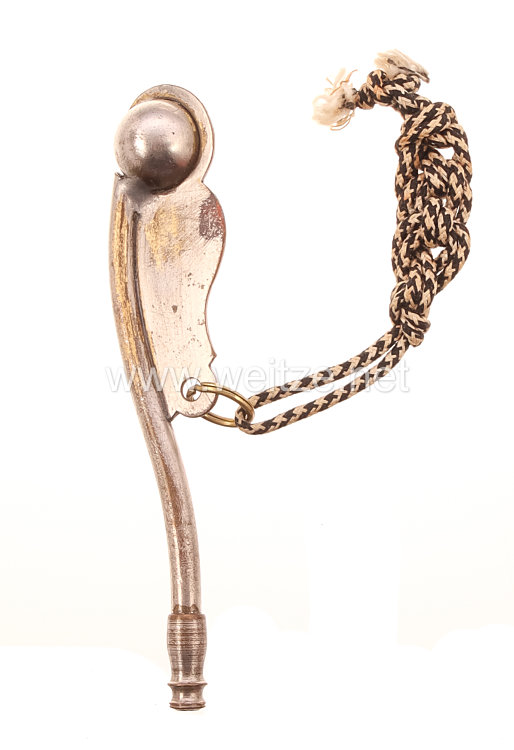
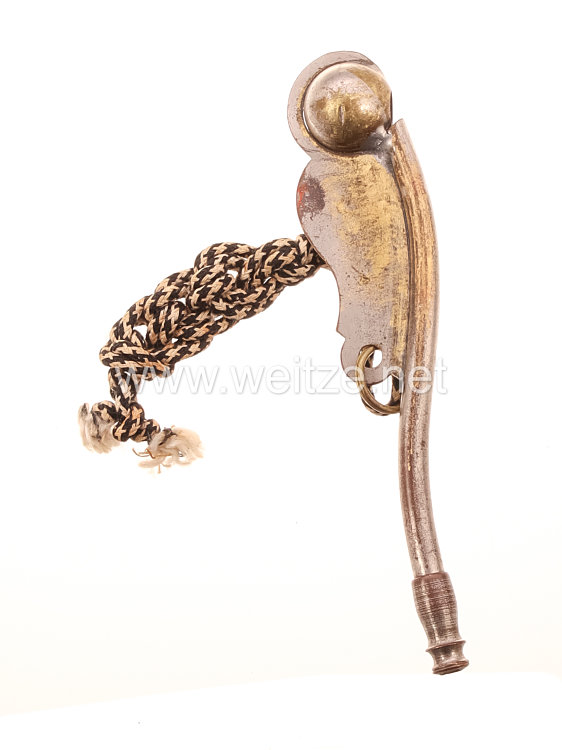
Federal Republic of Germany (FRG) Bundesmarine Boatswain's Pipe

, Condition 2.
439785
45,00

Federal Republic of Germany (FRG) Bundesmarine Boatswain's Pipe

The boatswain's call or bosun's pipe of the Bundesmarine (Federal German Navy) of the Federal Republic of Germany represents a tradition-rich nautical signaling and ceremonial instrument with roots in centuries of maritime history. This characteristic instrument belongs to the official equipment of the boatswain and embodies one of the oldest maritime traditions still in use today.

The Bundesmarine was established on January 2, 1956 as the naval force of the Federal Republic of Germany and existed until German reunification in 1990. Following unification with the Volksmarine of the GDR, it was renamed the German Navy (Deutsche Marine). During its 34-year history as the Bundesmarine, this service branch developed into a modern, NATO-integrated naval force that deliberately maintained maritime traditions.

The boatswain's call itself is traditionally made of metal, often silver-plated or chrome-plated brass, and consists of three main components: the buoy (mouthpiece), the ball, and the gun (or shank). Through different blowing and fingering techniques, various signal tones can be produced, each signifying specific commands or announcements. The construction of this instrument has remained virtually unchanged for centuries, underlining its functional perfection.

In the Bundesmarine, the boatswain's call was used in accordance with Central Service Regulations (Zentrale Dienstvorschrift - ZDv) and the maritime traditions of the German Navy. The boatswain, as a non-commissioned officer or senior NCO, is responsible for seamanship training of the crew, supervision of deck and rigging work, and ceremonial duties. The pipe serves both as a practical signaling instrument and as a badge of rank.

The various pipe calls have precisely defined meanings: The “Still” (a long rising tone sequence) calls for attention, the “Carry on” (a short falling tone) signals the end of a command. Other important signals include “Piping the Side” for honors when receiving high-ranking visitors, “Away Boats” for launching boats, and “Hands to Dinner” as the signal for meals. These signals were already used in the Imperial Navy (Kaiserliche Marine) and the Reichsmarine and were adopted by the Bundesmarine as part of seamanship tradition.

The historical roots of the boatswain's call reach back to the 13th century. The English Royal Navy demonstrably used it from the 15th century onward, and from there it spread to all seafaring nations. In the age of sail, the pipe was particularly important because its high, piercing tones could be heard over great distances even in heavy weather and strong winds - far better than the human voice.

In German naval tradition, the boatswain's call was systematically employed at least since the founding of the Imperial Navy in 1871. The Kriegsmarine of the Wehrmacht continued this tradition, and after World War II it was deliberately adopted into the new Bundesmarine. This occurred within the framework of the “Tradition Decree” discussions, in which decisions were made about which elements of German naval history were considered worthy of preservation.

The boatswain's call is worn on a cord or chain placed around the neck or over the shoulder. In the Bundesmarine, the pipe was part of the boatswain's service uniform and was worn visibly at official occasions, watch changes, and ceremonial functions. It symbolizes the authority and responsibility of the wearer in maritime matters.

These pipes were manufactured by specialized producers who often also produced other military equipment items. Quality and workmanship were precisely specified, with Condition 2 in military categorizations typically indicating a used but well-preserved state with slight signs of wear.

With the renaming to German Navy in 1990 and the integration of modern communication technology, the practical significance of the boatswain's call has diminished, but it remains a ceremonial and traditional element of German naval culture to this day. It continues to be used at official occasions, ship christenings, and receptions, and is taught during training, thereby keeping the connection to maritime history alive.

The boatswain's call of the Bundesmarine thus represents far more than a simple whistle - it is a tangible link to naval history, a functional tool of seamanship, and a symbol of the continuity of maritime tradition across political and historical discontinuities. For collectors and historians of military antiques, such pieces offer insight into the organizational culture and ceremonial practices of the post-war German Navy.

r