Austria - Carinthian Singers' Association
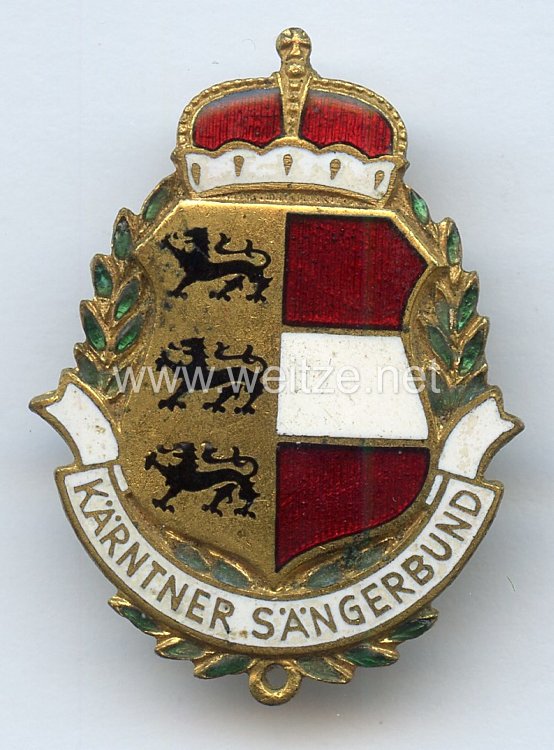
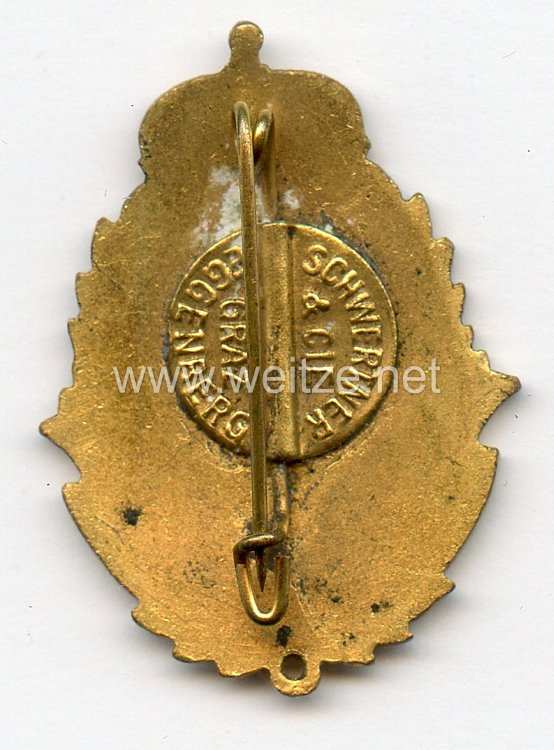
The membership badge of the Carinthian Singers' Association (Kärntner Sängerbund) represents a fascinating testimony to Austrian associational culture and cultural life in the Carinthia region. This enameled badge, manufactured by the renowned firm Schwertner & Cie in Graz-Eggenberg, embodies the significant tradition of choral societies in the German-speaking areas during the 19th and 20th centuries.
The choral movement in Austria-Hungary developed parallel to similar movements in the German Empire and Switzerland. The Kärntner Sängerbund was founded as an umbrella organization for the numerous male choral societies in Carinthia dedicated to cultivating polyphonic choral singing. These associations played an important social and cultural role in their communities and contributed significantly to regional identity formation.
The firm Schwertner & Cie in Graz-Eggenberg was among the leading manufacturers of association badges, orders, and decorations in the Austro-Hungarian Monarchy and the subsequent Republic of Austria. The company was renowned for its high-quality enameled work, which met the highest technical and artistic standards. The enameling technique, in which glass flux is fused onto a metal base, required great craftsmanship and guaranteed lasting color brilliance.
Membership badges like this were typically attached to clothing via a pin on the reverse and worn at official events, concerts, and singing festivals. They served not only to identify members of the association but also as an expression of commitment to the ideals of the choral movement: community, cultural education, and attachment to homeland.
The Austrian choral movement experienced its heyday between the 1880s and World War I. During this period, numerous choral societies emerged, organizing themselves into regional and supra-regional umbrella associations. The Carinthian Singers' Association regularly organized singing festivals (Sängerfeste), where choirs from throughout the region gathered to showcase their skills and foster community.
After the collapse of the Austro-Hungarian Monarchy in 1918 and during the period of the First Republic (1918-1938), choral societies remained important cultural institutions. Particularly in Carinthia, where intense disputes took place after World War I regarding the affiliation of southern territories to either Austria or the newly founded Kingdom of Serbs, Croats, and Slovenes, cultural organizations played a significant role in preserving regional identity.
The manufacturer's mark “Schwertner & Cie Graz Eggenberg” on the badge enables temporal classification and confirms the authenticity of the piece. Graz-Eggenberg, today a district of Graz, was an important center for metalworking and arts and crafts during the first half of the 20th century.
Such membership badges were produced in various designs, often decorated with specific symbols of vocal art such as lyres, clefs, or laurel wreaths. The enamel decoration could feature the provincial colors of Carinthia (yellow and red) or other symbolic colors. The craftsmanship quality of these badges varied considerably depending on the manufacturer, with Schwertner & Cie ranking among the most prestigious producers.
After the Anschluss of Austria to the German Reich in 1938, many associations were brought into line or dissolved. After 1945, traditional associational culture experienced a revival, and many singers' associations resumed their activities. Historical badges from the pre-1938 period are now sought-after collectibles that provide insight into the rich associational culture of Austrian history.
The preservation condition “Condition 2” according to numismatic classification indicates a very well-preserved example with possibly only minor signs of wear. This underscores the quality of the original manufacture and the careful treatment by previous owners.