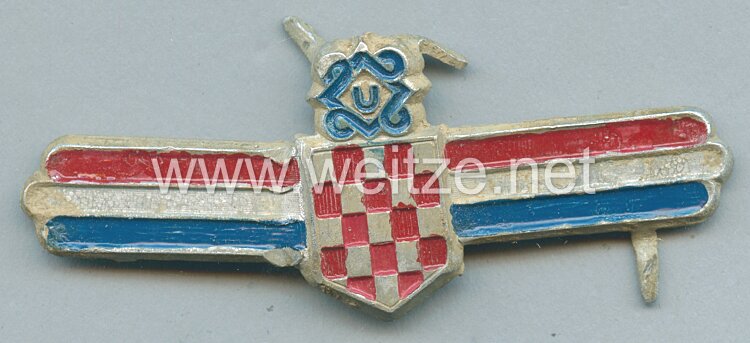
Croatia World War II Breast Badge of the Croatian Army NDH

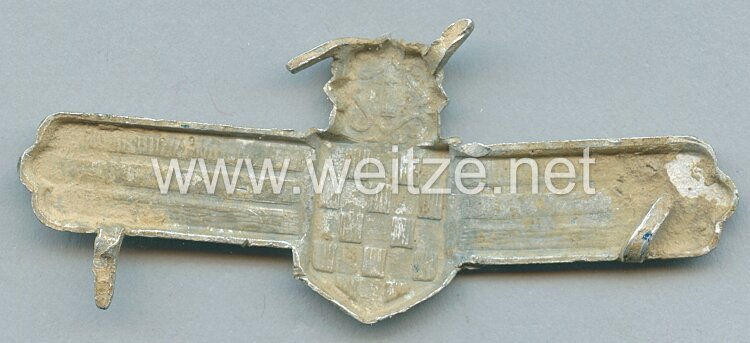
Embossed aluminum, color lacquered. Side-mounted fastening pins. Worn condition, Grade 2-.
235684
120,00

Croatia World War II Breast Badge of the Croatian Army NDH

The breast badge of the Croatian Army of the Independent State of Croatia (Nezavisna Država Hrvatska, NDH) represents a significant artifact of Croatian military history during World War II. This embossed aluminum badge with colored lacquer finish and side mounting pins embodies the military traditions and political reality of a short-lived but historically significant state entity.

The Independent State of Croatia was proclaimed on April 10, 1941, following the invasion and dismemberment of the Kingdom of Yugoslavia by the Axis powers. Under the leadership of Ante Pavelić and his fascist Ustaša movement, a satellite state emerged that was closely aligned with Nazi Germany and Fascist Italy. The state territory encompassed not only present-day Croatia but also Bosnia-Herzegovina and parts of neighboring regions.

The Croatian Army (Hrvatsko domobranstvo) was established as the regular armed force of the NDH and was organizationally distinct from the paramilitary Ustaša units. The Domobranstvo was intended to represent a conventional army following European models and, at its peak, comprised several divisions with different branches of service. The army was charged with defending the state territory and fought on various fronts, particularly against Yugoslav partisan forces under Josip Broz Tito.

The breast badge described here served to identify membership in the Croatian armed forces. Such badges were typically worn on the uniform and fulfilled multiple functions: they served identification purposes, strengthened esprit de corps, and symbolized loyalty to the NDH regime. The use of aluminum as a material was widespread during World War II, as it was lightweight, cost-effective, and available despite wartime economic constraints. The colored lacquer finish enabled the display of national symbols, typically the red-and-white checkerboard pattern (Šahovnica) that served as the Croatian national emblem.

The attachment method using side pins was a practical solution that allowed secure fastening to the uniform while permitting relatively easy replacement. This construction method is found in numerous military badges of this era and followed proven technical standards.

The uniforming and decoration practices of the Croatian armed forces were heavily influenced by German and Italian models. After the Italian capitulation in September 1943, Germany assumed complete control over the NDH, which was reflected in the further development of military equipment and symbolism. German military advisors played an important role in organizing and training Croatian troops.

It is important to emphasize that the NDH regime was responsible for severe war crimes. The systematic persecution and murder of Serbs, Jews, Roma, and political opponents in concentration camps such as Jasenovac belongs to the darkest chapters of Croatian and European history. While the regular army was formally separated from the Ustaša militias, in practice the boundaries between different armed formations of the regime often blurred.

With the advance of Partisan troops and the Red Army, the NDH collapsed in May 1945. Many members of the Croatian armed forces attempted to retreat to Austria, hoping to surrender to the Western Allies. The events at Bleiburg and the subsequent death marches marked the tragic end of this army.

From a historical perspective, such military artifacts are important material witnesses to a complex and painful past. They document the military organization, material culture, and symbolic representation of a regime that existed within the context of World War II and the Holocaust. Scholarly engagement with such objects requires historical sensitivity and acknowledgment of the crimes committed under this regime.

Today, such badges can be found in military history collections and museums, where they serve as objects of study for research into the history of World War II in the Balkans. They remind us of an era of extreme political violence and admonish critical engagement with totalitarian ideologies and their devastating consequences.