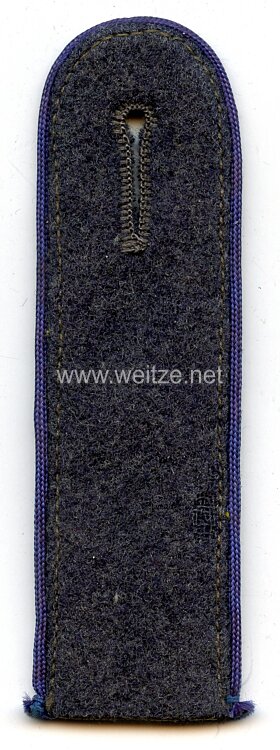
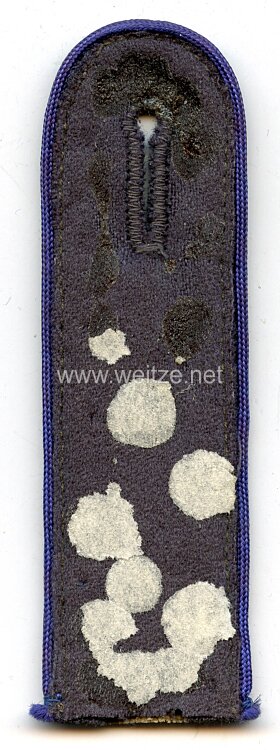
DLV Deutscher Luftsport Verband: Single Shoulder Strap for Enlisted Men

circa 1935, for sewing onto the tunic, reverse with adhesive residue. Condition 2.
462684
70,00

DLV Deutscher Luftsport Verband: Single Shoulder Strap for Enlisted Men

The Shoulder Strap of the German Air Sports Association (DLV) for Enlisted Men

This single shoulder strap for enlisted men of the Deutscher Luftsport Verband (DLV) represents a significant historical artifact from the early phase of German aviation history under National Socialist rule. Manufactured around 1935, this shoulder strap was designed to be sewn onto the service tunic and embodies the organizational structure of an institution that played a central role in preparing German air forces.

The Deutscher Luftsport Verband (German Air Sports Association) was founded on March 25, 1933, emerging from the merger of various aviation sports organizations from the Weimar Republic. Following the National Socialist seizure of power, the DLV was transformed under the leadership of Hermann Göring into a paramilitary organization that officially served civilian air sports but actually functioned as a disguised training organization for aircraft crews and ground personnel for the emerging Luftwaffe. The Treaty of Versailles of 1919 had prohibited Germany from possessing a military air force, necessitating training under the guise of sports activities.

The organizational structure of the DLV followed military principles and included various rank groups. The enlisted men (Mannschaften) formed the lowest rank level and comprised ordinary members without leadership functions. The shoulder strap as a rank insignia was an essential element of uniforming and enabled immediate identification of the wearer's rank.

The design of shoulder straps for enlisted men was deliberately plain. They typically consisted of dark blue base cloth matching the color of the DLV service tunic. Unlike higher ranks, enlisted men's shoulder straps lacked any rank stars, braids, or other decorations. The simplicity of execution emphasized the hierarchical position within the organization.

This shoulder strap was designed to be sewn in, which was typical for pre-war service tunics. The service tunic represented the walking-out uniform and differed from practical service clothing. The adhesive traces visible on the reverse suggest that the shoulder strap may have been mounted on a backing for exhibition or collection purposes at a later date.

The uniform regulations of the DLV were detailed and strongly oriented toward military standards. Correct attachment of shoulder straps occurred on both shoulders of the service tunic, with firm sewing ensuring proper fit and meeting the demands of military precision.

The historical context of the dating around 1935 is of particular significance. In March 1935, Hitler officially announced the reintroduction of universal conscription and the existence of the Luftwaffe, making the DLV's cover unnecessary. Nevertheless, the organization initially continued and was only dissolved in 1937, when its members and functions were completely transferred to the newly created structures of the Luftwaffe and the National Socialist Flying Corps (NSFK).

The importance of the DLV for building the German Luftwaffe cannot be overstated. Thousands of pilots, observers, radio operators, and ground personnel received their basic training in this organization. The enlisted men's shoulder straps were worn by those men who served as simple helpers, mechanics, or prospective flight students.

From a collector's perspective, DLV shoulder straps are sought-after military historical objects today. They document a specific phase of German history when rearmament still had to occur under the guise of civilian organizations. The relatively short existence of the DLV of only four years makes authentic equipment items comparatively rare finds.

The material composition of these shoulder straps corresponded to contemporary textile processing. They were manufactured from wool felt or similar durable materials that had to withstand the demands of daily wear. Workmanship was generally of good quality, as the organization valued a well-groomed military appearance.

The uniforming of the DLV served multiple purposes beyond mere identification. It created esprit de corps, instilled discipline, and prepared members for eventual transition to military service. The shoulder straps, though simple in design, were part of a comprehensive system that transformed civilian aviation enthusiasts into disciplined personnel ready for military integration.

In conclusion, this DLV enlisted men's shoulder strap represents an authentic testimony to a transitional phase in German military history, when the boundaries between civilian sport and military preparation were deliberately blurred to circumvent international restrictions.