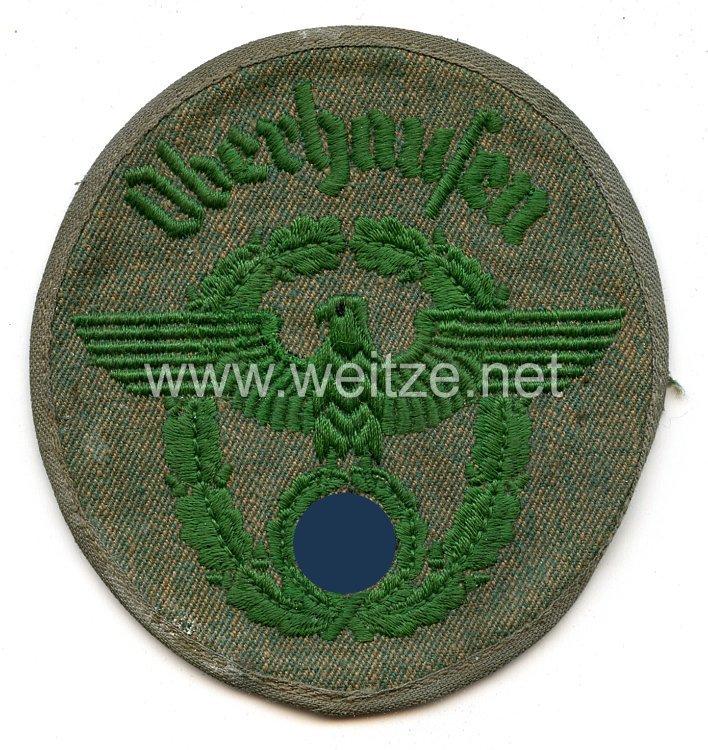
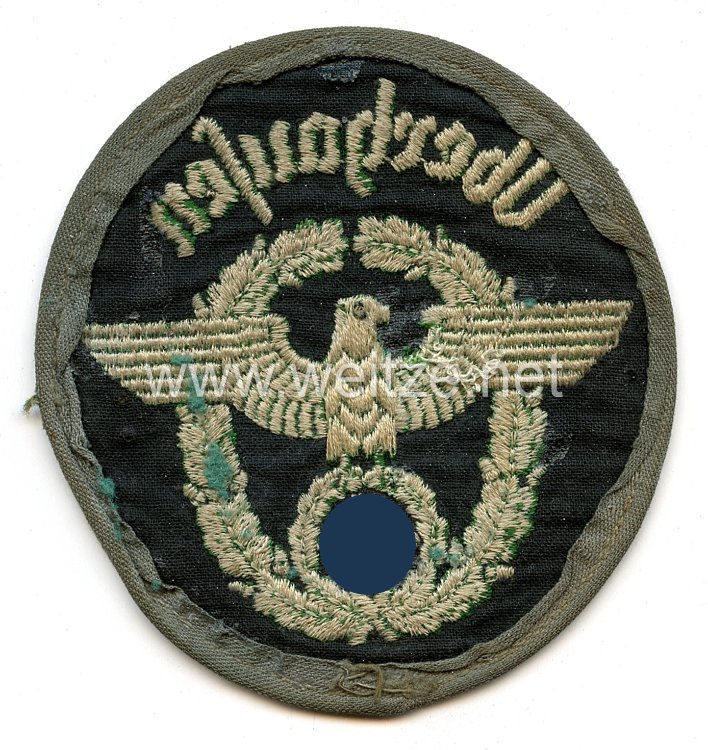
Police Sleeve Eagle for the Schutzpolizei “Oberhausen”

Version for the lightweight summer drill tunic, machine-embroidered. Worn, condition 2.
443382
185,00

Police Sleeve Eagle for the Schutzpolizei “Oberhausen”

The Police Sleeve Eagle for the Schutzpolizei represents a significant piece of equipment from the German police organization during the National Socialist period. This particular specimen marked “Oberhausen” was designed to be worn on the light summer drill jacket and was manufactured in machine-embroidered execution.

The Schutzpolizei (Protection Police) formed one of the main pillars of the German police organization from 1933 to 1945. Following the Nazi seizure of power, the entire police structure underwent fundamental reorganization. In 1936, all police forces were consolidated under Heinrich Himmler as Chief of the German Police. This centralization led to the standardization of uniforms, insignia, and rank markings throughout the Reich.

The sleeve eagle was an essential feature of the National Socialist police uniform. It was worn on the left upper arm and symbolized allegiance to the Nazi state. The version for the drill jacket differed from those intended for cloth or gabardine uniforms. Drill was a robust, twilled cotton fabric particularly suitable for summer uniforms and work clothing. The light summer jacket made from this material was worn in warm temperatures or during physically demanding operations.

Machine embroidery was the standard manufacturing method for such sleeve insignia. In contrast to hand-embroidered variants, which were usually reserved for officer ranks, machine-embroidered eagles were produced in larger quantities and were more cost-effective. The embroidery was typically executed with gray or silver-colored thread on a dark green background, corresponding to the typical colors of the Schutzpolizei.

The designation “Oberhausen” indicates the local assignment of this insignia. Oberhausen, an industrial city in the Ruhr region, had its own Schutzpolizei station responsible for public order and safety in the city and surrounding area. Due to their industrial importance and high population density, Ruhr region cities maintained particularly strong police forces.

The Schutzpolizei organization comprised various units: the Kasernierte Polizei (Barracked Police), the Einzeldienst-Polizei (Individual Service Police), and the Verkehrspolizei (Traffic Police). Schutzpolizei officers wore different uniforms depending on the season and type of duty. Besides the parade uniform and the service dress made of cloth, there was also the practical drill uniform for summer service.

The legal foundations for wearing police insignia were regulated through various decrees and uniform regulations. The Police Uniform Regulation of 1936 standardized the appearance of the German police throughout the Reich. Subsequent additions and modifications specified details regarding insignia, their attachment, and manner of wear.

After the end of World War II in 1945, all National Socialist symbols and insignia were prohibited. The police organization was completely rebuilt in the occupation zones, with democratic principles and federal structures taking precedence. Old uniform parts and insignia were confiscated or destroyed.

Today, such police sleeve eagles are collectible items sought by those interested in militaria and police history. They document a dark chapter of German history and serve as illustrative material for researching the police organization during National Socialism. The condition of such historical pieces is classified according to an evaluation system, with Condition 2 indicating a well-preserved, worn piece with minor signs of use.

Scientific examination of such objects is important for understanding the mechanisms of totalitarian rule, in which the police also functioned as an instrument of oppression. Museums and research institutions preserve such testimonies to convey history tangibly to future generations.