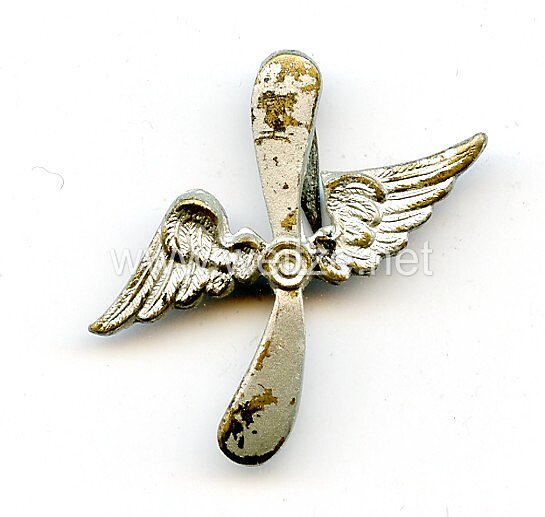
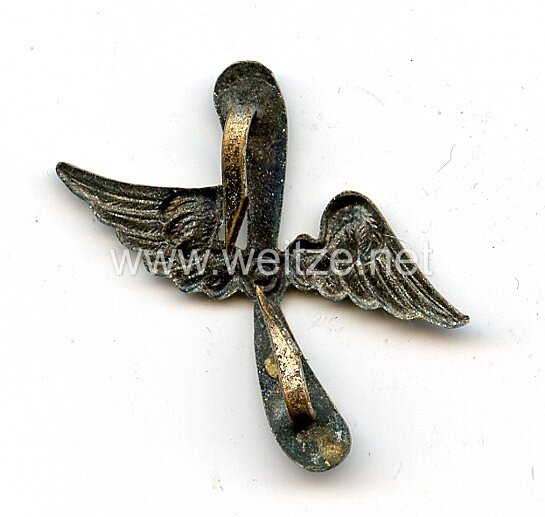
DLV Deutscher Luftsport Verband: Base for Collar Tabs
The Deutscher Luftsport-Verband (DLV) or German Air Sports Association represented a significant organization in German aviation history and played a crucial role in the rearmament of German air forces during the 1930s. This brass collar tab backing, dating from around 1934, represents an authentic witness to this transitional period in German military history.
The DLV was founded on March 25, 1933, shortly after the Nazi seizure of power. The organization emerged from the merger of the Deutscher Luftfahrt-Verband (German Aviation Association) and several other aviation clubs under the leadership of Hermann Göring. The actual purpose of the DLV extended far beyond civilian aviation: it served as a cover organization for training future Luftwaffe pilots and personnel, since Germany was prohibited from maintaining a military air force under the terms of the Treaty of Versailles of 1919.
The DLV's uniforming was precisely regulated and already oriented toward military standards. The collar tabs formed an essential component of the service uniform and served to identify rank insignia and affiliation with various departments within the organization. The execution in brass (Buntmetall) – typically a copper-zinc alloy – was characteristic of this early phase, before other materials came into use later due to the war economy.
The design of DLV insignia followed strict guidelines. The organization's main symbol was the stylized eagle with outstretched wings, frequently combined with the swastika as the political symbol of the NS regime. Collar tab backings were worn in pairs and attached to both sides of the uniform collar. They were available in various designs depending on the wearer's rank and function within the organization.
By 1935, the DLV had reached a considerable size with over 2.5 million members. The organization operated flight schools, gliding sites, and theoretical training facilities throughout the German Reich. Young men were trained in aviation technology, navigation, meteorology, and other disciplines relevant to aviation – all under the guise of civilian air sports.
With the official establishment of the Luftwaffe on March 1, 1935, and the associated open rejection of the military restrictions of the Treaty of Versailles by the NS regime, the DLV lost its primary function as a cover organization. Many of the members trained in the DLV were directly transferred to the newly created Luftwaffe. The DLV itself was transformed on March 26, 1935 into the Nationalsozialistisches Fliegerkorps (NSFK) or National Socialist Flying Corps, which continued to provide pre-military aviation training.
The choice of materials and manufacturing of the collar tab backings reflects the economic and industrial capabilities of the time. Brass was an inexpensive and easily processed material suitable for mass production of uniform insignia. Craftsmanship quality varied by manufacturer, with both state-run manufactories and private suppliers being used for production.
The condition described as “heavily worn” indicates intensive use, which is not uncommon for DLV equipment. Members wore their uniforms on numerous occasions: flight exercises, parades, assemblies, and official events. Practical use left natural signs of wear such as surface abrasion, metal oxidation, and possibly damage from attachment mechanisms.
From a historical perspective, such objects document the systematic preparation for war that took place years before the actual beginning of World War II. The DLV was an integral part of covert rearmament policy and demonstrates the NS regime's determination to circumvent the military restrictions of the Treaty of Versailles.
The organization's structure was highly militarized despite its civilian facade. Training programs included not only flight instruction but also discipline, physical fitness, and ideological education. The DLV served as an effective recruiting pool for the future Luftwaffe, with members already familiar with military discipline and aviation basics when they transferred to active military service.
Today, authentic DLV uniform parts and insignia are sought-after collector's items that make an important contribution to documenting this historical period. They enable historians and collectors to study and understand the development of German military uniforms and the organizational structures of the pre-war period.