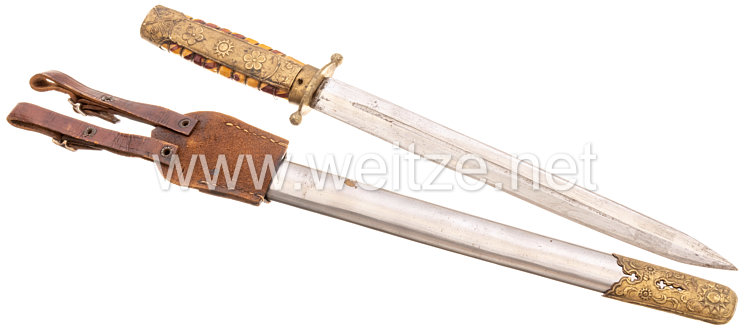
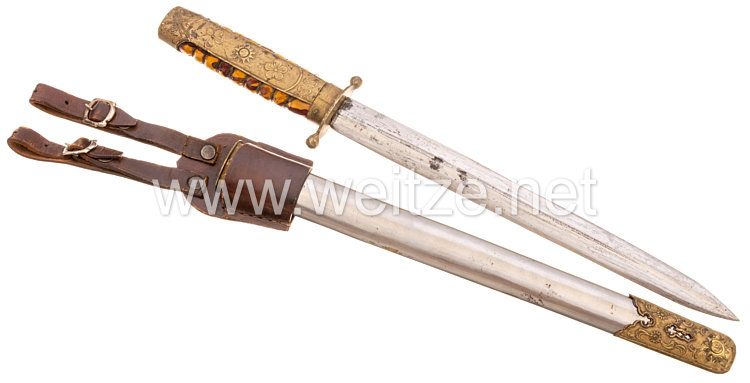
Chinese Army Officer's Dagger circa 1924 - 1949.
The Chinese Army officer's dagger from the period 1924 to 1949 represents a fascinating era in Chinese military history, marked by political upheaval, civil wars, and the modernization of armed forces. This epoch encompasses the late Warlord Era, the Nanking Decade under Kuomintang rule, and the devastating Second Sino-Japanese War (1937-1945), as well as the final phase of the Chinese Civil War.
Following the collapse of the Qing Dynasty in 1911 and the death of Yuan Shikai in 1916, China fragmented into regional power centers controlled by various military governors known as warlords. This period of fragmentation lasted until the partial reunification of China by Chiang Kai-shek and the Kuomintang in the late 1920s. Military units during this time were highly diverse in their organization, equipment, and uniforms.
Officer's daggers from this period reflected both traditional Chinese craftsmanship and modern military influences. The double-edged dagger blade with a central fuller followed an international standard found in many European military daggers of the early 20th century. The nickel plating of the blade served both aesthetic and practical purposes, providing corrosion protection and giving the wearer a well-maintained appearance.
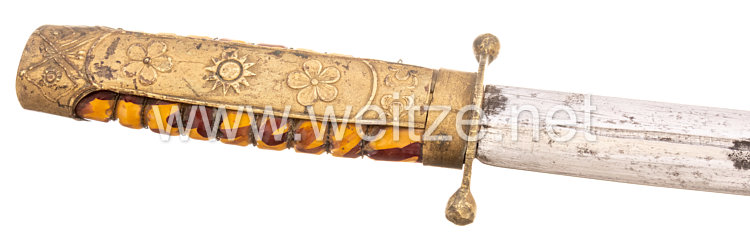
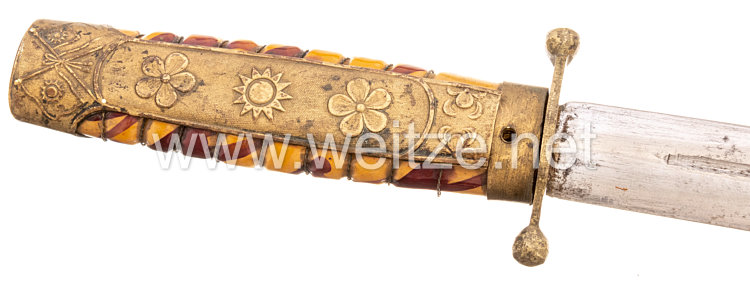
Particularly noteworthy about these officer's daggers is the combination of Western and Chinese design elements. The clear lacquer-coated wooden grip with Chinese characters demonstrates the preservation of cultural identity despite military modernization along Western lines. The Chinese characters on the grip could carry various meanings: military virtues such as loyalty, courage, and honor, as well as ownership inscriptions or manufacturer marks.
The wire wrapping on the grip was a practical necessity that ensured a secure hold even in wet conditions. This technique was widespread in military daggers worldwide and had proven effective for centuries. The elaborate decoration of the brass plates on the grip and pommel indicates the dagger's status as a badge of rank for officers. In the hierarchically structured military society of this time, such distinguishing features were of great significance.
The short brass crossguard ending in spheres is a characteristic feature of many Chinese officer's daggers from this period. This design offered both hand protection and aesthetic elegance. The use of brass for fittings and crossguard was widespread, as this material was not only decorative but also relatively corrosion-resistant.
The nickel-plated steel scabbard with brass fittings and belt hook completes the typical appearance of these officer's daggers. The belt hook allowed wearing on the officer's belt, marking the dagger as an integral part of the officer's uniform. During this period, the dagger increasingly transformed from a practical weapon to a symbolic badge of rank.
The timespan from 1924 to 1949 was of enormous significance for China. The Northern Expedition (1926-1928) under Chiang Kai-shek led to the nominal reunification of the country. The subsequent Nanking Decade (1927-1937) was a phase of relative stability and modernization during which the National Revolutionary Army was reorganized following the German model. German military advisors such as Hans von Seeckt and Alexander von Falkenhausen played an important role in the modernization of Chinese forces.
The Japanese invasion of China in 1937 brutally interrupted these modernization efforts. During the eight-year war against Japan, both the Kuomintang troops and the communist forces under Mao Zedong fought against the common enemy, though their alliance remained fragile. After the Japanese surrender in 1945, the civil war between Nationalists and Communists erupted with full force and ended in 1949 with the Communist victory and the establishment of the People's Republic of China.
Officer's daggers like the described example are today exceptionally rare collector's items, as many were lost or destroyed during the turbulent years of war and revolution. They are important historical artifacts that provide insight into the military culture of a transformative period in Chinese history. Each surviving example carries the silent history of a time when China struggled for its political identity and territorial integrity while simultaneously striving to become a modern nation.