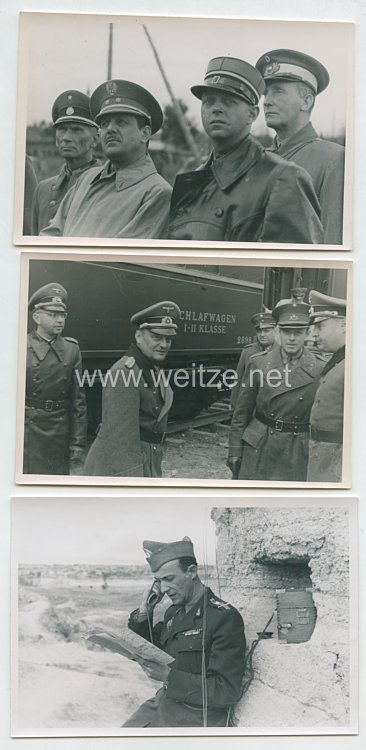
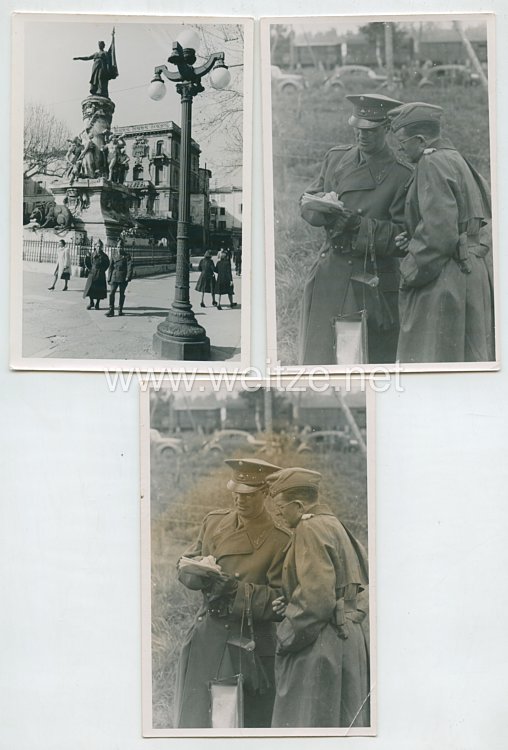
Wehrmacht Heer Press Photographs, German and Romanian Soldiers

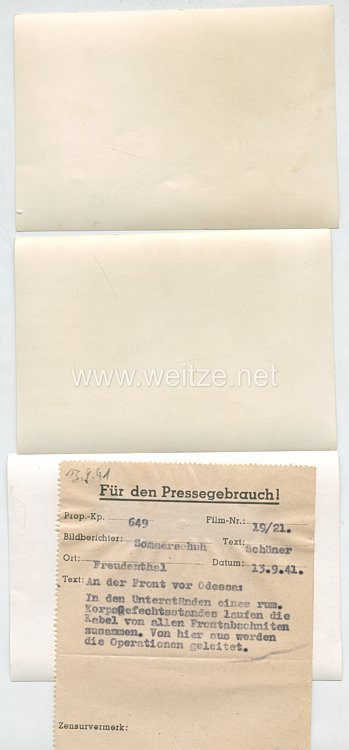
6 photographs, dimensions approx. 13 x 8.7 cm. Used condition.


330781
60,00

Wehrmacht Heer Press Photographs, German and Romanian Soldiers

Wehrmacht Heer Press Photos: German and Romanian Soldiers in World War II

The press photographs in question document the military cooperation between the German Wehrmacht and Romanian armed forces during the Second World War. Such photographs played a central role in war propaganda and official reporting on military operations on the Eastern Front.

Historical Context of the German-Romanian Military Alliance

Romania joined the Tripartite Pact on November 23, 1940, becoming an official ally of Nazi Germany. This alliance was based on shared ideological interests, economic considerations – particularly regarding the Romanian oil fields at Ploiești – and territorial ambitions. On June 22, 1941, Romania under the leadership of Marshal Ion Antonescu participated in Operation Barbarossa, the German invasion of the Soviet Union.

The Romanian armed forces provided the second-largest troop contingent among the Axis powers on the Eastern Front after Germany. Between 1941 and 1944, an estimated 600,000 to 800,000 Romanian soldiers fought alongside the Wehrmacht, primarily in Army Group South. Their main areas of deployment included Ukraine, Crimea, the Caucasus, and later the defense of their own territory.

The Role of Press Photography in the Wehrmacht

The Wehrmacht's Propaganda Companies (Propagandakompanien or PK) were specifically established to document the course of the war photographically and cinematically. These units, subordinate to the High Command of the Wehrmacht (OKW) and the Reich Ministry of Public Enlightenment and Propaganda under Joseph Goebbels, were staffed with professional photographers and journalists. The photographs were intended both to document military successes and to portray cooperation with allied nations.

Press photos of German and Romanian soldiers served several propaganda purposes: they were meant to demonstrate the strength of the Axis powers, emphasize the international coalition against Bolshevism, and strengthen morale both at the front and at home. Such images were published in magazines like “Signal,” “Die Wehrmacht,” or the “Berliner Illustrirten Zeitung.”

Joint Operations and Military Daily Life

German and Romanian troops fought particularly closely together during the siege of Odessa (August to October 1941) and the Battle of Sevastopol (1941-1942). The Romanian 3rd and 4th Armies frequently operated in direct coordination with German units. However, tensions also existed: German officers often criticized the equipment and training of Romanian troops, while Romanian soldiers felt treated as second-class auxiliary forces.

Photographic documentation of this cooperation typically showed scenes of camaraderie, joint meetings between officers, coordinated combat actions, or moments of rest behind the front lines. The standard size of approximately 13 x 8.7 cm corresponds to the usual format for press photos of that era, optimized for archiving and publication.

The End of the Alliance

On August 23, 1944, Romania under King Michael I executed a dramatic change of sides. Following a coup d'état, Antonescu was arrested, and Romania declared war on Germany. Romanian troops now fought alongside the Red Army. This switch had far-reaching strategic consequences and significantly accelerated the collapse of the German Eastern Front.

Source Value and Historical Significance

Press photos like these are important historical sources today. They document not only military events but also the staging of the war by Nazi propaganda. For historians, they offer insights into uniforms, equipment, military structures, and the visual representation of the Axis alliance. At the same time, they must be viewed critically, as they were part of a propaganda apparatus and often concealed or distorted the reality of war – with its atrocities, losses, and crimes.

The preservation of such photographs is of great importance for historical memory, provided they are understood and presented in their correct historical and ideological context.

r