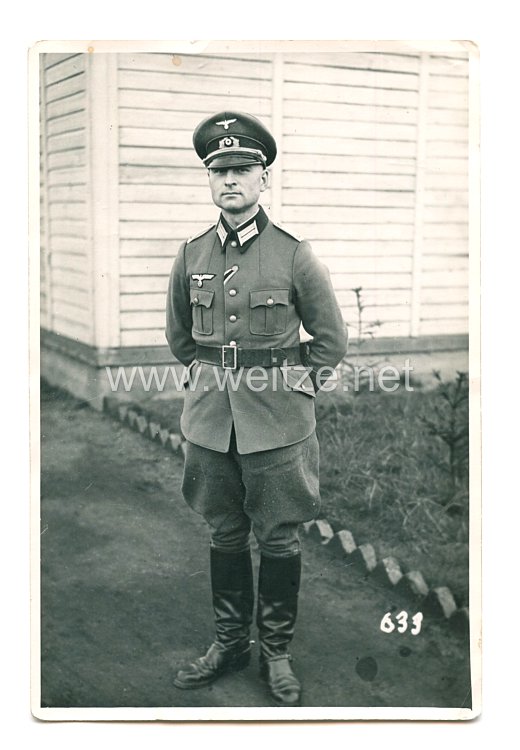
Wehrmacht Heer Photograph, First Lieutenant with Visor Cap
Historical Context: Wehrmacht Heer Officer Photograph with Peaked Cap
This photograph of a Wehrmacht Heer Oberleutnant (First Lieutenant) wearing a peaked cap (Schirmmütze) represents a typical period document from the Second World War era (1939-1945). Such photographs were widespread during this time and served both private and official purposes.
The Army Peaked Cap
The peaked cap was an essential component of the service uniform for German Army officers. It was worn in accordance with Army Service Regulations (Heeresdienstvorschrift - HDv) and clothing regulations. The officer's peaked cap differed significantly from the enlisted version through higher-quality materials and specific insignia. The cap body was made of field-gray cloth, while the peak was manufactured from vulcanized fiber or lacquered leather.
Characteristic features of the Army peaked cap included the national emblem (the Reich eagle with swastika) above the cockade in the national colors of black-white-red. For officers, the cap was additionally decorated with a silver-colored cord and corresponding chin strap. The cap band was red for generals, crimson for general staff officers, and dark green (later field-gray) for all other officers.
The Rank of Oberleutnant
The Oberleutnant was the second officer rank in the German Army after Leutnant (Second Lieutenant) and before Hauptmann (Captain). The rank insignia consisted of two stars on the shoulder straps. An Oberleutnant typically commanded a platoon or served as a company officer. Many young men achieved this rank after several years of service or through proven performance in combat, with promotions during wartime often being accelerated.
Photographic Practice During World War II
Military photographs were extremely popular during the Second World War. Soldiers frequently had themselves photographed in uniform to send these images to family members and fiancées. Professional photographers operated both in the homeland and in occupied territories. The standard format of approximately 10 x 15 cm corresponded to the then-common postcard format, which facilitated mailing.
Officers placed particular emphasis on representative photographs, as these documented their social status and military position. Portrait photography in uniform was part of military tradition and also served personal commemoration. Many soldiers commissioned studio photographers in larger cities or garrisons, where professional photographs with appropriate backgrounds and lighting were possible.
Uniform Regulations and Wearing Protocol
The Wehrmacht maintained strict regulations regarding the wearing of uniforms and headgear. Army Service Regulation 10 (HDv 10) detailed clothing specifications. The peaked cap was part of the walking-out uniform and service uniform, while in the field the field cap or steel helmet was more frequently worn.
For official occasions and photographs, correct wearing of the peaked cap was prescribed. It should sit straight and at an appropriate height on the head, with the peak slightly shading the eyes. The care and maintenance of the uniform, particularly the peaked cap, was part of military discipline.
Historical Classification and Collector Value
Photographs such as this are today important contemporary historical documents. They convey information about uniforming, military hierarchies, and the everyday culture of the Wehrmacht. For military historians and uniform researchers, such images provide valuable details about the actual wearing of uniform items, which often deviated from official regulations.
The documentary value of such photographs lies in their authenticity as primary sources. They show not staged propaganda photographs, but personal mementos that provide immediate insight into the military reality of the time. The preservation of such documents serves historical research and the examination of this epoch.
Wehrmacht Organization and Context
The Wehrmacht was established in 1935 and consisted of three branches: the Heer (Army), Kriegsmarine (Navy), and Luftwaffe (Air Force). The Heer was the largest branch, encompassing infantry, armor, artillery, and support units. The officer corps was organized in a hierarchical structure based on Prussian military traditions.
Photographs from this period must be understood within their historical context. They represent both personal memories and artifacts of a military force involved in aggressive warfare and war crimes. Modern historical research examines these objects critically, recognizing their documentary value while acknowledging the broader historical context of the Wehrmacht's actions.
Conclusion
This photograph of an Oberleutnant with peaked cap is a characteristic example of Wehrmacht military photography during the Second World War. It documents not only the uniforming and rank insignia of the Army, but also the social practice of photography as a means of remembrance and communication during wartime. As a historical document, it contributes to understanding the military culture and daily life of German soldiers during this period.