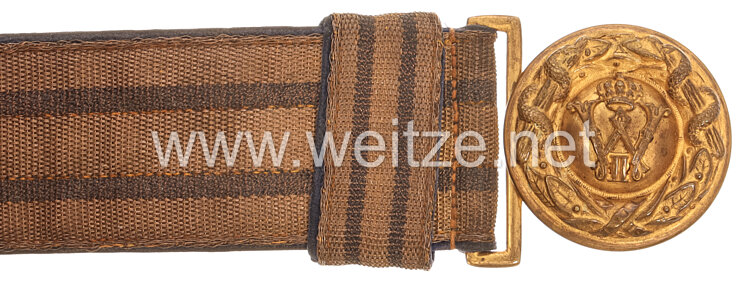
Prussia Field Sash for a Medical Officer

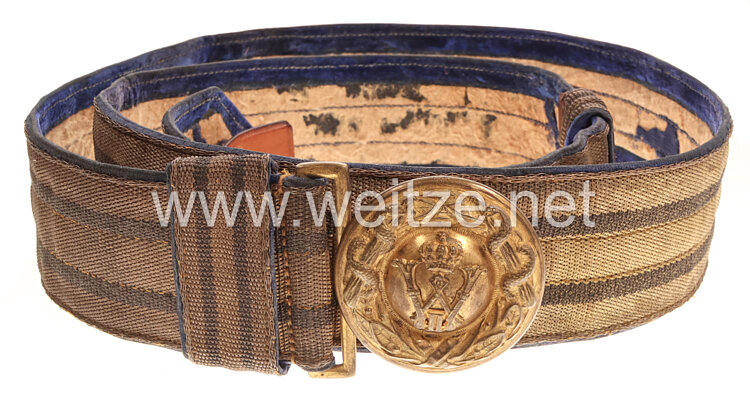
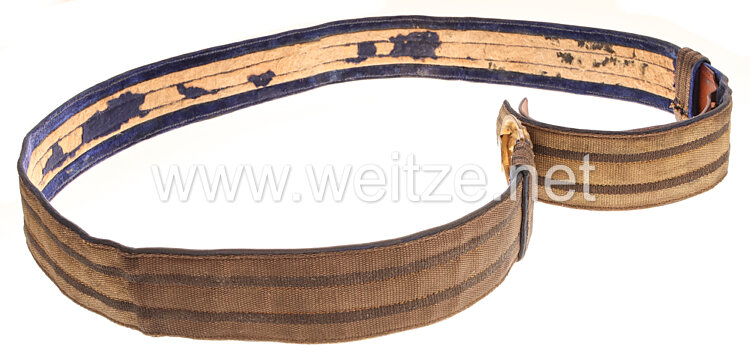
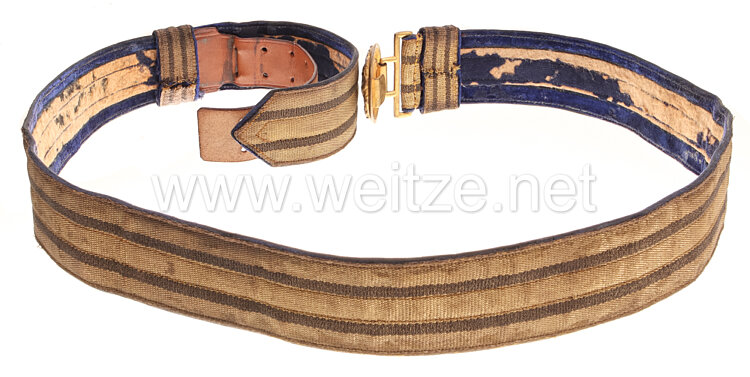
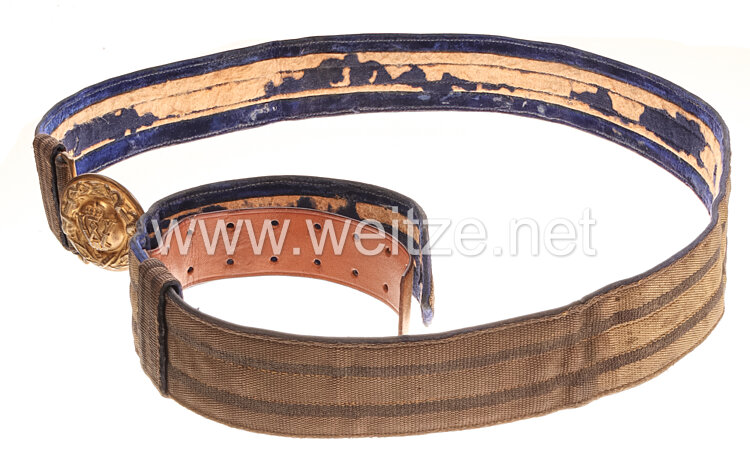
Gold bullion sash with 2 gray stripes, lined with blue velvet, the buckle gilt brass, embossed at the edge with Aesculapian staffs, with clasped cipher “WII”. Length without buckle 113 cm. Worn condition, the hook is missing (!), the lining heavily worn. Condition 2-.

458381
320,00

Prussia Field Sash for a Medical Officer

The Prussian field sash for military physicians represents a significant element of the military medical uniform of the Kingdom of Prussia during the 19th and early 20th centuries. This special field sash identified its wearer as a member of the Medical Corps and symbolized his particular position within the military hierarchy.

The present field sash is crafted from gold bullion thread, a precious material consisting of gilt metal threads woven onto a base material. The two gray stripes are characteristic of rank insignia in the Prussian army and served to distinguish different grades within the Medical Corps. The lining of blue velvet underscores the quality and representative character of this uniform piece.

Particularly noteworthy is the gilt brass clasp with embossed staffs of Asclepius along the edge. The staff of Asclepius, named after the Greek god of healing, has been the international symbol of medicine since antiquity and was consistently used in the Prussian military to identify medical personnel. The attached cipher “WII” refers to Kaiser Wilhelm II, who reigned from 1888 to 1918 as the last German Emperor and King of Prussia.

The development of the Prussian medical service gained considerable momentum in the 19th century. After the experiences of the Wars of Liberation against Napoleon (1813-1815), the necessity of organized medical care for troops was recognized. The Medical Regulations of 1835 created for the first time a unified system for military medical care in Prussia. During the army reforms under King Frederick William III and later Wilhelm I, the Medical Corps was continuously expanded and professionalized.

Military physicians in Prussia underwent rigorous training. They first had to complete regular medical studies and then undergo special military medical training. The most renowned training institution was the Royal Prussian Pepinière (later: Kaiser Wilhelm Academy for Military Medical Education) in Berlin, founded in 1795. Military physicians enjoyed special status: although they wore uniforms and were subject to military discipline, they had authority in medical matters even over higher military ranks.

The field sash itself was an essential component of the parade uniform and was worn over the right shoulder to the left hip. It served not only for representation but also for immediate recognition of medical personnel in the field. This was particularly important because, according to the Geneva Convention of 1864, the first international agreement for the protection of wounded and medical personnel, medical officers enjoyed special protection and had to be clearly marked.

During the Wars of Unification (1864-1871), the Prussian Medical Corps played a decisive role. The experiences from the Second Schleswig War, the Austro-Prussian War, and especially the Franco-Prussian War led to further improvements in military medical organization. Pioneers such as Johann Friedrich August von Esmarch, who conceived the first field dressing station, and Friedrich von Loeffler contributed significantly to the development of military medicine.

The gold bullion sash bearing Wilhelm II's cipher dates this field sash to the period between 1888 and 1918. This era was characterized by further modernization of medical services, the introduction of new medical techniques, and preparation for a major European conflict. During World War I (1914-1918), the Prussian and German Medical Corps faced an unprecedented test. Millions of wounded had to be treated, and military physicians performed their duties under extreme conditions.

The field sash as an object thus documents not only military hierarchy and uniform regulations but also the history of military medicine and the social position of physicians in Wilhelmine Germany. The condition with signs of wear indicates that this piece was actually worn and was not merely a parade object but was used in active service.

The combination of precious materials, symbolic elements, and imperial insignia makes this field sash a valuable historical artifact that provides insight into the complex world of Prussian military medicine and the representation of medical officers in one of Europe's most powerful military establishments before the collapse of the monarchies in 1918.

r